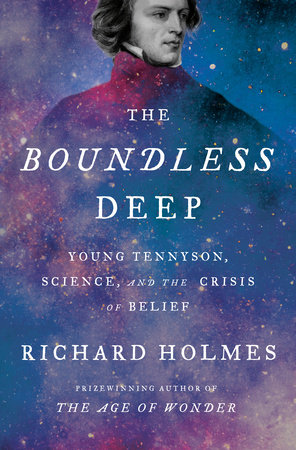
Chapter One: Old Monster
Was Tennyson ever young? It might seem unlikely. For generations he has been enshrined in the national memory as an ancient Victorian bard with a tremendous beard. That beard tells its own story. It began to flourish between the time Tennyson was appointed Poet Laureate and married in 1850, and the year he published his most famous poem “The Charge of the Light Brigade” to huge popular acclaim in December 1854.
The defining bearded image appears in the early photographs by Julia Margaret Cameron in the 1860s, and was finally consecrated by a statue in the anti-chapel of Tennyson’s alma mater, Trinity College, Cambridge. The entrance chamber, just off Trinity Great Court, is dominated by six massive and imposing monuments, each figure is slightly larger than life size, carved in white marble, now turned a somnolent grey. Two are previous Masters of the College, both distinguished scientists in their own field. But the remaining four are each symbolic of wider national genius. The first is Sir Isaac Newton, the father of British science. The second is Sir Francis Bacon, the avatar of modern British philosophy. The third is Lord Macaulay, godfather of British narrative history. And the fourth is Alfred Lord Tennyson, Poet Laureate of the British Empire.
The statue was carved by Hamo Thorneycroft RA to commemorate Tennyson’s solemn centenary in 1909. The Poet holds a large folio book on his knee, surely his enormous elegy
In Memoriam (131poems and an Epilogue) or perhaps his
Idylls of the King (an Arthurian Romance in a cycle of twelve narrative poems) ready for yet another drawing room recital, a favourite occupation of Tennyson’s in later years. Today his beard still overflows in stony prophetic locks, scrolling down beneath his chin and onto his mighty bardic chest. A small stone ash tray for his perpetual tobacco pipe lies hidden beneath the laurels. There he sits enthroned, monumental and Victorian; apparently immovable, and probably extinct.
Visitors to Trinity today, especially young ones, tend to walk past the Tennyson monument without a second glance. Why should they?
His mighty British Empire is mostly lost and derided, and so too is most of his later Laureate poetry
, especially the neo-gothic soap-opera of his Arthurian tales, twelve thousand lines of sonorous blank verse relentlessly composed and published over thirty years, already an anachronism in the great age of the realistic Victorian novel, and dedicated (posthumously, as it were) to Queen Victoria’s royal consort, the recently deceased Prince Albert. Does anyone even know how to
pronounce the word “Idylls”, or take seriously the “chivalric” code of knightly gallantry, or the “historic” ruins of Tintagel and Camelot?
As his great friend Edward FitzGerald once remarked of the famous Laureate photographs: “As to the bearded Daguerreotypes, they are very fine, I dare say: but I like the old beardless Alfred Tennyson.” [Fitz Letters 2. 5 July 7 1860, p.362]
It is strange to think that some eighty years before this statue was installed, a young and anxious Tennyson, awkward and beardless and very tall, was settling into bare student lodgings in bustling Trumpington Street, well outside the stately calm of Trinity Great Court, writing one of his greatest and most unsettling poems, about an apparently extinct monster, “The Kraken”.
“Below the thunders of the upper deep;
Far, far beneath in the abysmal sea,
His ancient, dreamless, uninvaded sleep
The Kraken sleepeth: faintest sunlights flee
About his shadowy sides: above him swell
Huge sponges of millennial growth and height;
And far away into the sickly light,
From many a wondrous grot and secret cell
Unnumbered and enormous polypi
Winnow with giant arms the slumbering green.
There hath he lain for ages and will lie
Battening upon huge sea-worms in his sleep,
Until the latter fire shall heat the deep;
Then once by man and angels to be seen,
In roaring he shall rise and on the surface die.” [Tennyson, Sel Poems, pp17-18]
The poetry of young Tennyson, before the beard made him a Victorian, continuously displays this kind of unsuspected and strangely modern magic. It emerges from those essentially “ vagrant years” 1829-1849,
before he married and became Poet Laureate, and was involved with the small group of friends, especially James Spedding, Edmund Lushington, and above all Edward FitzGerald, who tried to support and sustain him; and the women with whom he was variously in love: Sophie Rawnsley, Rosa Baring, and Emily Sellwood. And perhaps one imaginary one, known simply as Maud. [Memoir pp1-275]
It is sometimes thought that Tennyson’s whole existence was essentially elegiac and melancholy, given up to the lifelong mourning for just one lost undergraduate friend, the brilliant golden boy Arthur Hallam, suddenly and tragically dead, aged just twenty-two. This, it seems, was a particular extinction from which the poet Tennyson never recovered. As WH Auden summarised it in a single couplet:
“Black Tennyson whose talents were
For an articulate despair.”
[Auden,
New Year Letter]
Yet Alfred Tennyson’s early life also reveals a quite different kind of articulate hope: strange, energetic, independent minded, and subtly engaged with contemporary questions. He was driven by a number of major ideas and intellectual obsessions almost forgotten or subdued in later years, or at least overwhelmed by the Victorian legend of the grand established Laureate. During this turbulent early period Tennyson’s thought and poetry were fired and animated by the new science and the new scepticism; by ideas of geology and deep time; by the vastness, beauty and terror of the new cosmology; and the challenge of social revolution and women’s education. But beneath all these Tennyson was driven by the emergence – or eruption - of three new and fundamentally transformative ideas from science: that of biological evolution, a godless universe, and planetary extinction.
Their impact – not only intellectual, but also emotional and spiritual - challenged Tennyson’s whole imaginative world, and those around him. They brought him into contact with the life and scientific work of William Whewell (originally his university tutor), the astronomer John Herschel, the geologist Charles Lyell, the mathematician Mary Somerville, the computer pioneer Charles Babbage, and the brilliant science populariser Robert Chambers. He also shared his visions and anxieties with contemporary writers and social commentators like Thomas Carlyle and Charles Dickens, and poets like Elizabeth Barret Browning and Edgar Allan Poe.
They also lead him to grapple with his own problems of destiny and identity, the threat of suicide and depression, the struggle between love and loneliness, between intellectual hope and spiritual despair. This was an Inner Kraken with which the young Tennyson also had to do battle, a Kraken of the mind. Hidden grief and extrovert delight always fought within Tennyson, and shaped the poetry of these early years.
“The Kraken” (1830) was Tennyson’s first great poem, written at the age of twenty while an undergraduate at Cambridge. It is a mysterious combination of ancient folklore and modern marine science ,summoning a powerful, menacing and even repulsive image, and bringing a new tone and edge to 19th century poetry. It is a fifteen line sonnet. Perhaps it was originally inspired by his lonely wanderings along the wild North sea beaches of Lincolnshire, on the bleak dunes between Mablethorpe and Scarborough, during his restless childhood. He thought of these dunes, between the Wolds and the sea, as “the spine-bone of the world”. [HT Memoir pp 16-17] He was always aware of the dark undertow of things.
The poem is composed of a fantastic mixture of Norse mythology, 18th century zoology, 19th century science-fiction and the biblical Book of Revelations. It produced a great stir among his contemporaries at Cambridge (1830), and foreshadowed a powerful element in the next two decades of Tennyson’s life and writing. It seemed to be a projected image of unconscious forces, buried life and energy, and even psychic eruption. In what sense was the Kraken really extinct?
Certainly the poem itself almost disappeared. First published by Tennyson in 1832, it was then strangely suppressed from all subsequent recollections for forty years, until it finally resurfaced, still largely hidden away, in the huge Imperial Library edition of the
Collected Works in 1872.
The poem has deep tangled roots, both literary and scientific. The Kraken itself had become a subject of popular (half amused) speculation in the 1820s, not unlike the Loch Ness monster a century later in the 1930s. Such sea monster stories perhaps came originally from the chapter in
Revelations xiii, which bears witness: “And I stood upon the sands of the sea, and saw a beast rise up out of the sea.” But there is also the more violent prophesy from the Book of
Isaiah Book 27, verse 1: “In that day the Lord … will punish Leviathan the fleeing serpent, Leviathan the twisting serpent, and he will slay the dragon that is under the sea.” [Revised Standard Version, 27:1]
Tennyson’s own researches would find a nicely obscure reference quoted in the family copy of the
Biographie Universelle of 1823
. He noted: “See the account which Erik Pontoppidan , the Norwegian bishop, born 1698, gives of the fabulous sea-monster – the Kraken ”" [qt TSel Poems p17; JB p118]. Pontoppidan describes the creature as variously an enormous cephalopod, a giant crab or a huge starfish; it is so big that when on the surface fishermen have mistaken it for a small island, and fatally anchored along side it. When moving underwater, it was capable of producing a suction whirlpool like the notorious Norwegian
Maelstrom which was equally lethal (and which would later fascinate Edgar Allen Poe).
Pontoppidan gives the following description of the Creature’s powers in his
Natural History of Norway: "it is said that if the Creature's arms were to lay hold of the largest man-of-war, they would pull it down to the bottom". All these images of darkness, engulfment and capture, would find their many echoes and equivalents in Tennyson’s maturing imagination.
As a speculative subject, the Kraken was one of the intriguing topics that Coleridge had broached with the young John Keats, during their famous encounter on Hampstead Heath, a decade before in April 1819. These two Romantic poets of the previous generation, alongside Shelley, were the most important to young Tennyson . It is easy to forget how nearly they all over-lapped in time, and how alive their work still seemed to him. Keats had died less than a decade before in 1821; Shelley had drowned in 1822; Byron, extinguished by fever at Missolonghi in 1824. Even Coleridge, though not yet dead, was already a largely mythological presence (though visitable under the right sage-like conditions) at Highgate until 1834. While Wordsworth hung on in the Lake District, like some mighty low-lying luminous mist, doomed to condense into the Laureateship after Robert Southey. So the Romantics were a powerful continuing presence, a poetic generation that never grew old. The very fact of their ageless youth haunted Tennyson’s own youth, the glamourous ghosts at his troubled feast.
When Keats met Coleridge walking on London’s Hampstead Heath in the spring of 1819, (Tennyson then being a boy of ten in remote Lincolnshire) the Kraken quickly raised its head . Keats never forgot the topics Coleridge mentioned, almost like possible ideas for future poems. Coleridge as usual, dominated the talk during their slow two mile walk up towards Highgate, “at his alderman after-dinner pace”. Keats enthusiastically records the kaleidoscope of potential ideas in one of his letters: “In these two miles he broached a thousand things. Let me see if I can give you a list - Nightingales, Poetry, on Poetical sensation, Metaphysics, Different genera and species of Dream, Nightmares… Second Consciousness, Monsters, the Kraken.…” [Holmes Col 2 p497]
Tennyson soon knew much of the Romantics’ poetry. Stylistically his own “Kraken” poem already has echoes of Keatsian phrases like its “wondrous grot and secret cell”, as well as hints of Coleridge’s strange opium- dream pathology : “battening upon huge sea-worms in his sleep”. Tennyson also appears to draw variously on more immediate scientific sources. In 1818 the Scottish journalist James Wilson contributed a long speculative article on the biological nature of the Kraken to
Blackwood’s Edinburgh Magazine. [Will Abberley, Underwater Worlds, 2018, p53-60, google; and James Wilson, Edinburgh Magazine, online Wikipedia]
There were also echoes of the mathematician Mary Somerville’s account of hearing of the Kraken legend when a young girl growing up in Scotland “like a savage” and roaming the remote beech at Burntisland on the Firth of Forth and talking with the fishermen. She was fascinated to hear the legend of the Kraken, that enormous deep-sea monster ( a “gigantic flat-fish” or perhaps a “sea serpent” or a giant squid ), rumoured to lurk off the coast of Norway in the icy waters of the North Sea, and sometimes surfacing to devour unsuspecting mariners. “It was so enormous that when it came to the surface, covered with tangles and sand, it was supposed to be an island, till on occasion, part of a ship’s crew landed on it and found out their mistake.” [Somerville,
Personal Reminiscences, p21] For her it symbolized the mysteries and superstitions of Nature that science, and especially mathematics, was trying to rationalize.
So Tennyson’s “Kraken” is in some ways the first modern science fiction poem , and can be compared to the first modern science fiction novel of monstrosity, Mary Shelley’s
Frankenstein, which became popular in its second 1832 printing. It also strangely anticipates the world of Poe’s horror stories; and Jules Verne’s
Twenty Thousand Leagues under the Sea. The Kraken surfaces menacingly in the form of “The Squid” in chapter 59 of Melville’s
Moby Dick (1850) “curling and twisting like a nest of anacondas”; and hence eventually huge and ravenous in the Steven Spielberg film
Jaws (1975)
. Although it dies in the last line of the poem, Tennyson’s monster was in fact bursting with life.
Copyright © 2026 by Richard Holmes. All rights reserved. No part of this excerpt may be reproduced or reprinted without permission in writing from the publisher.