Books for Arab American Heritage Month
In honor of Arab American Heritage Month in April, we are sharing books by Arab and Arab American authors that share their culture, history, and personal lives.
*
Your job as a writer is making sentences.
Most of your time will be spent making sentences in your head.
In your head.
Did no one ever tell you this?
That is the writer's life.
Never imagine you've left the level of the sentence behind.
Most of the sentences you make will need to be killed.
The rest will need to be fixed.
This will be true for a long time.
The hard part now is deciding which to kill and which
to fix and how to fix them.
This will get much, much easier, but the decision making will never end.
*
As you practice noticing, notice how thickly particled
with names the world around you is.
This will gradually become part of your noticing,
looking not for words to make us see the way you saw--
But for the names of what you've noticed.
Names that announce the whatness of the world to a single species.
It's hard to grasp at first the density, the specificity
With which the world has been named.
This is a planet of overlapping lexicons,
Generation after generation, trade after trade,
Expedition after expedition sent out to bring home
Name upon name, terms of identity in endless degrees of intimacy,
And all at hand, if you look for them.
*
In the syntax and rhythm of sentences,
In the page of thought, the intensity of movement,
The crescendo and decrescendo,
The trustworthy reader learns the writer's habitude and how to move with it.
You converse, in a sense, with the voice on the other side of the ink.
The kind of reading is the pleasure of being summoned out of ourselves by the grace,
The ferocity, the skill of the writing before us.
How else to explain our love of even difficult writers?
Their agility evokes our agility.
We move at their speed, elliptically, obliquely,
However they move.
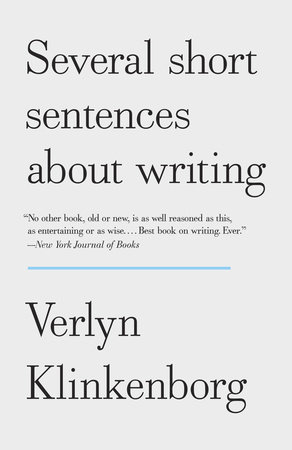
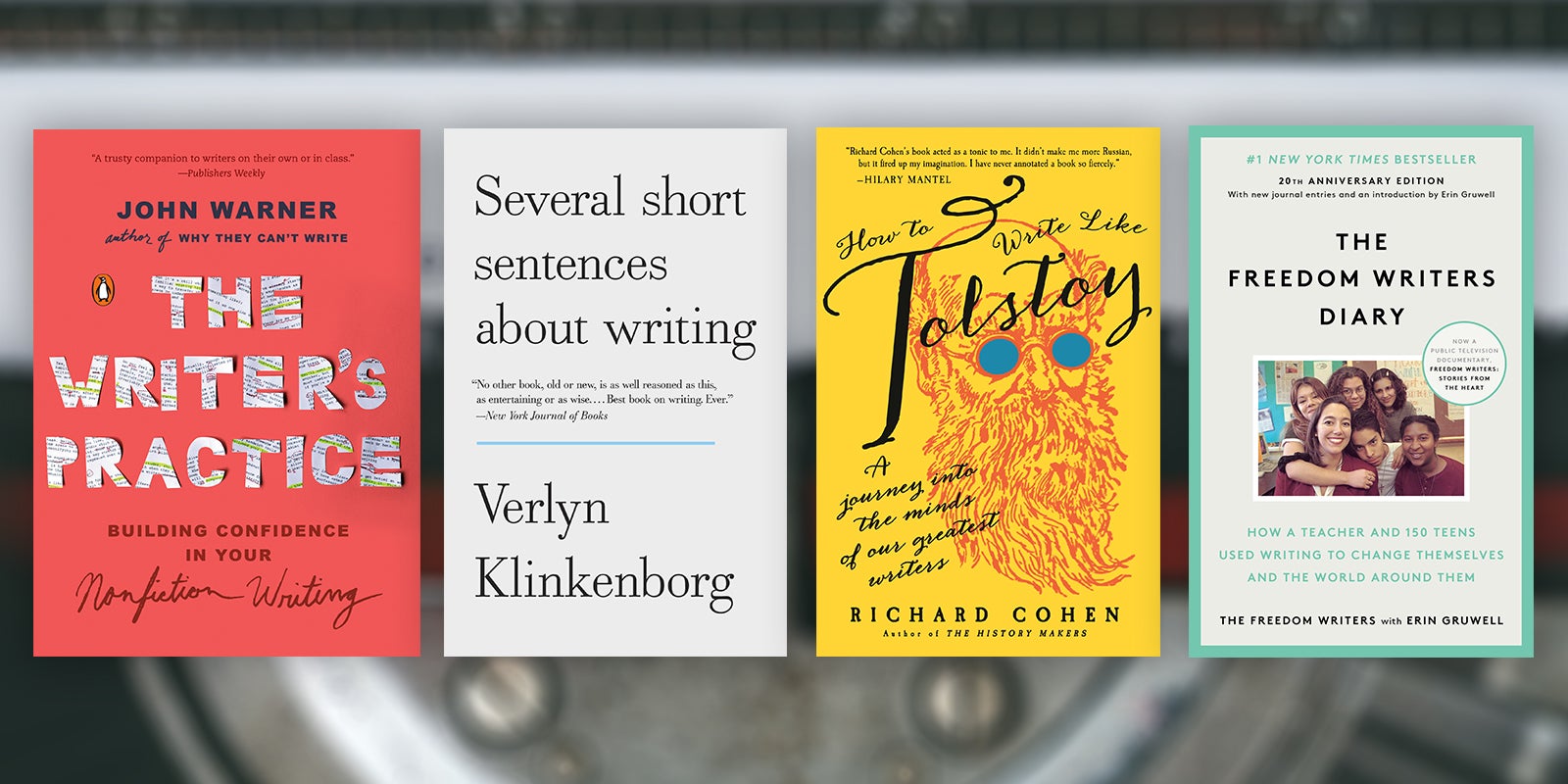
Praise for Verlyn Klinkenborg's Several Short Sentences About Writing:
“No other book, old or new, is as well reasoned as this, as entertaining or as wise. . . . Best book on writing. Ever. . . . To paraphrase Voltaire’s statement concerning the Almighty, ‘if Verlyn Klinkenborg did not exist, it would be necessary to invent him.’ Because having read Several Short Sentences About Writing, I do not think that it would be possible to not have this book on hand. . . . Indeed, no other book is as filled with as much grounded, practical advice for putting words to the paper or electronic page or gives better, more helpful exercises.”
—New York Journal of Books
“Powerful . . . each sentence miraculously contains an idea or insight that lesser writers would have milked for several pages.”
—Pittsburgh Post-Gazette
“An exceptionally interesting and useful book about writing.”
—Tom McGuane
“A fresh perspective on writing that goes against conventional classroom theory.”
—Shelf Awareness
“Klinkenborg does away with much of the traditional wisdom on writing and dissects the sentence—its structure, its intention, its semantic craftsmanship—to deliver a new, useful, and direct guide to the art of storytelling.”
—Brain Pickings
“Expertise and zeal are required for an established writer to offer genuinely useful guidance to aspiring writers. It also helps if the writer teaches writing, as Klinkenborg has for many years. . . . The result is a unique anatomy of the sentence and the writing mind and a clarifying and invigorating ‘book of first steps.’”
—Booklist
"This is a very interesting little book about writing. Modest. Learned. Good-natured. Direct and sympathetic to its readers. You don't even have to read it front to back (probably you couldn't, anyway). You can just open it anywhere—as I did—and take away something useful."
—Richard Ford
“There have been good books on grammar and style, some classics, but none to compare to this one for understanding where sentences come from in the first place, where their vitality is found, and what distinguishes their energy, their authenticity, and their prospects for life after birth—that is, the art of revision. This book's long future will be a testament to its author's principles.”
—Tom McGuane

*
Your job as a writer is making sentences.
Most of your time will be spent making sentences in your head.
In your head.
Did no one ever tell you this?
That is the writer's life.
Never imagine you've left the level of the sentence behind.
Most of the sentences you make will need to be killed.
The rest will need to be fixed.
This will be true for a long time.
The hard part now is deciding which to kill and which
to fix and how to fix them.
This will get much, much easier, but the decision making will never end.
*
As you practice noticing, notice how thickly particled
with names the world around you is.
This will gradually become part of your noticing,
looking not for words to make us see the way you saw--
But for the names of what you've noticed.
Names that announce the whatness of the world to a single species.
It's hard to grasp at first the density, the specificity
With which the world has been named.
This is a planet of overlapping lexicons,
Generation after generation, trade after trade,
Expedition after expedition sent out to bring home
Name upon name, terms of identity in endless degrees of intimacy,
And all at hand, if you look for them.
*
In the syntax and rhythm of sentences,
In the page of thought, the intensity of movement,
The crescendo and decrescendo,
The trustworthy reader learns the writer's habitude and how to move with it.
You converse, in a sense, with the voice on the other side of the ink.
The kind of reading is the pleasure of being summoned out of ourselves by the grace,
The ferocity, the skill of the writing before us.
How else to explain our love of even difficult writers?
Their agility evokes our agility.
We move at their speed, elliptically, obliquely,
However they move.
Praise for Verlyn Klinkenborg's Several Short Sentences About Writing:
“No other book, old or new, is as well reasoned as this, as entertaining or as wise. . . . Best book on writing. Ever. . . . To paraphrase Voltaire’s statement concerning the Almighty, ‘if Verlyn Klinkenborg did not exist, it would be necessary to invent him.’ Because having read Several Short Sentences About Writing, I do not think that it would be possible to not have this book on hand. . . . Indeed, no other book is as filled with as much grounded, practical advice for putting words to the paper or electronic page or gives better, more helpful exercises.”
—New York Journal of Books
“Powerful . . . each sentence miraculously contains an idea or insight that lesser writers would have milked for several pages.”
—Pittsburgh Post-Gazette
“An exceptionally interesting and useful book about writing.”
—Tom McGuane
“A fresh perspective on writing that goes against conventional classroom theory.”
—Shelf Awareness
“Klinkenborg does away with much of the traditional wisdom on writing and dissects the sentence—its structure, its intention, its semantic craftsmanship—to deliver a new, useful, and direct guide to the art of storytelling.”
—Brain Pickings
“Expertise and zeal are required for an established writer to offer genuinely useful guidance to aspiring writers. It also helps if the writer teaches writing, as Klinkenborg has for many years. . . . The result is a unique anatomy of the sentence and the writing mind and a clarifying and invigorating ‘book of first steps.’”
—Booklist
"This is a very interesting little book about writing. Modest. Learned. Good-natured. Direct and sympathetic to its readers. You don't even have to read it front to back (probably you couldn't, anyway). You can just open it anywhere—as I did—and take away something useful."
—Richard Ford
“There have been good books on grammar and style, some classics, but none to compare to this one for understanding where sentences come from in the first place, where their vitality is found, and what distinguishes their energy, their authenticity, and their prospects for life after birth—that is, the art of revision. This book's long future will be a testament to its author's principles.”
—Tom McGuane
In honor of Arab American Heritage Month in April, we are sharing books by Arab and Arab American authors that share their culture, history, and personal lives.
For National Poetry Month in April, we are sharing poetry collections and books about poetry by authors who have their own stories to tell. These poets delve into history, reimagine the present, examine poetry itself—from traditional poems many know and love to poems and voices that are new and original.
October 20th is the National Day on Writing and we are celebrating writing in all its forms by sharing books that teach and influence students to become better writers and understand the value of writing in everyday life. The Writer’s Practice The Writer’s Practice invites students and novice writers into an intellectually engaging, active