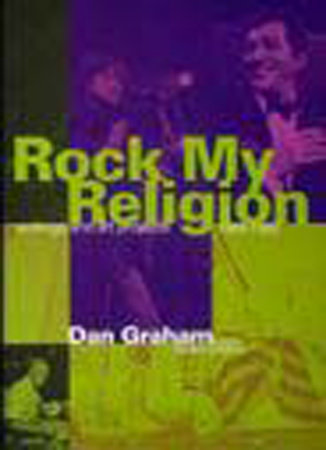
Rock My Religion collects eighteen of Graham's essays from all periods of his work, beginning with his essays on minimalist artists such as Dan Flavin and Donald Judd, continuing with his writings on punk rock and popular culture, and concluding with his more recent considerations of architecture, urban space, and power.Dan Graham's artworks and critical writings have had an enormous influence on the course of contemporary art over the past quarter century. Rock My Religion collects eighteen of Graham's essays from all periods of his work, beginning with his essays on minimalist artists such as Dan Flavin and Donald Judd, continuing with his writings on punk rock and popular culture, and concluding with his more recent considerations of architecture, urban space, and power.
Alternating with these theoretical essays are descriptions and documentations of Graham's own works and installations—projects that trace his explorations in conceptual art, video, photography, architecture, and public sculpture, showing the integral connections between Graham's criticism and his own artwork. Although as an artist Graham has been associated with minimalism, conceptual art, and postmodernism, his writing does not conform to the stylistic and theoretical constraints of any specific movement. With sources and topics ranging from Ronald Reagan to the Sex Pistols, from Michel Foucault to Dean Martin, Graham's eclectic investigations into the complex cultural relationships between art production and social reality are always strikingly original. What makes these writings particularly astonishing, though, is Graham's willingness to examine specific manifestations of popular culture (television, magazines, rock and roll, drugs) without regard to traditional qualitative judgments and without separating "high" or "low" culture from the processes of everyday life.