
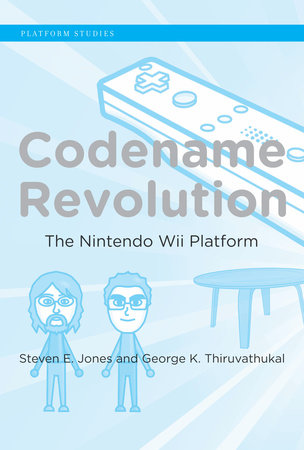
















Codename Revolution

The Nintendo Wii Platform

Look inside
Paperback
$30.00 US
On sale Dec 17, 2024 | 216 Pages | 9780262553780

See Additional Formats
Nintendo's hugely popular and influential video game console system considered as technological device and social phenomenon.

The Nintendo Wii, introduced in 2006, helped usher in a moment of retro-reinvention in video game play. This hugely popular console system, codenamed Revolution during development, signaled a turn away from fully immersive, time-consuming MMORPGs or forty-hour FPS games and back toward family fun in the living room. Players using the wireless motion-sensitive controller (the Wii Remote, or “Wiimote”) play with their whole bodies, waving, swinging, swaying. The mimetic interface shifts attention from what's on the screen to what's happening in physical space. This book describes the Wii's impact in technological, social, and cultural terms, examining the Wii as a system of interrelated hardware and software that was consciously designed to promote social play in physical space.

Each chapter of Codename Revolution focuses on a major component of the Wii as a platform: the console itself, designed to be low-powered and nimble; the iconic Wii Remote; Wii Fit Plus, and its controller, the Wii Balance Board; the Wii Channels interface and Nintendo's distribution system; and the Wii as a social platform that not only affords multiplayer options but also encourages social interaction in shared physical space. Finally, the authors connect the Wii's revolution in mimetic interface gaming—which eventually led to the release of Sony's Move and Microsoft's Kinect—to some of the economic and technological conditions that influence the possibility of making something new in this arena of computing and culture.
Steven E. Jones is Professor of English at Loyola University Chicago.

George K. Thiruvathukal is Professor of Computer Science at Loyola University Chicago.
George K. Thiruvathukal View titles by George K. Thiruvathukal
ENDORSEMENTS

"As a model example of interdisciplinary analysis, Codename Revolution offers a comprehensive guide to the Wii platform, while providing insights into broader interactions between technology, commerce, textual creativity, and cultural practices. A must-read not only for game scholars, but for anyone interested in contemporary media and culture."
-Jason Mittell, Associate Professor of American Studies and Film & Media Culture, Middlebury College

"Codename Revolution
is a remarkable look at the history of the Nintendo Wii, at its design, its games, and how it changed our idea of what video games can be."
-Jesper Juul, visiting assistant arts professor, NYU Game Center, author of Half-Real

About

Nintendo's hugely popular and influential video game console system considered as technological device and social phenomenon.

The Nintendo Wii, introduced in 2006, helped usher in a moment of retro-reinvention in video game play. This hugely popular console system, codenamed Revolution during development, signaled a turn away from fully immersive, time-consuming MMORPGs or forty-hour FPS games and back toward family fun in the living room. Players using the wireless motion-sensitive controller (the Wii Remote, or “Wiimote”) play with their whole bodies, waving, swinging, swaying. The mimetic interface shifts attention from what's on the screen to what's happening in physical space. This book describes the Wii's impact in technological, social, and cultural terms, examining the Wii as a system of interrelated hardware and software that was consciously designed to promote social play in physical space.

Each chapter of Codename Revolution focuses on a major component of the Wii as a platform: the console itself, designed to be low-powered and nimble; the iconic Wii Remote; Wii Fit Plus, and its controller, the Wii Balance Board; the Wii Channels interface and Nintendo's distribution system; and the Wii as a social platform that not only affords multiplayer options but also encourages social interaction in shared physical space. Finally, the authors connect the Wii's revolution in mimetic interface gaming—which eventually led to the release of Sony's Move and Microsoft's Kinect—to some of the economic and technological conditions that influence the possibility of making something new in this arena of computing and culture.

Author

Steven E. Jones is Professor of English at Loyola University Chicago.

George K. Thiruvathukal is Professor of Computer Science at Loyola University Chicago.
George K. Thiruvathukal View titles by George K. Thiruvathukal

Praise

ENDORSEMENTS

"As a model example of interdisciplinary analysis, Codename Revolution offers a comprehensive guide to the Wii platform, while providing insights into broader interactions between technology, commerce, textual creativity, and cultural practices. A must-read not only for game scholars, but for anyone interested in contemporary media and culture."
-Jason Mittell, Associate Professor of American Studies and Film & Media Culture, Middlebury College

"Codename Revolution
is a remarkable look at the history of the Nintendo Wii, at its design, its games, and how it changed our idea of what video games can be."
-Jesper Juul, visiting assistant arts professor, NYU Game Center, author of Half-Real

Books for LGBTQIA+ Pride Month

In June we celebrate Lesbian, Gay, Bisexual, Transgender, Queer, Intersex, and Asexual + (LGBTQIA+) Pride Month, which honors the 1969 Stonewall riots in Manhattan. Pride Month is a time to both celebrate the accomplishments of those in the LGBTQ+ community and recognize the ongoing struggles faced by many across the world who wish to live

Read more