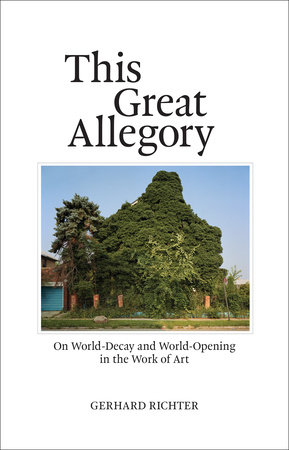

This Great Allegory

On World-Decay and World-Opening in the Work of Art

Look inside
Paperback
$35.00 US
On sale Nov 29, 2022 | 336 Pages | 9780262544146

An engagement with the relation between the world in which an artwork is created—a world that perishes or decays over time—and the new world that the artwork opens up.

Gerhard Richter explores the relation between two worlds: the world in which an artwork is created, that is, a world that over time perishes or decays beyond interpretive understanding, and the new world that the artwork opens up. The multiple relations between these worlds are examined in a number of central thinkers and in various modes of aesthetic production, including poetry, painting, music, film, literature, and photography. It is precisely in and through the work of art, Richter shows, that central elements of the thinking of world as world are negotiated in the most essential and moving ways.

Exploring the relationship between these worlds through art and European philosophy, Richter offers bold new interpretations of Karl Marx, Friedrich Nietzsche, Martin Heidegger, Maurice Blanchot, Georges Bataille, Emmanuel Levinas, Theodor W. Adorno, Walter Benjamin, and Jacques Derrida. The book also provides stimulating new insights into the works of heterogeneous artists such as Paul Celan, Friedrich Hölderlin, Werner Herzog, Arnold Schönberg, Franz Kafka, Herman Melville, Andrew Moore, Botho Strauß, Didier Eribon, and even prehistoric cave painters. In each case, Richter’s readings are guided by a consideration of the conceptual constraints and singular interpretive demands imposed by the specific genre and medium.
Introduction: The Work of Art and the Notion of World 1
1 The Work of Art between World-Decay and World-Opening (Heidegger, Hölderlin) 31
2 Of Cave Worlds and the Birth of the Artwork in Painting and Film (Blanchot, Bataille, Werner Herzog) 69
3 The Work for a Time without Me and the World Stepping toward Us (Levinas, Celan) 103
4 Inheriting the World of the Subcutaneous Musical Artwork (Adorno, Schöberg) 121
5 A World of Gray: Color, Grayness, and Utopia in the Work of Art (Adorno) 151
6 Conjoining the Intimate with the Infinite: On World-Decay in the Photographic Work of Art (Benjamin, Andrew Moore) 171
7 Troubled Origins: Accounting for Oneself as World-Creation (Derrida, Botho Strauß, Didier Eribon) 203
8 Keep Yourself Alive: The World of Life Death and the Work of Mourning (Derrida, Nietzsche, Kafka) 233
9 Changing the World Is Not What You Think (Marx) 259
Coda: Intermundia, Finitude 287
Acknowledgments 293
Notes 295
List of Illustrations 315
Index 317
Gerhard Richter is the L. Herbert Ballou University Professor of German Studies and Comparative Literature at Brown University. Among his most recent books are Uncontainable Legacies: Theses on Intellectual, Cultural, and Political Inheritance and Thinking with Adorno: The Uncoercive Gaze.
"This Great Allegory generously invites us to become part of the interpretive project it develops and provides a host of examples as to how we might do so. Academia is rarely compared to a work of art and today betrays far too many symptoms of decay, but the argumentative richness of this book gives this reader hope that our discourses still have the potential to open up new intellectual horizons."
Monatshefte

"At a time of fracturing information sources, where customisation is shifting from a mode of consumerism into a metaphysical horizon, it might be that the very notion of a shared world is quaint, let alone the idea that the work of art might be able to open up such a world. Yet it is for precisely that reason that Richter’s meditations on world-opening in a time of world-decay speak to today’s most urgent concerns."
—David Nowell Smith, Modern Language Notes

About

An engagement with the relation between the world in which an artwork is created—a world that perishes or decays over time—and the new world that the artwork opens up.

Gerhard Richter explores the relation between two worlds: the world in which an artwork is created, that is, a world that over time perishes or decays beyond interpretive understanding, and the new world that the artwork opens up. The multiple relations between these worlds are examined in a number of central thinkers and in various modes of aesthetic production, including poetry, painting, music, film, literature, and photography. It is precisely in and through the work of art, Richter shows, that central elements of the thinking of world as world are negotiated in the most essential and moving ways.

Exploring the relationship between these worlds through art and European philosophy, Richter offers bold new interpretations of Karl Marx, Friedrich Nietzsche, Martin Heidegger, Maurice Blanchot, Georges Bataille, Emmanuel Levinas, Theodor W. Adorno, Walter Benjamin, and Jacques Derrida. The book also provides stimulating new insights into the works of heterogeneous artists such as Paul Celan, Friedrich Hölderlin, Werner Herzog, Arnold Schönberg, Franz Kafka, Herman Melville, Andrew Moore, Botho Strauß, Didier Eribon, and even prehistoric cave painters. In each case, Richter’s readings are guided by a consideration of the conceptual constraints and singular interpretive demands imposed by the specific genre and medium.

Table of Contents

Introduction: The Work of Art and the Notion of World 1
1 The Work of Art between World-Decay and World-Opening (Heidegger, Hölderlin) 31
2 Of Cave Worlds and the Birth of the Artwork in Painting and Film (Blanchot, Bataille, Werner Herzog) 69
3 The Work for a Time without Me and the World Stepping toward Us (Levinas, Celan) 103
4 Inheriting the World of the Subcutaneous Musical Artwork (Adorno, Schöberg) 121
5 A World of Gray: Color, Grayness, and Utopia in the Work of Art (Adorno) 151
6 Conjoining the Intimate with the Infinite: On World-Decay in the Photographic Work of Art (Benjamin, Andrew Moore) 171
7 Troubled Origins: Accounting for Oneself as World-Creation (Derrida, Botho Strauß, Didier Eribon) 203
8 Keep Yourself Alive: The World of Life Death and the Work of Mourning (Derrida, Nietzsche, Kafka) 233
9 Changing the World Is Not What You Think (Marx) 259
Coda: Intermundia, Finitude 287
Acknowledgments 293
Notes 295
List of Illustrations 315
Index 317

Author

Gerhard Richter is the L. Herbert Ballou University Professor of German Studies and Comparative Literature at Brown University. Among his most recent books are Uncontainable Legacies: Theses on Intellectual, Cultural, and Political Inheritance and Thinking with Adorno: The Uncoercive Gaze.

Praise

"This Great Allegory generously invites us to become part of the interpretive project it develops and provides a host of examples as to how we might do so. Academia is rarely compared to a work of art and today betrays far too many symptoms of decay, but the argumentative richness of this book gives this reader hope that our discourses still have the potential to open up new intellectual horizons."
Monatshefte

"At a time of fracturing information sources, where customisation is shifting from a mode of consumerism into a metaphysical horizon, it might be that the very notion of a shared world is quaint, let alone the idea that the work of art might be able to open up such a world. Yet it is for precisely that reason that Richter’s meditations on world-opening in a time of world-decay speak to today’s most urgent concerns."
—David Nowell Smith, Modern Language Notes