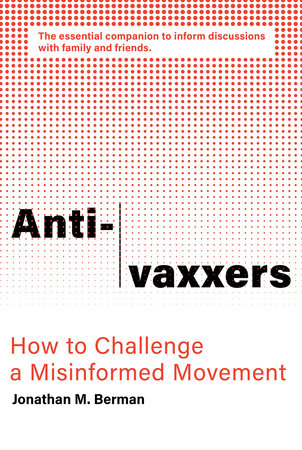

Anti-vaxxers

How to Challenge a Misinformed Movement

Look inside
Paperback
$19.95 US
On sale Sep 08, 2020 | 296 Pages | 9780262539326

See Additional Formats
A “clear and insightful” takedown of the anti-vaccination movement, from its 19th-century antecedents to modern-day Facebook activists—with strategies for refuting false claims of friends and family (Financial Times)

Vaccines are a documented success story, one of the most successful public health interventions in history. Yet there is a vocal anti-vaccination movement, featuring celebrity activists (including Kennedy scion Robert F. Kennedy Jr. and actress Jenny McCarthy) and the propagation of anti-vax claims through books, documentaries, and social media. In Anti-Vaxxers, Jonathan Berman explores the phenomenon of the anti-vaccination movement, recounting its history from its nineteenth-century antecedents to today’s activism, examining its claims, and suggesting a strategy for countering them.

After providing background information on vaccines and how they work, Berman describes resistance to Britain’s Vaccination Act of 1853, showing that the arguments anticipate those made by today’s anti-vaxxers. He discusses the development of new vaccines in the twentieth century, including those protecting against polio and MMR (measles, mumps, rubella), and the debunked paper that linked the MMR vaccine to autism; the CDC conspiracy theory promoted in the documentary Vaxxed; recommendations for an alternative vaccination schedule; Kennedy’s misinformed campaign against thimerosal; and the much-abused religious exemption to vaccination.

Anti-vaxxers have changed their minds, but rarely because someone has given them a list of facts. Berman argues that anti-vaccination activism is tied closely to how people see themselves as parents and community members. Effective pro-vaccination efforts should emphasize these cultural aspects rather than battling social media posts.
Preface vii Introduction xiii
1 Is There Even a Problem? 1
2 Understanding Vaccines 9
3 The World before Vaccines 13
4 The First Vaccine 19
5 The First Anti-vaccine Movements 29
6 Vaccine Pioneers 45
7 The Twentieth-century Anti-vaccine Movement 49
8 Autism 63
9 The Anti-vaccine Movement, 1998–Present 69 10 Vaxxed 87
11 Too Many, Too Soon 97
12 Deadly Immunity 107
13 Ineffective “Alternatives” to Vaccination 115
14 Social Media, “Fake News,” and the Spread of
Information 135
15 Escalation of Commitment 151
16 Religion and Vaccine Hesitancy 155
17 Big Pharma 165
18 Anti-vaccine Activism in 2018 and 2019 179
19 Vaccine Advocates 187
20 Who Are They? 197
21 The Anti-vaccine Parent 201
22 What Changes Minds about Vaccines? 205
Conclusions 211
Acknowledgments 215
Notes 217
Index 273
Anti-vaccine activists have been successful in limited ways by establishing doubt within isolated communities. In the United States, when rates have dropped low enough in enclaves that an outbreak occurs, historically, the reaction has been swift, culturally competent, and very effective in recovering vaccination rates. In absolute numbers, the number of children who have died because of these outbreaks in the United States is low.
These data are heartening because they show that the overall impact of the anti-vaccine movement has been low. However, if you are a parent or relative of a child who does become infected with a vaccine-preventable illness, your child is still sick. If you are a parent whose children attend school, you will have an interest in knowing that your community has high vaccination rates. If you are the parent of an immunocompromised child who is unable to be vaccinated, membership in a community where immunization rates are high is an important step in protecting your child’s life. Oscillations between minor outbreaks and adequate vaccination rates is less desirable than eliminating those diseases or maintaining a high steady state of vaccination.
Public health efforts to eliminate diseases have so far eliminated only two worldwide, smallpox and rinderpest. The goal of eliminating polio by 2015 has been missed, and it seems unlikely to be eliminated by 2020, although the cases of wild polio have decreased to the low double digits, and elimination still appears to be an achievable near-term goal. 

All politics is local.
—attributed to Tip O’Neill

Because the risks of the anti-vaccine movement take place at the level of local communities, schools, preschools, churches, mosques, synagogues, and neighborhoods, it is important that each of us knows how to understand the anti-vaccine movement. We should learn the kinds of arguments it uses and how it spreads in communities and becomes associated with group identity. We should learn how we can individually respond to the doubts or questions of our friends, neighbors, and family members in a way that is compassionate, well informed, and correct. Anti-vaccination activism is a local problem that demands local, personal solutions.
Jonathan M. Berman is Assistant Professor in the Department of Basic Sciences at NYITCOM–Arkansas. An active science communicator, he served as national cochair of the 2017 March for Science.
“Science professor Berman debuts with a useful guide for readers concerned about the opposition to vaccinations . . . The book’s greatest value comes from its insights into how common cognitive errors can lead even the well-informed to see false correlations between vaccination and health problems. Berman also provides practical suggestions about how best to engage, and potentially convert, vaccine opponents, arguing that ‘people change their own minds; we can’t do it for them.’ Given hopes for a Covid-19 vaccine, this accomplished exploration of a vexing topic couldn’t be more timely.”
Publishers Weekly

“Recommended for those countering the anti-vaccination movement, as well as those with an interest in cultural and historical antecedents of the movement.”
Library Jounal

“Berman dispels anti-vax fears and subterfuges with straight, scientific evidence.”
Kirkus Reviews


“A clear and insightful book.”
Financial Times

Anti-vaxxers is a book that reminds us of the historical precedents to the odd alliances—anti-vaccine, anti-mask, anti-5G, for instance—that are getting in the way of public health right now . . . By taking the story of vaccine opposition back to its earliest examples, Anti-vaxxers cautions against simplistic solutions. In tracing the movement across three centuries, Berman underlines that is unlikely to be ended by keyboard warriors or the repetition of even the best scientific evidence.”
Nature

“Berman, an assistant professor of basic science at an osteopathic medical school, explores the history of anti-vaccine movements and how best to counter them. Such movements, he finds, share beliefs and features: wariness of government control, distrust of the medical establishment and its products, false claims about vaccines (often made by people with economic interests), and unfounded fears of harm, spread by misinformation and social media. Those most vulnerable to such claims are often parents trying to decide what is best for their children’s health. Rather than learning from reliable sources why childhood vaccines are necessary to protect both individuals and the population as a whole from infections, they may receive unreliable information from others in their community who oppose vaccination . . . Berman’s advice on how to talk with people who are uncertain about vaccinating their children is enlightening and practical.”
Washington Post Book World


“This accessible and informative book provides not only a rational analysis of the many sources of anti-vaccine thinking, but also practical ideas that can be used to overcome objections against vaccines.”
CHOICE

“Written by one of the founders of the ‘March for Science’ movement, Anti-vaxxers is a tour-de-force examination of anti-vax arguments that is destined to become a classic in the field. Before you get into another argument with an anti-vaxxer, simply pull this book off the shelf, hand it to them, and say ‘here.’”
Lee McIntyre, Research Fellow, Center for Philosophy and History of Science, Boston University; author of Post-Truth and The Scientific Attitude

“In Anti-Vaxxers, Jonathan Berman reveals the strategies, influence, and psychology of a movement that the World Health Organization has called one of the top ten threats to global health. An urgent and engaging read.”
—Paul A. Offit, Professor of Pediatrics, the Children’s Hospital of Philadelphia; author of Overkill: When Modern Medicine Goes Too Far

About

A “clear and insightful” takedown of the anti-vaccination movement, from its 19th-century antecedents to modern-day Facebook activists—with strategies for refuting false claims of friends and family (Financial Times)

Vaccines are a documented success story, one of the most successful public health interventions in history. Yet there is a vocal anti-vaccination movement, featuring celebrity activists (including Kennedy scion Robert F. Kennedy Jr. and actress Jenny McCarthy) and the propagation of anti-vax claims through books, documentaries, and social media. In Anti-Vaxxers, Jonathan Berman explores the phenomenon of the anti-vaccination movement, recounting its history from its nineteenth-century antecedents to today’s activism, examining its claims, and suggesting a strategy for countering them.

After providing background information on vaccines and how they work, Berman describes resistance to Britain’s Vaccination Act of 1853, showing that the arguments anticipate those made by today’s anti-vaxxers. He discusses the development of new vaccines in the twentieth century, including those protecting against polio and MMR (measles, mumps, rubella), and the debunked paper that linked the MMR vaccine to autism; the CDC conspiracy theory promoted in the documentary Vaxxed; recommendations for an alternative vaccination schedule; Kennedy’s misinformed campaign against thimerosal; and the much-abused religious exemption to vaccination.

Anti-vaxxers have changed their minds, but rarely because someone has given them a list of facts. Berman argues that anti-vaccination activism is tied closely to how people see themselves as parents and community members. Effective pro-vaccination efforts should emphasize these cultural aspects rather than battling social media posts.

Table of Contents

Preface vii Introduction xiii
1 Is There Even a Problem? 1
2 Understanding Vaccines 9
3 The World before Vaccines 13
4 The First Vaccine 19
5 The First Anti-vaccine Movements 29
6 Vaccine Pioneers 45
7 The Twentieth-century Anti-vaccine Movement 49
8 Autism 63
9 The Anti-vaccine Movement, 1998–Present 69 10 Vaxxed 87
11 Too Many, Too Soon 97
12 Deadly Immunity 107
13 Ineffective “Alternatives” to Vaccination 115
14 Social Media, “Fake News,” and the Spread of
Information 135
15 Escalation of Commitment 151
16 Religion and Vaccine Hesitancy 155
17 Big Pharma 165
18 Anti-vaccine Activism in 2018 and 2019 179
19 Vaccine Advocates 187
20 Who Are They? 197
21 The Anti-vaccine Parent 201
22 What Changes Minds about Vaccines? 205
Conclusions 211
Acknowledgments 215
Notes 217
Index 273

Excerpt

Anti-vaccine activists have been successful in limited ways by establishing doubt within isolated communities. In the United States, when rates have dropped low enough in enclaves that an outbreak occurs, historically, the reaction has been swift, culturally competent, and very effective in recovering vaccination rates. In absolute numbers, the number of children who have died because of these outbreaks in the United States is low.
These data are heartening because they show that the overall impact of the anti-vaccine movement has been low. However, if you are a parent or relative of a child who does become infected with a vaccine-preventable illness, your child is still sick. If you are a parent whose children attend school, you will have an interest in knowing that your community has high vaccination rates. If you are the parent of an immunocompromised child who is unable to be vaccinated, membership in a community where immunization rates are high is an important step in protecting your child’s life. Oscillations between minor outbreaks and adequate vaccination rates is less desirable than eliminating those diseases or maintaining a high steady state of vaccination.
Public health efforts to eliminate diseases have so far eliminated only two worldwide, smallpox and rinderpest. The goal of eliminating polio by 2015 has been missed, and it seems unlikely to be eliminated by 2020, although the cases of wild polio have decreased to the low double digits, and elimination still appears to be an achievable near-term goal. 

All politics is local.
—attributed to Tip O’Neill

Because the risks of the anti-vaccine movement take place at the level of local communities, schools, preschools, churches, mosques, synagogues, and neighborhoods, it is important that each of us knows how to understand the anti-vaccine movement. We should learn the kinds of arguments it uses and how it spreads in communities and becomes associated with group identity. We should learn how we can individually respond to the doubts or questions of our friends, neighbors, and family members in a way that is compassionate, well informed, and correct. Anti-vaccination activism is a local problem that demands local, personal solutions.

Author

Jonathan M. Berman is Assistant Professor in the Department of Basic Sciences at NYITCOM–Arkansas. An active science communicator, he served as national cochair of the 2017 March for Science.

Praise

“Science professor Berman debuts with a useful guide for readers concerned about the opposition to vaccinations . . . The book’s greatest value comes from its insights into how common cognitive errors can lead even the well-informed to see false correlations between vaccination and health problems. Berman also provides practical suggestions about how best to engage, and potentially convert, vaccine opponents, arguing that ‘people change their own minds; we can’t do it for them.’ Given hopes for a Covid-19 vaccine, this accomplished exploration of a vexing topic couldn’t be more timely.”
Publishers Weekly

“Recommended for those countering the anti-vaccination movement, as well as those with an interest in cultural and historical antecedents of the movement.”
Library Jounal

“Berman dispels anti-vax fears and subterfuges with straight, scientific evidence.”
Kirkus Reviews


“A clear and insightful book.”
Financial Times

Anti-vaxxers is a book that reminds us of the historical precedents to the odd alliances—anti-vaccine, anti-mask, anti-5G, for instance—that are getting in the way of public health right now . . . By taking the story of vaccine opposition back to its earliest examples, Anti-vaxxers cautions against simplistic solutions. In tracing the movement across three centuries, Berman underlines that is unlikely to be ended by keyboard warriors or the repetition of even the best scientific evidence.”
Nature

“Berman, an assistant professor of basic science at an osteopathic medical school, explores the history of anti-vaccine movements and how best to counter them. Such movements, he finds, share beliefs and features: wariness of government control, distrust of the medical establishment and its products, false claims about vaccines (often made by people with economic interests), and unfounded fears of harm, spread by misinformation and social media. Those most vulnerable to such claims are often parents trying to decide what is best for their children’s health. Rather than learning from reliable sources why childhood vaccines are necessary to protect both individuals and the population as a whole from infections, they may receive unreliable information from others in their community who oppose vaccination . . . Berman’s advice on how to talk with people who are uncertain about vaccinating their children is enlightening and practical.”
Washington Post Book World


“This accessible and informative book provides not only a rational analysis of the many sources of anti-vaccine thinking, but also practical ideas that can be used to overcome objections against vaccines.”
CHOICE

“Written by one of the founders of the ‘March for Science’ movement, Anti-vaxxers is a tour-de-force examination of anti-vax arguments that is destined to become a classic in the field. Before you get into another argument with an anti-vaxxer, simply pull this book off the shelf, hand it to them, and say ‘here.’”
Lee McIntyre, Research Fellow, Center for Philosophy and History of Science, Boston University; author of Post-Truth and The Scientific Attitude

“In Anti-Vaxxers, Jonathan Berman reveals the strategies, influence, and psychology of a movement that the World Health Organization has called one of the top ten threats to global health. An urgent and engaging read.”
—Paul A. Offit, Professor of Pediatrics, the Children’s Hospital of Philadelphia; author of Overkill: When Modern Medicine Goes Too Far