
Books for Arab American Heritage Month
In honor of Arab American Heritage Month in April, we are sharing books by Arab and Arab American authors that share their culture, history, and personal lives.


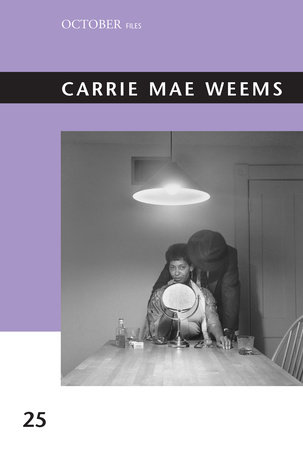
In this October Files volume, essays and interviews explore the work of the influential American artist Carrie Mae Weems—her invention and originality, the formal dimensions of her practice, and her importance to the history of photography and contemporary art. Since the 1980s, Weems (b. 1953) has challenged the status of the black female body within the complex social fabric of American society. Her photographic work, film, and performance investigate spaces that range from the American kitchen table to the nineteenth-century world of historically black Hampton University to the ancient landscapes of Rome.
These texts consider the underpinnings of photographic history in Weems's work, focusing on such early works as The Kitchen Table series; Weems's engagement with photographic archives, historical spaces, and the conceptual legacy of art history; and the relationship between her work and its institutional venues. The book makes clear not only the importance of Weems's work but also the necessity for an expanded set of concerns in contemporary art—one in which race does not restrict a discussion of aesthetics, as it has in the past, robbing black artists of a full consideration of their work.
Contributors
Dawoud Bey, Jennifer Blessing, Kimberly Juanita Brown, Huey Copeland, Erina Duganne, Kimberly Drew, Coco Fusco, Thelma Golden, Katori Hall, Robin Kelsey, Thomas J. Lax, Sarah Lewis, Jeremy McCarter, Yxta Maya Murray, José Rivera, Gwendolyn DuBois Shaw, Salamishah Tillet, Deborah Willis
In this October Files volume, essays and interviews explore the work of the influential American artist Carrie Mae Weems—her invention and originality, the formal dimensions of her practice, and her importance to the history of photography and contemporary art. Since the 1980s, Weems (b. 1953) has challenged the status of the black female body within the complex social fabric of American society. Her photographic work, film, and performance investigate spaces that range from the American kitchen table to the nineteenth-century world of historically black Hampton University to the ancient landscapes of Rome.
These texts consider the underpinnings of photographic history in Weems's work, focusing on such early works as The Kitchen Table series; Weems's engagement with photographic archives, historical spaces, and the conceptual legacy of art history; and the relationship between her work and its institutional venues. The book makes clear not only the importance of Weems's work but also the necessity for an expanded set of concerns in contemporary art—one in which race does not restrict a discussion of aesthetics, as it has in the past, robbing black artists of a full consideration of their work.
Contributors
Dawoud Bey, Jennifer Blessing, Kimberly Juanita Brown, Huey Copeland, Erina Duganne, Kimberly Drew, Coco Fusco, Thelma Golden, Katori Hall, Robin Kelsey, Thomas J. Lax, Sarah Lewis, Jeremy McCarter, Yxta Maya Murray, José Rivera, Gwendolyn DuBois Shaw, Salamishah Tillet, Deborah Willis




In honor of Arab American Heritage Month in April, we are sharing books by Arab and Arab American authors that share their culture, history, and personal lives.
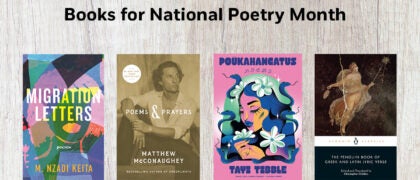
For National Poetry Month in April, we are sharing poetry collections and books about poetry by authors who have their own stories to tell. These poets delve into history, reimagine the present, examine poetry itself—from traditional poems many know and love to poems and voices that are new and original.
/