
Books for Arab American Heritage Month
In honor of Arab American Heritage Month in April, we are sharing books by Arab and Arab American authors that share their culture, history, and personal lives.


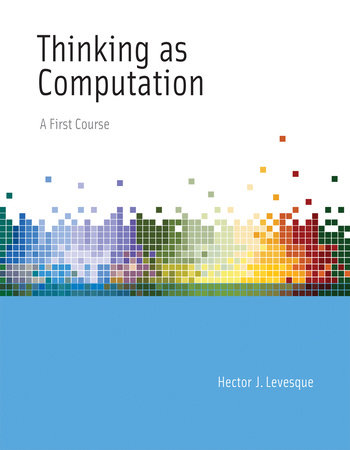
This book guides students through an exploration of the idea that thinking might be understood as a form of computation. Students make the connection between thinking and computing by learning to write computer programs for a variety of tasks that require thought, including solving puzzles, understanding natural language, recognizing objects in visual scenes, planning courses of action, and playing strategic games. The material is presented with minimal technicalities and is accessible to undergraduate students with no specialized knowledge or technical background beyond high school mathematics. Students use Prolog (without having to learn algorithms: “Prolog without tears!”), learning to express what they need as a Prolog program and letting Prolog search for answers.
After an introduction to the basic concepts, Thinking as Computation offers three chapters on Prolog, covering back-chaining, programs and queries, and how to write the sorts of Prolog programs used in the book. The book follows this with case studies of tasks that appear to require thought, then looks beyond Prolog to consider learning, explaining, and propositional reasoning. Most of the chapters conclude with short bibliographic notes and exercises. The book is based on a popular course at the University of Toronto and can be used in a variety of classroom contexts, by students ranging from first-year liberal arts undergraduates to more technically advanced computer science students.
This book guides students through an exploration of the idea that thinking might be understood as a form of computation. Students make the connection between thinking and computing by learning to write computer programs for a variety of tasks that require thought, including solving puzzles, understanding natural language, recognizing objects in visual scenes, planning courses of action, and playing strategic games. The material is presented with minimal technicalities and is accessible to undergraduate students with no specialized knowledge or technical background beyond high school mathematics. Students use Prolog (without having to learn algorithms: “Prolog without tears!”), learning to express what they need as a Prolog program and letting Prolog search for answers.
After an introduction to the basic concepts, Thinking as Computation offers three chapters on Prolog, covering back-chaining, programs and queries, and how to write the sorts of Prolog programs used in the book. The book follows this with case studies of tasks that appear to require thought, then looks beyond Prolog to consider learning, explaining, and propositional reasoning. Most of the chapters conclude with short bibliographic notes and exercises. The book is based on a popular course at the University of Toronto and can be used in a variety of classroom contexts, by students ranging from first-year liberal arts undergraduates to more technically advanced computer science students.
In honor of Arab American Heritage Month in April, we are sharing books by Arab and Arab American authors that share their culture, history, and personal lives.
For National Poetry Month in April, we are sharing poetry collections and books about poetry by authors who have their own stories to tell. These poets delve into history, reimagine the present, examine poetry itself—from traditional poems many know and love to poems and voices that are new and original.
/