
Books for Arab American Heritage Month
In honor of Arab American Heritage Month in April, we are sharing books by Arab and Arab American authors that share their culture, history, and personal lives.


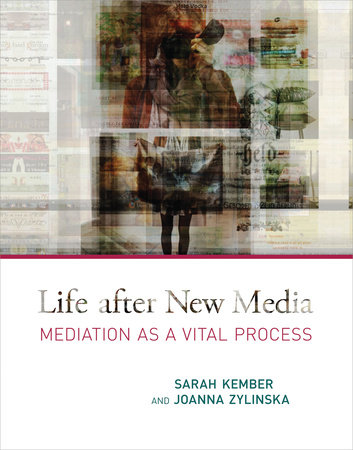
In Life after New Media, Sarah Kember and Joanna Zylinska make a case for a significant shift in our understanding of new media. They argue that we should move beyond our fascination with objects—computers, smart phones, iPods, Kindles—to an examination of the interlocking technical, social, and biological processes of mediation. Doing so, they say, reveals that life itself can be understood as mediated—subject to the same processes of reproduction, transformation, flattening, and patenting undergone by other media forms.
By Kember and Zylinska's account, the dispersal of media and technology into our biological and social lives intensifies our entanglement with nonhuman entities. Mediation—all-encompassing and indivisible—becomes for them a key trope for understanding our being in the technological world. Drawing on the work of Bergson and Derrida while displaying a rigorous playfulness toward philosophy, Kember and Zylinska examine the multiple flows of mediation. Importantly, they also consider the ethical necessity of making a “cut” to any media processes in order to contain them. Considering topics that range from media-enacted cosmic events to the intelligent home, they propose a new way of “doing” media studies that is simultaneously critical and creative, and that performs an encounter between theory and practice.
In Life after New Media, Sarah Kember and Joanna Zylinska make a case for a significant shift in our understanding of new media. They argue that we should move beyond our fascination with objects—computers, smart phones, iPods, Kindles—to an examination of the interlocking technical, social, and biological processes of mediation. Doing so, they say, reveals that life itself can be understood as mediated—subject to the same processes of reproduction, transformation, flattening, and patenting undergone by other media forms.
By Kember and Zylinska's account, the dispersal of media and technology into our biological and social lives intensifies our entanglement with nonhuman entities. Mediation—all-encompassing and indivisible—becomes for them a key trope for understanding our being in the technological world. Drawing on the work of Bergson and Derrida while displaying a rigorous playfulness toward philosophy, Kember and Zylinska examine the multiple flows of mediation. Importantly, they also consider the ethical necessity of making a “cut” to any media processes in order to contain them. Considering topics that range from media-enacted cosmic events to the intelligent home, they propose a new way of “doing” media studies that is simultaneously critical and creative, and that performs an encounter between theory and practice.
In honor of Arab American Heritage Month in April, we are sharing books by Arab and Arab American authors that share their culture, history, and personal lives.
For National Poetry Month in April, we are sharing poetry collections and books about poetry by authors who have their own stories to tell. These poets delve into history, reimagine the present, examine poetry itself—from traditional poems many know and love to poems and voices that are new and original.
/