
Books for Arab American Heritage Month
In honor of Arab American Heritage Month in April, we are sharing books by Arab and Arab American authors that share their culture, history, and personal lives.


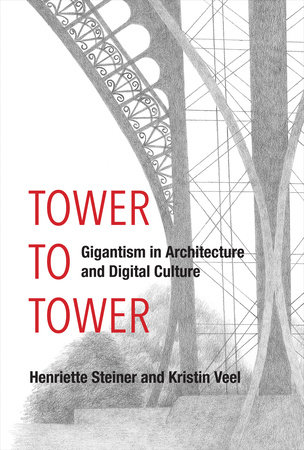
The gigantic is everywhere, and gigantism is manifest in everything from excessively tall skyscrapers to globe-spanning digital networks. In this book, Henriette Steiner and Kristin Veel map and critique the trajectory of gigantism in architecture and digital culture—the convergence of tall buildings and networked infrastructures—from the Eiffel Tower to One World Trade Center. They show how these two forms of gigantism intersect in the figure of the skyscraper with a transmitting antenna on its roof, a gigantic building that is also a nodal point in a gigantic digital infrastructure.
Steiner and Veel focus on two paradigmatic tower sites: the Eiffel Tower and the Twin Towers of the destroyed World Trade Center (as well as their replacement, the One World Trade Center tower). They consider, among other things, philosophical interpretations of the Eiffel Tower; the design and destruction of the Twin Towers; the architectural debates surrounding the erection of One World Trade Center on the Ground Zero site; and such recent examples of gigantism across architecture and digital culture as Rem Koolhaas's headquarters for China Central TV and the phenomenon of the “tech giant.” Examining the cultural, architectural, and media history of these towers, they analyze the changing conceptions of the gigantism that they represent, not just as physical structures but as sites for the projection of cultural ideas and ideals.
The gigantic is everywhere, and gigantism is manifest in everything from excessively tall skyscrapers to globe-spanning digital networks. In this book, Henriette Steiner and Kristin Veel map and critique the trajectory of gigantism in architecture and digital culture—the convergence of tall buildings and networked infrastructures—from the Eiffel Tower to One World Trade Center. They show how these two forms of gigantism intersect in the figure of the skyscraper with a transmitting antenna on its roof, a gigantic building that is also a nodal point in a gigantic digital infrastructure.
Steiner and Veel focus on two paradigmatic tower sites: the Eiffel Tower and the Twin Towers of the destroyed World Trade Center (as well as their replacement, the One World Trade Center tower). They consider, among other things, philosophical interpretations of the Eiffel Tower; the design and destruction of the Twin Towers; the architectural debates surrounding the erection of One World Trade Center on the Ground Zero site; and such recent examples of gigantism across architecture and digital culture as Rem Koolhaas's headquarters for China Central TV and the phenomenon of the “tech giant.” Examining the cultural, architectural, and media history of these towers, they analyze the changing conceptions of the gigantism that they represent, not just as physical structures but as sites for the projection of cultural ideas and ideals.
In honor of Arab American Heritage Month in April, we are sharing books by Arab and Arab American authors that share their culture, history, and personal lives.
For National Poetry Month in April, we are sharing poetry collections and books about poetry by authors who have their own stories to tell. These poets delve into history, reimagine the present, examine poetry itself—from traditional poems many know and love to poems and voices that are new and original.