
Books for Jewish American Heritage Month
In celebration of Jewish American Heritage Month in May, we are sharing books by authors who share their individual stories, experiences, and lives. Find our full collection of books here.


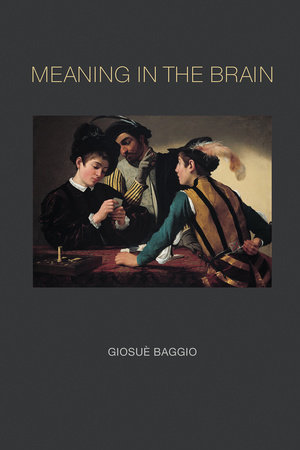
When we read a text or listen to speech, meaning seems to be given to us instantaneously, as if it were part of the input. In Meaning in the Brain, Giosuè Baggio explains that this is an illusion created by the tremendous speed at which sensory systems and systems for meaning and grammar operate in the brain. Meaning, Baggio argues, is not derived from input but results from the brain's internal construction process. With this book, Baggio offers the first integrated, multilevel theory of semantics in the brain, describing how meaning is generated during language comprehension, production, and acquisition.
Baggio's theory draws on recent advances in formal semantics and pragmatics, including vector-space semantics, discourse representation theory, and signaling game theory. It is designed to explain a growing body of experimental results on semantic processing that have accumulated in the absence of a unifying theory since the introduction of electrophysiology and neuroimaging methods.
Baggio argues that there is evidence for the existence of three semantic systems in the brain—relational semantics, interpretive semantics, and evolutionary semantics—and he discusses each in turn, developing neural theories of meaning for all three. Moreover, in the course of his argument, Baggio addresses several long-standing issues in the neuroscience of language, including the role of compositionality as a principle of meaning construction in the brain, the role of sensory-motor processes in language comprehension, and the neural and evolutionary links among meaning, consciousness, sociality, and action.
When we read a text or listen to speech, meaning seems to be given to us instantaneously, as if it were part of the input. In Meaning in the Brain, Giosuè Baggio explains that this is an illusion created by the tremendous speed at which sensory systems and systems for meaning and grammar operate in the brain. Meaning, Baggio argues, is not derived from input but results from the brain's internal construction process. With this book, Baggio offers the first integrated, multilevel theory of semantics in the brain, describing how meaning is generated during language comprehension, production, and acquisition.
Baggio's theory draws on recent advances in formal semantics and pragmatics, including vector-space semantics, discourse representation theory, and signaling game theory. It is designed to explain a growing body of experimental results on semantic processing that have accumulated in the absence of a unifying theory since the introduction of electrophysiology and neuroimaging methods.
Baggio argues that there is evidence for the existence of three semantic systems in the brain—relational semantics, interpretive semantics, and evolutionary semantics—and he discusses each in turn, developing neural theories of meaning for all three. Moreover, in the course of his argument, Baggio addresses several long-standing issues in the neuroscience of language, including the role of compositionality as a principle of meaning construction in the brain, the role of sensory-motor processes in language comprehension, and the neural and evolutionary links among meaning, consciousness, sociality, and action.
In celebration of Jewish American Heritage Month in May, we are sharing books by authors who share their individual stories, experiences, and lives. Find our full collection of books here.
For Mental Health Awareness Month in May, we are sharing books to educate and raise awareness about mental health and the various factors that may affect it, and to provide tools and resources for student wellness. Find our full collection of titles here.
Each May, we honor the stories, histories, and cultures of Asian Americans, Native Hawaiians, and Pacific Islanders. Below is a selection of acclaimed fiction and nonfiction books by AANHPI creators to share with your students this month and throughout the year. Find our full collection of titles for Higher Education here.