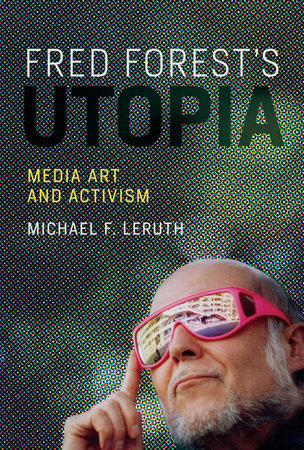

The innovative French media artist and prankster-provocateur Fred Forest first gained notoriety in 1972 when he inserted a small blank space in Le Monde, called it 150 cm2 of Newspaper (150 cm2 de papier journal), and invited readers to fill in the space with their own work and mail their efforts to him. In 1977, he satirized speculation in both the art and real estate markets by offering the first parcel of officially registered “artistic square meters” of undeveloped rural land for sale at an art auction. Although praised by leading media theorists—Vilém Flusser lauded Forest as “the artist who pokes holes in media”—Forest's work has been largely ignored by the canon-making authorities. Forest calls himself “France's most famous unknown artist.” In this book, Michael Leruth offers the first book-length consideration of this iconoclastic artist, examining Forest's work from the 1960s to the present.
Leruth shows that Forest chooses alternative platforms (newspapers, mock commercial ventures, video-based interactive social interventions, media hacks and hybrids, and, more recently, the Internet) that are outside the exclusive precincts of the art world. A fierce critic of the French contemporary art establishment, Forest famously sued the Centre Pompidou in 1994 over its opaque acquisition practices. After making foundational contributions to Sociological Art in the 1970s and the Aesthetics of Communication in the 1980s, the pioneering Forest saw the Internet as another way for artists to bypass the art establishment in the 1990s. Arguing that there is a strong utopian quality in Forest's work, Leruth sees this utopianism not as naive or conventional but as a reverse utopianism: rather than envisioning an impossible ideal, Forest reenvisions and probes the quasi-utopia of our media-augented everyday reality. The interface is the symbolic threshold to be crossed with an open mind.
The innovative French media artist and prankster-provocateur Fred Forest first gained notoriety in 1972 when he inserted a small blank space in Le Monde, called it 150 cm2 of Newspaper (150 cm2 de papier journal), and invited readers to fill in the space with their own work and mail their efforts to him. In 1977, he satirized speculation in both the art and real estate markets by offering the first parcel of officially registered “artistic square meters” of undeveloped rural land for sale at an art auction. Although praised by leading media theorists—Vilém Flusser lauded Forest as “the artist who pokes holes in media”—Forest's work has been largely ignored by the canon-making authorities. Forest calls himself “France's most famous unknown artist.” In this book, Michael Leruth offers the first book-length consideration of this iconoclastic artist, examining Forest's work from the 1960s to the present.
Leruth shows that Forest chooses alternative platforms (newspapers, mock commercial ventures, video-based interactive social interventions, media hacks and hybrids, and, more recently, the Internet) that are outside the exclusive precincts of the art world. A fierce critic of the French contemporary art establishment, Forest famously sued the Centre Pompidou in 1994 over its opaque acquisition practices. After making foundational contributions to Sociological Art in the 1970s and the Aesthetics of Communication in the 1980s, the pioneering Forest saw the Internet as another way for artists to bypass the art establishment in the 1990s. Arguing that there is a strong utopian quality in Forest's work, Leruth sees this utopianism not as naive or conventional but as a reverse utopianism: rather than envisioning an impossible ideal, Forest reenvisions and probes the quasi-utopia of our media-augented everyday reality. The interface is the symbolic threshold to be crossed with an open mind.