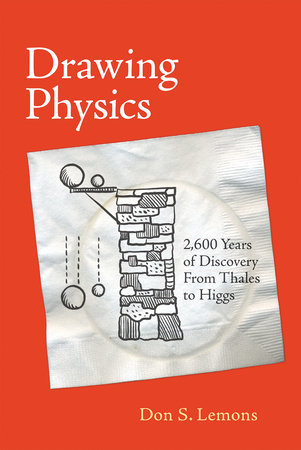

Drawing Physics

2,600 Years of Discovery From Thales to Higgs

Ebook
On sale Feb 03, 2017 | 264 Pages | 9780262338752

See Additional Formats
THE HISTORY OF THE PHYSICS: Short chronological essays and simple drawings “illuminate a millennia of famous discoveries” and explain 51 key physics concepts (Physics Today).

Humans have been trying to understand the physical universe since antiquity. Aristotle had one vision (the realm of the celestial spheres is perfect), and Einstein another (all motion is relativistic). More often than not, understanding begins with a drawing—a humble but effective tool of the physicist’s craft.

Professor of physics Don Lemons puts that skill to use in this collection of essays and drawings that convey important concepts from the history of physics. Follow 2,600 years of discovery in chronological order:

• Thales’ discovery of triangulation
• The Pythagorean monochord
• Archimedes’ explanation of balance.
• Leonardo’s “earthshine” (the ghostly glow between the horns of a crescent moon)
• Kepler’s laws of planetary motion
• Newton’s cradle
• 20th and 21st century discoveries like the hydrogen atom, general relativity, and more

Each essay also places the science of the drawings in historical context—describing Galileo’s conflict with the Roman Catholic Church over his teaching that the sun is the center of the universe; the link between the discovery of electrical phenomena and the romanticism of William Wordsworth; and the shadow cast by the Great War over Einstein’s discovery of relativity.

With Drawing Physics, even readers with little background in mathematics or physics will say, “Now I see, and now I understand.”
Don S. Lemons is Emeritus Professor of Physics at Bethel College in North Newton, Kansas.
“Although physics complexifies through the 19th and 20th centuries, with Maxwell, Einstein and their fellow brainiacs pushing the limits of comprehension, the book retains its clarity and charm.”
Wall Street Journal

“Simple, evocative black-and-white line drawings illustrate millennia of famous discoveries in this delightful volume.... The book is a perfect starting point for those who want to learn more about the history of physics.”
Physics Today

“A must-have for teachers, Drawing Physics would also be enjoyed by an layperson interested in improving their grasp on physics and learning about the history of scientific thought.”
Skeptical Inquirer

About

THE HISTORY OF THE PHYSICS: Short chronological essays and simple drawings “illuminate a millennia of famous discoveries” and explain 51 key physics concepts (Physics Today).

Humans have been trying to understand the physical universe since antiquity. Aristotle had one vision (the realm of the celestial spheres is perfect), and Einstein another (all motion is relativistic). More often than not, understanding begins with a drawing—a humble but effective tool of the physicist’s craft.

Professor of physics Don Lemons puts that skill to use in this collection of essays and drawings that convey important concepts from the history of physics. Follow 2,600 years of discovery in chronological order:

• Thales’ discovery of triangulation
• The Pythagorean monochord
• Archimedes’ explanation of balance.
• Leonardo’s “earthshine” (the ghostly glow between the horns of a crescent moon)
• Kepler’s laws of planetary motion
• Newton’s cradle
• 20th and 21st century discoveries like the hydrogen atom, general relativity, and more

Each essay also places the science of the drawings in historical context—describing Galileo’s conflict with the Roman Catholic Church over his teaching that the sun is the center of the universe; the link between the discovery of electrical phenomena and the romanticism of William Wordsworth; and the shadow cast by the Great War over Einstein’s discovery of relativity.

With Drawing Physics, even readers with little background in mathematics or physics will say, “Now I see, and now I understand.”

Author

Don S. Lemons is Emeritus Professor of Physics at Bethel College in North Newton, Kansas.

Praise

“Although physics complexifies through the 19th and 20th centuries, with Maxwell, Einstein and their fellow brainiacs pushing the limits of comprehension, the book retains its clarity and charm.”
Wall Street Journal

“Simple, evocative black-and-white line drawings illustrate millennia of famous discoveries in this delightful volume.... The book is a perfect starting point for those who want to learn more about the history of physics.”
Physics Today

“A must-have for teachers, Drawing Physics would also be enjoyed by an layperson interested in improving their grasp on physics and learning about the history of scientific thought.”
Skeptical Inquirer