
Books for Arab American Heritage Month
In honor of Arab American Heritage Month in April, we are sharing books by Arab and Arab American authors that share their culture, history, and personal lives.


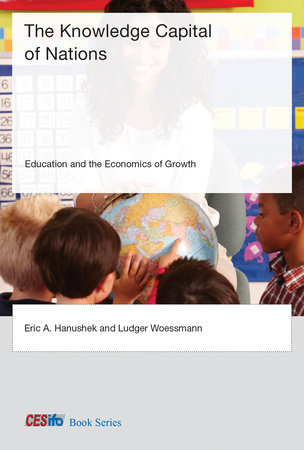
In this book Eric Hanushek and Ludger Woessmann make a simple, central claim, developed with rigorous theoretical and empirical support: knowledge is the key to a country's development. Of course, every country acknowledges the importance of developing human capital, but Hanushek and Woessmann argue that message has become distorted, with politicians and researchers concentrating not on valued skills but on proxies for them. The common focus is on school attainment, although time in school provides a very misleading picture of how skills enter into development. Hanushek and Woessmann contend that the cognitive skills of the population—which they term the “knowledge capital” of a nation—are essential to long-run prosperity.
Hanushek and Woessmann subject their hypotheses about the relationship between cognitive skills (as consistently measured by international student assessments) and economic growth to a series of tests, including alternate specifications, different subsets of countries, and econometric analysis of causal interpretations. They find that their main results are remarkably robust, and equally applicable to developing and developed countries. They demonstrate, for example, that the “Latin American growth puzzle” and the “East Asian miracle” can be explained by these regions' knowledge capital. Turning to the policy implications of their argument, they call for an education system that develops effective accountability, promotes choice and competition, and provides direct rewards for good performance.
In addition to compiling a data set of internationally comparable measures of cognitive skills, the authors have convincingly shown that such measures correlate highly with economic growth and cognitive skills can explain away large differences in growth rates between world regions… [A] valuable contribution and an interesting read.
—Mikael Lindahl, Journal of Economic Literature—In this book Eric Hanushek and Ludger Woessmann make a simple, central claim, developed with rigorous theoretical and empirical support: knowledge is the key to a country's development. Of course, every country acknowledges the importance of developing human capital, but Hanushek and Woessmann argue that message has become distorted, with politicians and researchers concentrating not on valued skills but on proxies for them. The common focus is on school attainment, although time in school provides a very misleading picture of how skills enter into development. Hanushek and Woessmann contend that the cognitive skills of the population—which they term the “knowledge capital” of a nation—are essential to long-run prosperity.
Hanushek and Woessmann subject their hypotheses about the relationship between cognitive skills (as consistently measured by international student assessments) and economic growth to a series of tests, including alternate specifications, different subsets of countries, and econometric analysis of causal interpretations. They find that their main results are remarkably robust, and equally applicable to developing and developed countries. They demonstrate, for example, that the “Latin American growth puzzle” and the “East Asian miracle” can be explained by these regions' knowledge capital. Turning to the policy implications of their argument, they call for an education system that develops effective accountability, promotes choice and competition, and provides direct rewards for good performance.
In addition to compiling a data set of internationally comparable measures of cognitive skills, the authors have convincingly shown that such measures correlate highly with economic growth and cognitive skills can explain away large differences in growth rates between world regions… [A] valuable contribution and an interesting read.
—Mikael Lindahl, Journal of Economic Literature—
In honor of Arab American Heritage Month in April, we are sharing books by Arab and Arab American authors that share their culture, history, and personal lives.
For National Poetry Month in April, we are sharing poetry collections and books about poetry by authors who have their own stories to tell. These poets delve into history, reimagine the present, examine poetry itself—from traditional poems many know and love to poems and voices that are new and original.