


Books for Arab American Heritage Month
In honor of Arab American Heritage Month in April, we are sharing books by Arab and Arab American authors that share their culture, history, and personal lives.
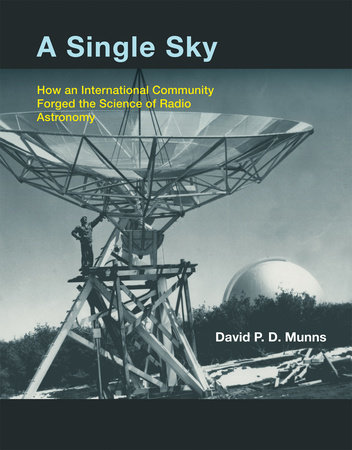
For more than three thousand years, the science of astronomy depended on visible light. In just the last sixty years, radio technology has fundamentally altered how astronomers see the universe. Combining the wartime innovation of radar and the established standards of traditional optical telescopes, the “radio telescope” offered humanity a new vision of the universe. In A Single Sky, the historian David Munns explains how the idea of the radio telescope emerged from a new scientific community uniting the power of radio with the international aspirations of the discipline of astronomy. The radio astronomers challenged Cold War era rivalries by forging a united scientific community looking at a single sky.
Munns tells the interconnecting stories of Australian, British, Dutch, and American radio astronomers, all seeking to learn how to see the universe by means of radio. Jointly, this international array of radio astronomers built a new “community” style of science opposing the “glamour” of nuclear physics. A Single Sky describes a communitarian style of science, a culture of interdisciplinary and international integration and cooperation, and counters the notion that recent science has been driven by competition. Collaboration, or what a prominent radio astronomer called “a blending of radio invention and astronomical insight,” produced a science as revolutionary as Galileo's first observations with a telescope. Working together, the community of radio astronomers revealed the structure of the galaxy.
A Single Sky makes an important contribution to the history of physics in the high Cold War (ca. 1944–1964). In choosing to tell the story of radio astronomy, Munns has selected a science that operated in the looming shadow of physics and one in which participants chose not to mimic their more well-known and well-supported colleagues in high-energy physics.
—Ann Johnson, The Journal of American History—For more than three thousand years, the science of astronomy depended on visible light. In just the last sixty years, radio technology has fundamentally altered how astronomers see the universe. Combining the wartime innovation of radar and the established standards of traditional optical telescopes, the “radio telescope” offered humanity a new vision of the universe. In A Single Sky, the historian David Munns explains how the idea of the radio telescope emerged from a new scientific community uniting the power of radio with the international aspirations of the discipline of astronomy. The radio astronomers challenged Cold War era rivalries by forging a united scientific community looking at a single sky.
Munns tells the interconnecting stories of Australian, British, Dutch, and American radio astronomers, all seeking to learn how to see the universe by means of radio. Jointly, this international array of radio astronomers built a new “community” style of science opposing the “glamour” of nuclear physics. A Single Sky describes a communitarian style of science, a culture of interdisciplinary and international integration and cooperation, and counters the notion that recent science has been driven by competition. Collaboration, or what a prominent radio astronomer called “a blending of radio invention and astronomical insight,” produced a science as revolutionary as Galileo's first observations with a telescope. Working together, the community of radio astronomers revealed the structure of the galaxy.
A Single Sky makes an important contribution to the history of physics in the high Cold War (ca. 1944–1964). In choosing to tell the story of radio astronomy, Munns has selected a science that operated in the looming shadow of physics and one in which participants chose not to mimic their more well-known and well-supported colleagues in high-energy physics.
—Ann Johnson, The Journal of American History—In honor of Arab American Heritage Month in April, we are sharing books by Arab and Arab American authors that share their culture, history, and personal lives.
For National Poetry Month in April, we are sharing poetry collections and books about poetry by authors who have their own stories to tell. These poets delve into history, reimagine the present, examine poetry itself—from traditional poems many know and love to poems and voices that are new and original.