
Books for Jewish American Heritage Month
In celebration of Jewish American Heritage Month in May, we are sharing books by authors who share their individual stories, experiences, and lives. Find our full collection of books here.


In Cybernetic Revolutionaries, Eden Medina tells the history of two intersecting utopian visions, one political and one technological. The first was Chile's experiment with peaceful socialist change under Salvador Allende; the second was the simultaneous attempt to build a computer system that would manage Chile's economy. Neither vision was fully realized—Allende's government ended with a violent military coup; the system, known as Project Cybersyn, was never completely implemented—but they hold lessons for today about the relationship between technology and politics.
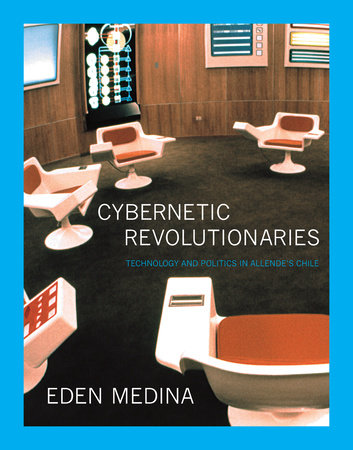
Drawing on extensive archival material and interviews, Medina examines the cybernetic system envisioned by the Chilean government—which was to feature holistic system design, decentralized management, human-computer interaction, a national telex network, near real-time control of the growing industrial sector, and modeling the behavior of dynamic systems. She also describes, and documents with photographs, the network's Star Trek-like operations room, which featured swivel chairs with armrest control panels, a wall of screens displaying data, and flashing red lights to indicate economic emergencies.
Studying project Cybersyn today helps us understand not only the technological ambitions of a government in the midst of political change but also the limitations of the Chilean revolution. This history further shows how human attempts to combine the political and the technological with the goal of creating a more just society can open new technological, intellectual, and political possibilities. Technologies, Medina writes, are historical texts; when we read them we are reading history.
This is indispensable reading for historians of Latin America and historians of technology alike.
—Suzanne Moone, American Historical Review—In Cybernetic Revolutionaries, Eden Medina tells the history of two intersecting utopian visions, one political and one technological. The first was Chile's experiment with peaceful socialist change under Salvador Allende; the second was the simultaneous attempt to build a computer system that would manage Chile's economy. Neither vision was fully realized—Allende's government ended with a violent military coup; the system, known as Project Cybersyn, was never completely implemented—but they hold lessons for today about the relationship between technology and politics.
Drawing on extensive archival material and interviews, Medina examines the cybernetic system envisioned by the Chilean government—which was to feature holistic system design, decentralized management, human-computer interaction, a national telex network, near real-time control of the growing industrial sector, and modeling the behavior of dynamic systems. She also describes, and documents with photographs, the network's Star Trek-like operations room, which featured swivel chairs with armrest control panels, a wall of screens displaying data, and flashing red lights to indicate economic emergencies.
Studying project Cybersyn today helps us understand not only the technological ambitions of a government in the midst of political change but also the limitations of the Chilean revolution. This history further shows how human attempts to combine the political and the technological with the goal of creating a more just society can open new technological, intellectual, and political possibilities. Technologies, Medina writes, are historical texts; when we read them we are reading history.
This is indispensable reading for historians of Latin America and historians of technology alike.
—Suzanne Moone, American Historical Review—
In celebration of Jewish American Heritage Month in May, we are sharing books by authors who share their individual stories, experiences, and lives. Find our full collection of books here.
For Mental Health Awareness Month in May, we are sharing books to educate and raise awareness about mental health and the various factors that may affect it, and to provide tools and resources for student wellness. Find our full collection of titles here.
Each May, we honor the stories, histories, and cultures of Asian Americans, Native Hawaiians, and Pacific Islanders. Below is a selection of acclaimed fiction and nonfiction books by AANHPI creators to share with your students this month and throughout the year. Find our full collection of titles for Higher Education here.