Multiplicity

A Scientist’s Journey into Evolutionary Space

The awe-inspiring, little-known story of Nobel laureate Frances Arnold’s discovery of directed enzyme evolution—and how it was sparked by reading Jorge Luis Borges.

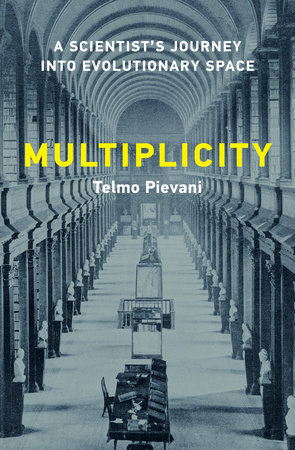
In 1976, a young engineering student from Princeton, Frances Arnold, happened upon Jorge Luis Borges’s short story “The Library of Babel” while in Madrid.  The tale recounts a vast honeycomb of a library that contains all the answers to the mysteries of humanity. Little did Arnold know that the story would change the course of her life—and the course of science.

In Multiplicity, Telmo Pievani explores her journey and the significance—and scientific potential—of Borges’s legendary library and others like it. The famous evolutionist John Maynard Smith, for instance, had fantasized about the existence of a similar enormous library full of proteins rather than books. And in 1995 the philosopher of mind Daniel Dennett would devise a library no less confounding: one that collects all possible genomes, or all possible combinations of the nucleotide bases of DNA. Why? Because by comparing all the proteins, genomes, and plants and animals that exist and have existed throughout evolution, what is finally revealed is possibility—what doesn’t exist but could.

For Arnold, the concept of such a library ultimately led to the discovery of the directed evolution of enzymes: a way of using nature’s own method to produce new and better enzymes. The revolutionary idea transformed protein chemistry and biotechnology and earned her the Nobel Prize in Chemistry in 2018. With literary echoes ranging from Borges to Italo Calvino, this slim book tells her brilliant story.
Telmo Pievani is Distinguished Professor in the Department of Pharmacological and Biomolecular Sciences at the University of Milan, where he holds the chair of Philosophy of Biological Sciences. He is the author of Imperfection and Serendipity.
ENDORSEMENTS

“An electrifying and elegantly crafted journey into biology’s heart of darkness.”
—Adrian Woolfson, cofounder of Genyro; author of On the Future of Species

“This book is a jewel. Telmo Pievani explores the borderlands of biology, philosophy, and literature with wit, erudition, and grace. And he tells the extraordinary story of Frances Arnold with deep humanity. An intensely interesting and valuable volume.”
—David Quammen, author of Breathless and Spillover

“Telmo Pievani once again enchants us with a penetrating perspective on the process that put us all here. This time his perceptive eye alights on the thorny issue of possibility vs. actuality, with compulsively readable results.”
—Ian Tattersall, paleoanthropologist; Curator Emeritus, American Museum of Natural History

“The life journey of an outstanding scientist, literary labyrinths, and some of the most fundamental questions about the tree of life … all seamlessly combined in a fascinating read. I was immediately hooked on this book.”
—Sandra Díaz, Córdoba National University, Argentina

“In Multiplicity, Pievani explores the limits of biological design and how it has been probed by both evolution and science, explained elegantly through his masterful weaving of philosophy, science, and classic literature.”
—Philip Donoghue, Professor of Palaeobiology, University of Bristol

“In Multiplicity, Pievani’s singular voice reaches through the page and plunges the reader into the astonishing world of Frances Arnold, a visionary whose remarkable life deserves far greater recognition. Bold and deeply original, this biography challenges our conventional view of evolution as linear progression, using philosophical concepts to reimagine it as a vast, interconnected library of possibility. The result is a fascinating and thought-provoking read, one that reminds us that there are many ways of understanding life, and many ways of being human.”
—Nathalia Holt, author of Rise of the Rocket Girls

About

The awe-inspiring, little-known story of Nobel laureate Frances Arnold’s discovery of directed enzyme evolution—and how it was sparked by reading Jorge Luis Borges.

In 1976, a young engineering student from Princeton, Frances Arnold, happened upon Jorge Luis Borges’s short story “The Library of Babel” while in Madrid.  The tale recounts a vast honeycomb of a library that contains all the answers to the mysteries of humanity. Little did Arnold know that the story would change the course of her life—and the course of science.

In Multiplicity, Telmo Pievani explores her journey and the significance—and scientific potential—of Borges’s legendary library and others like it. The famous evolutionist John Maynard Smith, for instance, had fantasized about the existence of a similar enormous library full of proteins rather than books. And in 1995 the philosopher of mind Daniel Dennett would devise a library no less confounding: one that collects all possible genomes, or all possible combinations of the nucleotide bases of DNA. Why? Because by comparing all the proteins, genomes, and plants and animals that exist and have existed throughout evolution, what is finally revealed is possibility—what doesn’t exist but could.

For Arnold, the concept of such a library ultimately led to the discovery of the directed evolution of enzymes: a way of using nature’s own method to produce new and better enzymes. The revolutionary idea transformed protein chemistry and biotechnology and earned her the Nobel Prize in Chemistry in 2018. With literary echoes ranging from Borges to Italo Calvino, this slim book tells her brilliant story.

Author

Telmo Pievani is Distinguished Professor in the Department of Pharmacological and Biomolecular Sciences at the University of Milan, where he holds the chair of Philosophy of Biological Sciences. He is the author of Imperfection and Serendipity.

Praise

ENDORSEMENTS

“An electrifying and elegantly crafted journey into biology’s heart of darkness.”
—Adrian Woolfson, cofounder of Genyro; author of On the Future of Species

“This book is a jewel. Telmo Pievani explores the borderlands of biology, philosophy, and literature with wit, erudition, and grace. And he tells the extraordinary story of Frances Arnold with deep humanity. An intensely interesting and valuable volume.”
—David Quammen, author of Breathless and Spillover

“Telmo Pievani once again enchants us with a penetrating perspective on the process that put us all here. This time his perceptive eye alights on the thorny issue of possibility vs. actuality, with compulsively readable results.”
—Ian Tattersall, paleoanthropologist; Curator Emeritus, American Museum of Natural History

“The life journey of an outstanding scientist, literary labyrinths, and some of the most fundamental questions about the tree of life … all seamlessly combined in a fascinating read. I was immediately hooked on this book.”
—Sandra Díaz, Córdoba National University, Argentina

“In Multiplicity, Pievani explores the limits of biological design and how it has been probed by both evolution and science, explained elegantly through his masterful weaving of philosophy, science, and classic literature.”
—Philip Donoghue, Professor of Palaeobiology, University of Bristol

“In Multiplicity, Pievani’s singular voice reaches through the page and plunges the reader into the astonishing world of Frances Arnold, a visionary whose remarkable life deserves far greater recognition. Bold and deeply original, this biography challenges our conventional view of evolution as linear progression, using philosophical concepts to reimagine it as a vast, interconnected library of possibility. The result is a fascinating and thought-provoking read, one that reminds us that there are many ways of understanding life, and many ways of being human.”
—Nathalia Holt, author of Rise of the Rocket Girls