
Books for Arab American Heritage Month
In honor of Arab American Heritage Month in April, we are sharing books by Arab and Arab American authors that share their culture, history, and personal lives.


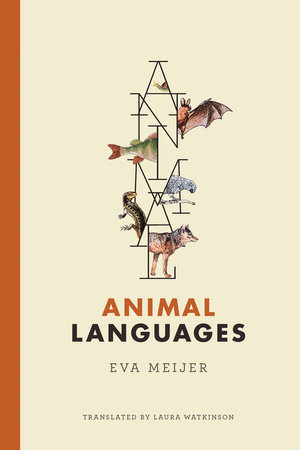
Is language what sets humans apart from other animals, as many have argued? Or do animals speak in their own languages, to each other and to us? In Animal Languages, Eva Meijer explores the latter possibility.
Meijer tells us about Alex, the gray parrot who knew more than one hundred words, and Chaser, the border collie who had a talent for grammar. She introduces us to Washoe, the chimpanzee who grew up with humans and learned sign language; Kosik, the elephant who spoke to humans in human language and to his female elephant companion in elephant language; and Noc, the beluga whale who mimicked human speech. She tells us that dogs are able to interpret the meaning of other dogs' growls; that prairie dogs have alarm calls that offer informative details about intruders (specifying, among other things, size, color, and speed of approach); and that marmosets take turns in conversations and teach this skill to their offspring.
But beyond all these interesting details, Meijer makes a more profound observation. Talking with animals forces us to challenge the hierarchy of humans and other animals, and suggests a new way of thinking about language. Animal Languages shows us that language is broader and richer than we imagined, and that meaningful expression does not require human words.
Is language what sets humans apart from other animals, as many have argued? Or do animals speak in their own languages, to each other and to us? In Animal Languages, Eva Meijer explores the latter possibility.
Meijer tells us about Alex, the gray parrot who knew more than one hundred words, and Chaser, the border collie who had a talent for grammar. She introduces us to Washoe, the chimpanzee who grew up with humans and learned sign language; Kosik, the elephant who spoke to humans in human language and to his female elephant companion in elephant language; and Noc, the beluga whale who mimicked human speech. She tells us that dogs are able to interpret the meaning of other dogs' growls; that prairie dogs have alarm calls that offer informative details about intruders (specifying, among other things, size, color, and speed of approach); and that marmosets take turns in conversations and teach this skill to their offspring.
But beyond all these interesting details, Meijer makes a more profound observation. Talking with animals forces us to challenge the hierarchy of humans and other animals, and suggests a new way of thinking about language. Animal Languages shows us that language is broader and richer than we imagined, and that meaningful expression does not require human words.
In honor of Arab American Heritage Month in April, we are sharing books by Arab and Arab American authors that share their culture, history, and personal lives.
For National Poetry Month in April, we are sharing poetry collections and books about poetry by authors who have their own stories to tell. These poets delve into history, reimagine the present, examine poetry itself—from traditional poems many know and love to poems and voices that are new and original.