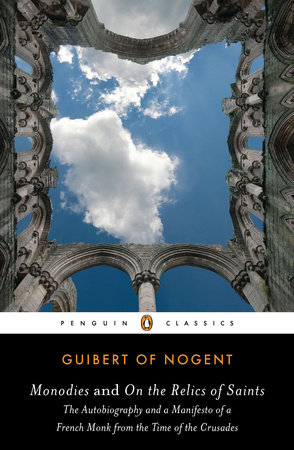

Monodies and On the Relics of Saints

The Autobiography and a Manifesto of a French Monk from theTime of the Crusades

Introduction by Jay Rubenstein
Edited by Joseph McAlhany
Translated by Joseph McAlhany
The first Western autobiography since Augustine's Confessions, the Monodies is set against the backdrop of the First Crusade and offers stunning insights into medieval society. As Guibert of Nogent intimately recounts his early years, monastic life, and the bloody uprising at Laon in 1112, we witness a world-and a mind-populated by royals, heretics, nuns, witches, and devils, and come to understand just how fervently he was preoccupied with sin, sexuality, the afterlife, and the dark arts. Exotic, disquieting, and illuminating, the Monodies is a work in which the dreams, fears, and superstitions of one man illuminate the psychology of an entire people. It is joined in this volume by On the Relics of Saints, a theological manifesto that has never appeared in English until now.

For more than seventy years, Penguin has been the leading publisher of classic literature in the English-speaking world. With more than 1,700 titles, Penguin Classics represents a global bookshelf of the best works throughout history and across genres and disciplines. Readers trust the series to provide authoritative texts enhanced by introductions and notes by distinguished scholars and contemporary authors, as well as up-to-date translations by award-winning translators.
Guibert of Nogent (c. 1060-c. 1125) was a French monk who has emerged as one of the most original thinkers of the twelfth century.

Joseph McAlhany is a professor of classics and great ideas at Carthage College in Kenosha, Wisconsin.

Jay Rubenstein, a MacArthur Fellow and Rhodes scholar, is a professor of history and the director of the Center for the Premodern World at the University of Southern California and the author of the first comprehensive study of Guibert's life and thought in over a century.
"The fascination of this elegantly translated volume lies in Guibert's perceptions of his own time, so utterly different from the worldview of a modern Westerner. Jay Rubenstein is a learned, witty, and sympathetic host as he introduces us to one of the twelfth century's most idiosyncratic, confessional, and engaging writers." —Diarmaid MacCulloch, author of Christianity & The Reformation

"Marvelous: a revelation. I had not heard of Guibert of Nogent. His Monodies is a very dark autobiography and profoundly moving in its visions of sin." —Harold Bloom

"This magnificent autobiography has all the stuff of a psychological drama, the excitement of a great social upheaval, and the intrigue of a monastic mystery. It is one of those rare books that both delights scholars of the period and makes fascinating reading for the general literate soul." R. Howard Bloch, Yale University

“This is a valuable addition to medieval literature, and Penguin are to be applauded for adding it to their list of Classics. . . . The Monodies has been translated before but clumsily, and here at last is a smooth and comprehensible version. . . . [It] provides an intriguing insight into the mind of a medieval monk . . . a complex and troubled man, austere, conservative, at sea with a changing world . . . an isolated and introspective figure who broods continually on his relationship with God. This is, of course, one of the reasons why the Monodies is so interesting.” Charles Freeman, History Today

About

The first Western autobiography since Augustine's Confessions, the Monodies is set against the backdrop of the First Crusade and offers stunning insights into medieval society. As Guibert of Nogent intimately recounts his early years, monastic life, and the bloody uprising at Laon in 1112, we witness a world-and a mind-populated by royals, heretics, nuns, witches, and devils, and come to understand just how fervently he was preoccupied with sin, sexuality, the afterlife, and the dark arts. Exotic, disquieting, and illuminating, the Monodies is a work in which the dreams, fears, and superstitions of one man illuminate the psychology of an entire people. It is joined in this volume by On the Relics of Saints, a theological manifesto that has never appeared in English until now.

For more than seventy years, Penguin has been the leading publisher of classic literature in the English-speaking world. With more than 1,700 titles, Penguin Classics represents a global bookshelf of the best works throughout history and across genres and disciplines. Readers trust the series to provide authoritative texts enhanced by introductions and notes by distinguished scholars and contemporary authors, as well as up-to-date translations by award-winning translators.

Author

Guibert of Nogent (c. 1060-c. 1125) was a French monk who has emerged as one of the most original thinkers of the twelfth century.

Joseph McAlhany is a professor of classics and great ideas at Carthage College in Kenosha, Wisconsin.

Jay Rubenstein, a MacArthur Fellow and Rhodes scholar, is a professor of history and the director of the Center for the Premodern World at the University of Southern California and the author of the first comprehensive study of Guibert's life and thought in over a century.

Praise

"The fascination of this elegantly translated volume lies in Guibert's perceptions of his own time, so utterly different from the worldview of a modern Westerner. Jay Rubenstein is a learned, witty, and sympathetic host as he introduces us to one of the twelfth century's most idiosyncratic, confessional, and engaging writers." —Diarmaid MacCulloch, author of Christianity & The Reformation

"Marvelous: a revelation. I had not heard of Guibert of Nogent. His Monodies is a very dark autobiography and profoundly moving in its visions of sin." —Harold Bloom

"This magnificent autobiography has all the stuff of a psychological drama, the excitement of a great social upheaval, and the intrigue of a monastic mystery. It is one of those rare books that both delights scholars of the period and makes fascinating reading for the general literate soul." R. Howard Bloch, Yale University

“This is a valuable addition to medieval literature, and Penguin are to be applauded for adding it to their list of Classics. . . . The Monodies has been translated before but clumsily, and here at last is a smooth and comprehensible version. . . . [It] provides an intriguing insight into the mind of a medieval monk . . . a complex and troubled man, austere, conservative, at sea with a changing world . . . an isolated and introspective figure who broods continually on his relationship with God. This is, of course, one of the reasons why the Monodies is so interesting.” Charles Freeman, History Today

Books for Asian American, Native Hawaiian, and Pacific Islander Heritage Month

Each May, we honor the stories, histories, and cultures of Asian Americans, Native Hawaiians, and Pacific Islanders. Below is a selection of acclaimed fiction and nonfiction books by AANHPI creators to share with your students this month and throughout the year. Find our full collection of titles for Higher Education here.


Read more