The Martian (Deluxe Edition)

A Novel

Author Andy Weir
Hardcover
$38.00 US
On sale May 26, 2026 | 384 Pages | 9798217300556

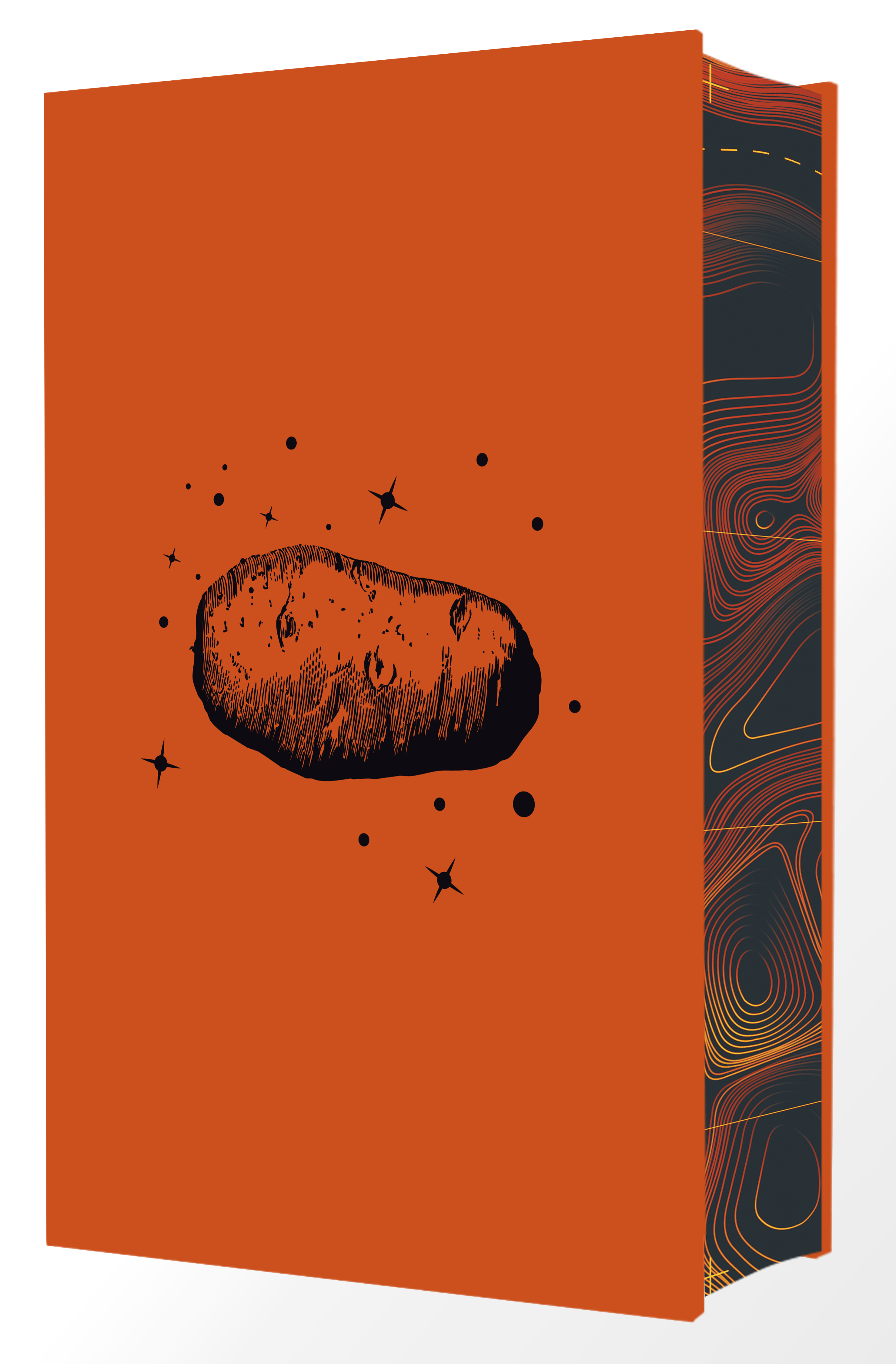
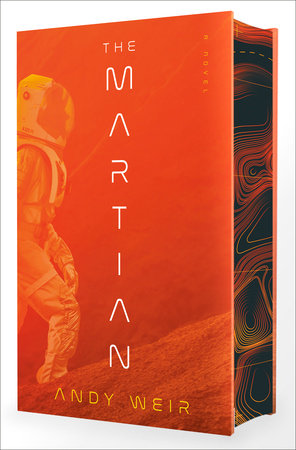
This hardcover edition celebrates the #1 New York Times bestseller that set our sights on Mars and inspired the major motion picture starring Matt Damon and Jessica Chastain, with special features including:

• Intricately designed sprayed edges
• New cover art on a deluxe jacket
• Full-color illustrated endpapers
• A custom-stamped case


A mission to Mars. A freak accident. One man’s struggle to survive. From the author of Project Hail Mary comes “a hugely entertaining novel that reads like a rocket ship afire” (Chicago Tribune).

“Brilliant . . . a celebration of human ingenuity [and] the purest example of real-science sci-fi for many years . . . utterly compelling.”—The Wall Street Journal

Six days ago, astronaut Mark Watney became one of the first people to walk on Mars.

Now, he’s sure he’ll be the first person to die there.

After a dust storm nearly kills him and forces his crew to evacuate while thinking him dead, Mark finds himself stranded and completely alone with no way to even signal Earth that he’s alive—and even if he could get word out, his supplies would be gone long before a rescue could arrive.

Chances are, though, he won’t have time to starve to death. The damaged machinery, unforgiving environment, or plain-old “human error” are much more likely to kill him first.

But Mark isn’t ready to give up yet. Drawing on his ingenuity, his engineering skills—and a relentless, dogged refusal to quit—he steadfastly confronts one seemingly insurmountable obstacle after the next. Will his resourcefulness be enough to overcome the impossible odds against him?

NAMED ONE OF PASTE’S BEST NOVELS OF THE DECADE

“A hugely entertaining novel [that] reads like a rocket ship afire . . . Weir has fashioned in Mark Watney one of the most appealing, funny, and resourceful characters in recent fiction.”Chicago Tribune

“As gripping as they come . . . You’ll be rooting for Watney the whole way, groaning at every setback and laughing at his pitchblack humor. Utterly nail-biting and memorable.”Financial Times
Chapter 1

LOG ENTRY: SOL 6

I’m pretty much f***ed.

That’s my considered opinion.

F***ed.

Six days into what should be the greatest two months of my life, and it’s turned into a nightmare.

I don’t even know who’ll read this. I guess someone will find it eventually. Maybe a hundred years from now.

For the record . . . I didn’t die on Sol 6. Certainly the rest of the crew thought I did, and I can’t blame them. Maybe there’ll be a day of national mourning for me, and my Wikipedia page will say, “Mark Watney is the only human being to have died on Mars.”

And it’ll be right, probably. ’Cause I’ll surely die here. Just not on Sol 6 when everyone thinks I did.

Let’s see . . . where do I begin?

The Ares Program. Mankind reaching out to Mars to send people to another planet for the very first time and expand the horizons of humanity blah, blah, blah. The Ares 1 crew did their thing and came back heroes. They got the parades and fame and love of the world.

Ares 2 did the same thing, in a different location on Mars. They got a firm handshake and a hot cup of coffee when they got home.

Ares 3. Well, that was my mission. Okay, not mine per se. Commander Lewis was in charge. I was just one of her crew. Actually, I was the very lowest ranked member of the crew. I would only be “in command” of the mission if I were the only remaining person.

What do you know? I’m in command.

I wonder if this log will be recovered before the rest of the crew die of old age. I presume they got back to Earth all right. Guys, if you’re reading this: It wasn’t your fault. You did what you had to do. In your position I would have done the same thing. I don’t blame you, and I’m glad you survived.


I guess I should explain how Mars missions work, for any layman who may be reading this. We got to Earth orbit the normal way, through an ordinary ship to Hermes. All the Ares missions use Hermes to get to and from Mars. It’s really big and cost a lot so NASA built only one.

Once we got to Hermes, four additional unmanned missions brought us fuel and supplies while we prepared for our trip. Once everything was a go, we set out for Mars. But not very fast. Gone are the days of heavy chemical fuel burns and trans-Mars injection orbits.

Hermes is powered by ion engines. They throw argon out the back of the ship really fast to get a tiny amount of acceleration. The thing is, it doesn’t take much reactant mass, so a little argon (and a nuclear reactor to power things) let us accelerate constantly the whole way there. You’d be amazed at how fast you can get going with a tiny acceleration over a long time.

I could regale you with tales of how we had great fun on the trip, but I won’t. I don’t feel like reliving it right now. Suffice it to say we got to Mars 124 days later without strangling each other.

From there, we took the MDV (Mars descent vehicle) to the surface. The MDV is basically a big can with some light thrusters and parachutes attached. Its sole purpose is to get six humans from Mars orbit to the surface without killing any of them.

And now we come to the real trick of Mars exploration: having all of our shit there in advance.

A total of fourteen unmanned missions deposited everything we would need for surface operations. They tried their best to land all the supply vessels in the same general area, and did a reasonably good job. Supplies aren’t nearly so fragile as humans and can hit the ground really hard. But they tend to bounce around a lot.

Naturally, they didn’t send us to Mars until they’d confirmed that all the supplies had made it to the surface and their containers weren’t breached. Start to finish, including supply missions, a Mars mission takes about three years. In fact, there were Ares 3 supplies en route to Mars while the Ares 2 crew were on their way home.

The most important piece of the advance supplies, of course, was the MAV. The Mars ascent vehicle. That was how we would get back to Hermes after surface operations were complete. The MAV was soft-landed (as opposed to the balloon bounce-fest the other supplies had). Of course, it was in constant communication with Houston, and if there had been any problems with it, we would have passed by Mars and gone home without ever landing.

The MAV is pretty cool. Turns out, through a neat set of chemical reactions with the Martian atmosphere, for every kilogram of hydrogen you bring to Mars, you can make thirteen kilograms of fuel. It’s a slow process, though. It takes twenty-four months to fill the tank. That’s why they sent it long before we got here.

You can imagine how disappointed I was when I discovered the MAV was gone.


It was a ridiculous sequence of events that led to me almost dying, and an even more ridiculous sequence that led to me surviving.

The mission is designed to handle sandstorm gusts up to 150 kph. So Houston got understandably nervous when we got whacked with 175 kph winds. We all got in our flight space suits and huddled in the middle of the Hab, just in case it lost pressure. But the Hab wasn’t the problem.

The MAV is a spaceship. It has a lot of delicate parts. It can put up with storms to a certain extent, but it can’t just get sandblasted forever. After an hour and a half of sustained wind, NASA gave the order to abort. Nobody wanted to stop a monthlong mission after only six days, but if the MAV took any more punishment, we’d all have gotten stranded down there.

We had to go out in the storm to get from the Hab to the MAV. That was going to be risky, but what choice did we have?

Everyone made it but me.

Our main communications dish, which relayed signals from the Hab to Hermes, acted like a parachute, getting torn from its foundation and carried with the torrent. Along the way, it crashed through the reception antenna array. Then one of those long thin antennae slammed into me end-first. It tore through my suit like a bullet through butter, and I felt the worst pain of my life as it ripped open my side. I vaguely remember having the wind knocked out of me (pulled out of me, really) and my ears popping painfully as the pressure of my suit escaped.

The last thing I remember was seeing Johanssen hopelessly reaching out toward me.


I awoke to the oxygen alarm in my suit. A steady, obnoxious beeping that eventually roused me from a deep and profound desire to just f***ing die.

The storm had abated; I was facedown, almost totally buried in sand. As I groggily came to, I wondered why I wasn’t more dead.

The antenna had enough force to punch through the suit and my side, but it had been stopped by my pelvis. So there was only one hole in the suit (and a hole in me, of course).

I had been knocked back quite a ways and rolled down a steep hill. Somehow I landed facedown, which forced the antenna to a strongly oblique angle that put a lot of torque on the hole in the suit. It made a weak seal.

Then, the copious blood from my wound trickled down toward the hole. As the blood reached the site of the breach, the water in it quickly evaporated from the airflow and low pressure, leaving a gunky residue behind. More blood came in behind it and was also reduced to gunk. Eventually, it sealed the gaps around the hole and reduced the leak to something the suit could counteract.

The suit did its job admirably. Sensing the drop in pressure, it constantly flooded itself with air from my nitrogen tank to equalize. Once the leak became manageable, it only had to trickle new air in slowly to relieve the air lost.

After a while, the CO2 (carbon dioxide) absorbers in the suit were expended. That’s really the limiting factor to life support. Not the amount of oxygen you bring with you, but the amount of CO2 you can remove. In the Hab, I have the oxygenator, a large piece of equipment that breaks apart CO2 to give the oxygen back. But the space suits have to be portable, so they use a simple chemical absorption process with expendable filters. I’d been asleep long enough that my filters were useless.

The suit saw this problem and moved into an emergency mode the engineers call “bloodletting.” Having no way to separate out the CO2, the suit deliberately vented air to the Martian atmosphere, then backfilled with nitrogen. Between the breach and the bloodletting, it quickly ran out of nitrogen. All it had left was my oxygen tank.

So it did the only thing it could to keep me alive. It started backfilling with pure oxygen. I now risked dying from oxygen toxicity, as the excessively high amount of oxygen threatened to burn up my nervous system, lungs, and eyes. An ironic death for someone with a leaky space suit: too much oxygen.

Every step of the way would have had beeping alarms, alerts, and warnings. But it was the high-oxygen warning that woke me.

The sheer volume of training for a space mission is astounding. I’d spent a week back on Earth practicing emergency space suit drills. I knew what to do.

Carefully reaching to the side of my helmet, I got the breach kit. It’s nothing more than a funnel with a valve at the small end and an unbelievably sticky resin on the wide end. The idea is you have the valve open and stick the wide end over a hole. The air can escape through the valve, so it doesn’t interfere with the resin making a good seal. Then you close the valve, and you’ve sealed the breach.
© Aubrie Pick
Andy Weir built a two-decade career as a software engineer until the success of his first published novel, The Martian, allowed him to live out his dream of writing full-time. He is a lifelong space nerd and a devoted hobbyist of such subjects as relativistic physics, orbital mechanics, and the history of manned spaceflight. He also mixes a mean cocktail. He lives in California. View titles by Andy Weir
additional book photo

About

This hardcover edition celebrates the #1 New York Times bestseller that set our sights on Mars and inspired the major motion picture starring Matt Damon and Jessica Chastain, with special features including:

• Intricately designed sprayed edges
• New cover art on a deluxe jacket
• Full-color illustrated endpapers
• A custom-stamped case


A mission to Mars. A freak accident. One man’s struggle to survive. From the author of Project Hail Mary comes “a hugely entertaining novel that reads like a rocket ship afire” (Chicago Tribune).

“Brilliant . . . a celebration of human ingenuity [and] the purest example of real-science sci-fi for many years . . . utterly compelling.”—The Wall Street Journal

Six days ago, astronaut Mark Watney became one of the first people to walk on Mars.

Now, he’s sure he’ll be the first person to die there.

After a dust storm nearly kills him and forces his crew to evacuate while thinking him dead, Mark finds himself stranded and completely alone with no way to even signal Earth that he’s alive—and even if he could get word out, his supplies would be gone long before a rescue could arrive.

Chances are, though, he won’t have time to starve to death. The damaged machinery, unforgiving environment, or plain-old “human error” are much more likely to kill him first.

But Mark isn’t ready to give up yet. Drawing on his ingenuity, his engineering skills—and a relentless, dogged refusal to quit—he steadfastly confronts one seemingly insurmountable obstacle after the next. Will his resourcefulness be enough to overcome the impossible odds against him?

NAMED ONE OF PASTE’S BEST NOVELS OF THE DECADE

“A hugely entertaining novel [that] reads like a rocket ship afire . . . Weir has fashioned in Mark Watney one of the most appealing, funny, and resourceful characters in recent fiction.”Chicago Tribune

“As gripping as they come . . . You’ll be rooting for Watney the whole way, groaning at every setback and laughing at his pitchblack humor. Utterly nail-biting and memorable.”Financial Times

Excerpt

Chapter 1

LOG ENTRY: SOL 6

I’m pretty much f***ed.

That’s my considered opinion.

F***ed.

Six days into what should be the greatest two months of my life, and it’s turned into a nightmare.

I don’t even know who’ll read this. I guess someone will find it eventually. Maybe a hundred years from now.

For the record . . . I didn’t die on Sol 6. Certainly the rest of the crew thought I did, and I can’t blame them. Maybe there’ll be a day of national mourning for me, and my Wikipedia page will say, “Mark Watney is the only human being to have died on Mars.”

And it’ll be right, probably. ’Cause I’ll surely die here. Just not on Sol 6 when everyone thinks I did.

Let’s see . . . where do I begin?

The Ares Program. Mankind reaching out to Mars to send people to another planet for the very first time and expand the horizons of humanity blah, blah, blah. The Ares 1 crew did their thing and came back heroes. They got the parades and fame and love of the world.

Ares 2 did the same thing, in a different location on Mars. They got a firm handshake and a hot cup of coffee when they got home.

Ares 3. Well, that was my mission. Okay, not mine per se. Commander Lewis was in charge. I was just one of her crew. Actually, I was the very lowest ranked member of the crew. I would only be “in command” of the mission if I were the only remaining person.

What do you know? I’m in command.

I wonder if this log will be recovered before the rest of the crew die of old age. I presume they got back to Earth all right. Guys, if you’re reading this: It wasn’t your fault. You did what you had to do. In your position I would have done the same thing. I don’t blame you, and I’m glad you survived.


I guess I should explain how Mars missions work, for any layman who may be reading this. We got to Earth orbit the normal way, through an ordinary ship to Hermes. All the Ares missions use Hermes to get to and from Mars. It’s really big and cost a lot so NASA built only one.

Once we got to Hermes, four additional unmanned missions brought us fuel and supplies while we prepared for our trip. Once everything was a go, we set out for Mars. But not very fast. Gone are the days of heavy chemical fuel burns and trans-Mars injection orbits.

Hermes is powered by ion engines. They throw argon out the back of the ship really fast to get a tiny amount of acceleration. The thing is, it doesn’t take much reactant mass, so a little argon (and a nuclear reactor to power things) let us accelerate constantly the whole way there. You’d be amazed at how fast you can get going with a tiny acceleration over a long time.

I could regale you with tales of how we had great fun on the trip, but I won’t. I don’t feel like reliving it right now. Suffice it to say we got to Mars 124 days later without strangling each other.

From there, we took the MDV (Mars descent vehicle) to the surface. The MDV is basically a big can with some light thrusters and parachutes attached. Its sole purpose is to get six humans from Mars orbit to the surface without killing any of them.

And now we come to the real trick of Mars exploration: having all of our shit there in advance.

A total of fourteen unmanned missions deposited everything we would need for surface operations. They tried their best to land all the supply vessels in the same general area, and did a reasonably good job. Supplies aren’t nearly so fragile as humans and can hit the ground really hard. But they tend to bounce around a lot.

Naturally, they didn’t send us to Mars until they’d confirmed that all the supplies had made it to the surface and their containers weren’t breached. Start to finish, including supply missions, a Mars mission takes about three years. In fact, there were Ares 3 supplies en route to Mars while the Ares 2 crew were on their way home.

The most important piece of the advance supplies, of course, was the MAV. The Mars ascent vehicle. That was how we would get back to Hermes after surface operations were complete. The MAV was soft-landed (as opposed to the balloon bounce-fest the other supplies had). Of course, it was in constant communication with Houston, and if there had been any problems with it, we would have passed by Mars and gone home without ever landing.

The MAV is pretty cool. Turns out, through a neat set of chemical reactions with the Martian atmosphere, for every kilogram of hydrogen you bring to Mars, you can make thirteen kilograms of fuel. It’s a slow process, though. It takes twenty-four months to fill the tank. That’s why they sent it long before we got here.

You can imagine how disappointed I was when I discovered the MAV was gone.


It was a ridiculous sequence of events that led to me almost dying, and an even more ridiculous sequence that led to me surviving.

The mission is designed to handle sandstorm gusts up to 150 kph. So Houston got understandably nervous when we got whacked with 175 kph winds. We all got in our flight space suits and huddled in the middle of the Hab, just in case it lost pressure. But the Hab wasn’t the problem.

The MAV is a spaceship. It has a lot of delicate parts. It can put up with storms to a certain extent, but it can’t just get sandblasted forever. After an hour and a half of sustained wind, NASA gave the order to abort. Nobody wanted to stop a monthlong mission after only six days, but if the MAV took any more punishment, we’d all have gotten stranded down there.

We had to go out in the storm to get from the Hab to the MAV. That was going to be risky, but what choice did we have?

Everyone made it but me.

Our main communications dish, which relayed signals from the Hab to Hermes, acted like a parachute, getting torn from its foundation and carried with the torrent. Along the way, it crashed through the reception antenna array. Then one of those long thin antennae slammed into me end-first. It tore through my suit like a bullet through butter, and I felt the worst pain of my life as it ripped open my side. I vaguely remember having the wind knocked out of me (pulled out of me, really) and my ears popping painfully as the pressure of my suit escaped.

The last thing I remember was seeing Johanssen hopelessly reaching out toward me.


I awoke to the oxygen alarm in my suit. A steady, obnoxious beeping that eventually roused me from a deep and profound desire to just f***ing die.

The storm had abated; I was facedown, almost totally buried in sand. As I groggily came to, I wondered why I wasn’t more dead.

The antenna had enough force to punch through the suit and my side, but it had been stopped by my pelvis. So there was only one hole in the suit (and a hole in me, of course).

I had been knocked back quite a ways and rolled down a steep hill. Somehow I landed facedown, which forced the antenna to a strongly oblique angle that put a lot of torque on the hole in the suit. It made a weak seal.

Then, the copious blood from my wound trickled down toward the hole. As the blood reached the site of the breach, the water in it quickly evaporated from the airflow and low pressure, leaving a gunky residue behind. More blood came in behind it and was also reduced to gunk. Eventually, it sealed the gaps around the hole and reduced the leak to something the suit could counteract.

The suit did its job admirably. Sensing the drop in pressure, it constantly flooded itself with air from my nitrogen tank to equalize. Once the leak became manageable, it only had to trickle new air in slowly to relieve the air lost.

After a while, the CO2 (carbon dioxide) absorbers in the suit were expended. That’s really the limiting factor to life support. Not the amount of oxygen you bring with you, but the amount of CO2 you can remove. In the Hab, I have the oxygenator, a large piece of equipment that breaks apart CO2 to give the oxygen back. But the space suits have to be portable, so they use a simple chemical absorption process with expendable filters. I’d been asleep long enough that my filters were useless.

The suit saw this problem and moved into an emergency mode the engineers call “bloodletting.” Having no way to separate out the CO2, the suit deliberately vented air to the Martian atmosphere, then backfilled with nitrogen. Between the breach and the bloodletting, it quickly ran out of nitrogen. All it had left was my oxygen tank.

So it did the only thing it could to keep me alive. It started backfilling with pure oxygen. I now risked dying from oxygen toxicity, as the excessively high amount of oxygen threatened to burn up my nervous system, lungs, and eyes. An ironic death for someone with a leaky space suit: too much oxygen.

Every step of the way would have had beeping alarms, alerts, and warnings. But it was the high-oxygen warning that woke me.

The sheer volume of training for a space mission is astounding. I’d spent a week back on Earth practicing emergency space suit drills. I knew what to do.

Carefully reaching to the side of my helmet, I got the breach kit. It’s nothing more than a funnel with a valve at the small end and an unbelievably sticky resin on the wide end. The idea is you have the valve open and stick the wide end over a hole. The air can escape through the valve, so it doesn’t interfere with the resin making a good seal. Then you close the valve, and you’ve sealed the breach.

Author

© Aubrie Pick
Andy Weir built a two-decade career as a software engineer until the success of his first published novel, The Martian, allowed him to live out his dream of writing full-time. He is a lifelong space nerd and a devoted hobbyist of such subjects as relativistic physics, orbital mechanics, and the history of manned spaceflight. He also mixes a mean cocktail. He lives in California. View titles by Andy Weir

Photos

additional book photo

Books for Asian American, Native Hawaiian, and Pacific Islander Heritage Month

Each May, we honor the stories, histories, and cultures of Asian Americans, Native Hawaiians, and Pacific Islanders. Below is a selection of acclaimed fiction and nonfiction books by AANHPI creators to share with your students this month and throughout the year. Find our full collection of titles for Higher Education here.

Read more