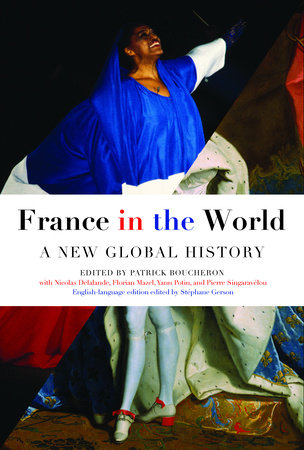
France in the World

A New Global History

Look inside
Paperback
$38.99 US
On sale Apr 09, 2019 | 992 Pages | 9781590519417

See Additional Formats
This dynamic collection presents a new way of writing national and global histories while developing our understanding of France in the world through short, provocative essays that range from prehistoric frescoes to Coco Chanel to the terrorist attacks of 2015.

Bringing together an impressive group of established and up-and-coming historians, this bestselling history conceives of France not as a fixed, rooted entity, but instead as a place and an idea in flux, moving beyond all borders and frontiers, shaped by exchanges and mixtures. Presented in chronological order from 34,000 BC to 2015, each chapter covers a significant year from its own particular angle--the marriage of a Viking leader to a Carolingian princess proposed by Charles the Fat in 882, the Persian embassy's reception at the court of Louis XIV in 1715, the Chilean coup d'état against President Salvador Allende in 1973 that mobilized a generation of French left-wing activists.

France in the World combines the intellectual rigor of an academic work with the liveliness and readability of popular history. With a brand-new preface aimed at an international audience, this English-language edition will be an essential resource for Francophiles and scholars alike.
PREFACE TO THE ENGLISH-LANGUAGE EDITION

Stéphane Gerson
 
This is an urgent book.
The world in which we live is saturated with history — in reenactments, themed video games, cable shows, books about our national history (or at least some aspects of it). And yet, this public appetite is often fed by media-savvy journalists or politicians and ideologues whose fast-paced, anecdote-rich sentimental sagas meld fact and fiction while appealing to the emotions. Rarely do they engage with the past in a serious, critical manner. For this, for guidance on how to situate ourselves in an unstable world, we need historians — not only in our universities, but in the public realm as well.
In 1931, the president of the American Historical Association, Carl Becker, reminded his colleagues that their “proper function is not to repeat the past but to make use of it, to correct and rationalize for common use Mr. Everyman’s mythological adaptation of what actually happened.” In a more recent History Manifesto (2014), Jo Guldi and David Armitage urged their fellow historians to explain large historical processes and small events in terms all of us can understand. This task, they said, should not be farmed out to economists and journalists. History has “a power to liberate” — from, for example, false notions about climate change or national destiny.
While some historians concur, others are reticent, or else too timid to write in a new key. Current attacks on truth and expert knowledge make this a pressing matter — and not just in the US. Consider France. 
For a long time, French historians were public intellectuals, making their voices heard in books, magazines, newspapers, and later on TV and radio. From Jules Michelet in the nineteenth century to Jacques Le Goff and Emmanuel Le Roy Ladurie after World War II, and later Michelle Perrot, historians rendered their craft topical and enthralling for a wide readership.
But things have changed in recent decades. Book sales have declined; the mass media have grown less welcoming; academic historians have been accused of writing a convoluted history, neglecting chronology, and in some cases not loving their country enough. Journalists, essayists, and even film actors have filled this void in recent years, appointing themselves curators of the roman national, a national narrative with which French citizens can identify. The mournful, nostalgic story they typically tell is one of loss and decline, in which national identity must battle immigration, multiculturalism, Islam, feminism, and “declining” school standards. Salvation rests upon a return to imagined origins.
In 2017, a collective of French historians responded to these developments by publishing a non-nationalist history of the nation. Histoire mondiale de la France, or France in the World: A New Global History, makes a deceptively strong statement: historians have a distinctive contribution to make to our public debates and collective self-understanding. The book was an instant success, “the literary phenomenon of the year” (in the words of one newsmagazine), with more than 110,000 copies sold. In newspapers and magazines, on TV and radio, commentators celebrated a work that, as one of them put it, “is good news for those among us who yearn for new pathways into the past of our dear old country.” Fellow historians agreed, lauding an “immense collection of knowledge and analysis” whose wide-ranging curiosity made it, they said, an “enemy of the tragic.” In other countries, France in the World provided a blueprint for histories that, while investigating the past, unravel contemporary notions we deem self-evident. Similar global histories of Italy, the Netherlands, Catalonia, Flanders, and Spain quickly followed — or will in the near future.
 
The book’s lead editor, Patrick Boucheron, is a specialist in late-medieval Italian history, a professor at the prestigious Collège de France, and the editor of, among other books, Histoire du monde au XVe siècle (History of the World in the Fifteenth Century). He also belongs to a generation of French historians who seek to recover the public role, the civic engagement of their predecessors — not as grand intellectuals who, like Jean-Paul Sartre, share their views on all issues, but rather as measured commentators who bring their expertise to bear on specific questions. In order to reach a broader readership, these historians are consulting on historical TV shows, participating in theater festivals, and writing threads about history on Twitter. They are also experimenting with graphic novels, memoirs, and other unconventional forms of historical writing.
France in the World is one such experiment, bold in its scope and its commitment to scholarship coupled with freedom and formal creativity. Patrick Boucheron and his four coeditors made several key decisions at the outset. They organized the book as a series of essays about 146 dates in the history of France, each one distilling the latest scholarship while avoiding jargon and footnotes. Ranging from 34,000 bce to 2015, these essays either explore turning points, such as Charlem- agne’s coronation in 800 or the May 1968 civil unrest, or else delve into less momentous yet still telling events, such as the draining of a Languedoc pond in 1247. “Some rare events are like glimmers of light in the darkness,” Antony Hostein writes in his essay on Gauls in the Roman Senate (48 ce). “Illuminated by a few extraordinary accounts telling of singular lives and exploits, they reveal truly significant historical occurrences.”
The editors invited dozens of historians to write these essays, and few turned them down. The members of this collective represent a multitude of historical specialties, from the Middle Ages to the contemporary era, archaeology to technology, law to finance, gender to cinema. The book thus invites readers to learn about states, wars, expeditions, and peace treaties, as we would expect, but also about diseases and penal colonies, canals and promenades, fashion and perfume, museums and best sellers, swindles and engineering feats. Generals and politicians, aristocrats and bureaucrats comingle with cave dwellers and textile traders, novelists and feminists, soccer players and philosophers, vagrants and immigrants, all of them protagonists in a variegated history.
The editors provided the contributors with considerable latitude, inviting them to select their own points of departure. History does not correspond to a single outlook, an all-knowing stance, pinpointing truth from its lofty heights. Instead, these multiple perspectives make it clear that the past becomes history through the questions we pose and the methods we fashion. “[I]t is not historical material that shapes interpretations,” Pierre Monnet writes in his essay on the 1214 Battle of Bouvines, “but rather the historian’s questions that shape historical material. And these questions are far from exhausted.” France in the World opens up the historian’s workshop, drawing attention to craft and sources, to doubts and choices and the debates that advance knowledge.
The editors also urged the contributors to embrace a free, welcoming language, to avail themselves of “all the resources of storytelling, of analysis, contextualization, exemplification.” Patrick Boucheron has long pushed his fellow historians toward “audacity and creativity and perhaps also greater confidence in the powers of language.” Literary, even poetic historical writing opens up common language by unsettling what seems familiar and breathing life into “the textures of the past.” And so, the essays in France in the World take different forms: narrative descriptions, direct addresses to the reader, slightly ironic glosses, political asides on the past and the present.
I want to emphasize the plural — resources, powers, contours of language — for the editors grant us — the readers — as much freedom and, therefore, as much trust and responsibility as they do the contributors. They encourage us to trace our own itineraries across the past, to read diagonally through time and the conventional periods that govern our vision of history. Begin at the beginning, or in the middle if you prefer, and see where you end up. By neglecting key dates (say, the 1916 Battle of Verdun) and adding others that may seem inconsequential, by granting the same number of words to Coco Chanel as to Charlemagne, they are telling us that all planes of history are equally revealing, that all historical actors deserve attention. Hierarchies exist, of course, but do not expect to find one ready-made in this book. It falls upon us, as attentive readers and critical thinkers, to create meaning out of the apparent chaos of history. France in the World is thus a political book if one understands politics not as the partisan reading of evidence or the explicit embrace of party positions, but instead as the deployment of reason against despair. The book is also political in its central question: What does it mean to belong to a nation in our globalized yet nationalistic world?
This question carried particular resonance during the book’s gestation in 2015 and 2016 — so much so that France in the World may already be read as a historical artifact, a trace of the contemporary past, a source for future histories of our troubled times. France’s annus horribilis of 2015 began with terrorist attacks in several Parisian locations, including the offices of the satirical weekly Charlie Hebdo and a kosher grocery store, and ended with yet bloodier assaults on the Bataclan concert hall and other targets. On January 11, dozens of heads of state traveled to Paris to reaffirm their commitment to political values — the rights of man, freedom of expression — that have long been linked to France. This gathering raised a new set of questions: Does France still live up to these ideals? What exactly does the country represent nowadays? What do the French want it to represent at this complicated juncture in the country’s history?
“A kaleidoscopic anthology of brief, vivid essays considering French culture from prehistoric times to today.” —New York Times Book Review

“Boucheron presents French history as a product of diverse ethnic and geographical influences.” —New York Times Magazine

“A major work, exhaustive, controversial and fresh—and entirely relevant to Anglophone readers…[France in the World’s authors] deploy literary verve and narrative skill.” —The Guardian

“This provocative history of France cover[s] a striking array of topics…The aim of this disparateness is to replace a nationalist narrative of linear progression, from the Gauls to now, with a web of surprising transnational connections.” —The New Yorker

“After several decades of somnolence, academic history is a hit…[France in the World] marks the arrival of a new generation of historians, full of energy and élan…in hooking essays onto events, [this collection] forces the reader to see the past from a different perspective, one that is not merely global but also connected with current issues.” —Robert Darnton, New York Review of Books

“An eclectic and forward-looking history…engaging…Patrick Boucheron and his merry band of historians have succeeded in putting more dynamic and inclusive…visions of Frenchness back into the limelight…their bracing scholarship looks set to shape the agenda of historical research and civic debate in France for years to come.” —Times Literary Supplement

“Traditional readings of French history are challenged in this fascinating, often provocative collection…entertaining and grounded in good scholarship…Its translation deserves a wide readership in the anglophone world.” —Financial Times

“Lively…The book is meant to serve as a reaction to the idea that there exists a single version of French history, and…it’s hard to argue, both on the virtue of the book’s content and also the success of it, that it hasn’t succeeded in making that argument.” —TIME

“Boucheron shines a refreshing new light on the history of France.” —France-Amérique

“A most inviting entree to the breadth of French history…Approachable and entertaining, yet academically driven, France in the World is written by historians intent on helping readers make use of France’s singular past.” —Foreword Reviews

“From Charles the Fat to Coco Chanel, France in the World manages to be both entertaining and encyclopedic. Diderot would approve.” —Sue Prideaux, author of I Am Dynamite!: A Life of Nietzsche

“How often does one come upon a book produced by dozens of authors covering centuries that is absolutely a joy to read! This collection of essays reframes French history by expanding historical time from the arrival of humans in ‘France’ long before there is a France. The consistency of style and talent is stunning—to say nothing of the rich content. One can read this book front to back, or by choosing topics from its rich table of contents. Each ‘chapter’ is at once stand-alone and an element in the narrative of a truly longue durée.” —Thomas Bender, author of A Nation Among Nations: America’s Place in World History

“We often say that ‘the past is a foreign country.’ France in the World brilliantly shows us that understanding the past of any country requires insistent rethinking of what ‘foreign’ means. The histories in this collection render visible the often starkly political reasons certain minor distinctions are transformed into forbidding walls. Boucheron and company have pioneered an approach to ‘French’ history that we—from the other side of the Atlantic or the Channel—need in order to understand the world in which we live and comprehend how we got here.” —Todd Shepard, author of The Invention of Decolonization: The Algerian War and the Remaking of France

France in the World offers fascinating insights into the ways a nation is shaped by borders and gateways, by the perspectives of its citizens and peoples throughout the world. This wonderful new English translation has much to teach us not only about French history, but about our own as well.” —Tyler Stovall, author of Paris Noir: African Americans in the City of Light

France in the World pushes against the traditional narrative of an ‘eternal France’ as a linear path of national development, from the Gauls to the Revolution and beyond. Instead, this inclusive history shows how much what we call ‘France’ has been molded by interactions with the world. By recovering this longue durée diversity, it offers both hope and suggestions for how to think about France’s continued dynamism.” —Emmanuelle Saada, author of Empire’s Children: Race, Filiation, and Citizenship in the French Colonies

“This sweeping, ambitious volume explores France’s place in the world from the dawn of humanity to the twenty-first century. Rather than a superficial overview of French history, the book offers dozens of in-depth snapshots of key moments that shaped both France and its relationship to the wider world. Beautifully translated from the original French, France in the World will be of profound interest to readers of French history and world history, revealing the events and forces that have made the two inextricably linked.” —Brett Rushforth, author of Bonds of Alliance: Indigenous and Atlantic Slaveries in New France

About

This dynamic collection presents a new way of writing national and global histories while developing our understanding of France in the world through short, provocative essays that range from prehistoric frescoes to Coco Chanel to the terrorist attacks of 2015.

Bringing together an impressive group of established and up-and-coming historians, this bestselling history conceives of France not as a fixed, rooted entity, but instead as a place and an idea in flux, moving beyond all borders and frontiers, shaped by exchanges and mixtures. Presented in chronological order from 34,000 BC to 2015, each chapter covers a significant year from its own particular angle--the marriage of a Viking leader to a Carolingian princess proposed by Charles the Fat in 882, the Persian embassy's reception at the court of Louis XIV in 1715, the Chilean coup d'état against President Salvador Allende in 1973 that mobilized a generation of French left-wing activists.

France in the World combines the intellectual rigor of an academic work with the liveliness and readability of popular history. With a brand-new preface aimed at an international audience, this English-language edition will be an essential resource for Francophiles and scholars alike.

Excerpt

PREFACE TO THE ENGLISH-LANGUAGE EDITION

Stéphane Gerson
 
This is an urgent book.
The world in which we live is saturated with history — in reenactments, themed video games, cable shows, books about our national history (or at least some aspects of it). And yet, this public appetite is often fed by media-savvy journalists or politicians and ideologues whose fast-paced, anecdote-rich sentimental sagas meld fact and fiction while appealing to the emotions. Rarely do they engage with the past in a serious, critical manner. For this, for guidance on how to situate ourselves in an unstable world, we need historians — not only in our universities, but in the public realm as well.
In 1931, the president of the American Historical Association, Carl Becker, reminded his colleagues that their “proper function is not to repeat the past but to make use of it, to correct and rationalize for common use Mr. Everyman’s mythological adaptation of what actually happened.” In a more recent History Manifesto (2014), Jo Guldi and David Armitage urged their fellow historians to explain large historical processes and small events in terms all of us can understand. This task, they said, should not be farmed out to economists and journalists. History has “a power to liberate” — from, for example, false notions about climate change or national destiny.
While some historians concur, others are reticent, or else too timid to write in a new key. Current attacks on truth and expert knowledge make this a pressing matter — and not just in the US. Consider France. 
For a long time, French historians were public intellectuals, making their voices heard in books, magazines, newspapers, and later on TV and radio. From Jules Michelet in the nineteenth century to Jacques Le Goff and Emmanuel Le Roy Ladurie after World War II, and later Michelle Perrot, historians rendered their craft topical and enthralling for a wide readership.
But things have changed in recent decades. Book sales have declined; the mass media have grown less welcoming; academic historians have been accused of writing a convoluted history, neglecting chronology, and in some cases not loving their country enough. Journalists, essayists, and even film actors have filled this void in recent years, appointing themselves curators of the roman national, a national narrative with which French citizens can identify. The mournful, nostalgic story they typically tell is one of loss and decline, in which national identity must battle immigration, multiculturalism, Islam, feminism, and “declining” school standards. Salvation rests upon a return to imagined origins.
In 2017, a collective of French historians responded to these developments by publishing a non-nationalist history of the nation. Histoire mondiale de la France, or France in the World: A New Global History, makes a deceptively strong statement: historians have a distinctive contribution to make to our public debates and collective self-understanding. The book was an instant success, “the literary phenomenon of the year” (in the words of one newsmagazine), with more than 110,000 copies sold. In newspapers and magazines, on TV and radio, commentators celebrated a work that, as one of them put it, “is good news for those among us who yearn for new pathways into the past of our dear old country.” Fellow historians agreed, lauding an “immense collection of knowledge and analysis” whose wide-ranging curiosity made it, they said, an “enemy of the tragic.” In other countries, France in the World provided a blueprint for histories that, while investigating the past, unravel contemporary notions we deem self-evident. Similar global histories of Italy, the Netherlands, Catalonia, Flanders, and Spain quickly followed — or will in the near future.
 
The book’s lead editor, Patrick Boucheron, is a specialist in late-medieval Italian history, a professor at the prestigious Collège de France, and the editor of, among other books, Histoire du monde au XVe siècle (History of the World in the Fifteenth Century). He also belongs to a generation of French historians who seek to recover the public role, the civic engagement of their predecessors — not as grand intellectuals who, like Jean-Paul Sartre, share their views on all issues, but rather as measured commentators who bring their expertise to bear on specific questions. In order to reach a broader readership, these historians are consulting on historical TV shows, participating in theater festivals, and writing threads about history on Twitter. They are also experimenting with graphic novels, memoirs, and other unconventional forms of historical writing.
France in the World is one such experiment, bold in its scope and its commitment to scholarship coupled with freedom and formal creativity. Patrick Boucheron and his four coeditors made several key decisions at the outset. They organized the book as a series of essays about 146 dates in the history of France, each one distilling the latest scholarship while avoiding jargon and footnotes. Ranging from 34,000 bce to 2015, these essays either explore turning points, such as Charlem- agne’s coronation in 800 or the May 1968 civil unrest, or else delve into less momentous yet still telling events, such as the draining of a Languedoc pond in 1247. “Some rare events are like glimmers of light in the darkness,” Antony Hostein writes in his essay on Gauls in the Roman Senate (48 ce). “Illuminated by a few extraordinary accounts telling of singular lives and exploits, they reveal truly significant historical occurrences.”
The editors invited dozens of historians to write these essays, and few turned them down. The members of this collective represent a multitude of historical specialties, from the Middle Ages to the contemporary era, archaeology to technology, law to finance, gender to cinema. The book thus invites readers to learn about states, wars, expeditions, and peace treaties, as we would expect, but also about diseases and penal colonies, canals and promenades, fashion and perfume, museums and best sellers, swindles and engineering feats. Generals and politicians, aristocrats and bureaucrats comingle with cave dwellers and textile traders, novelists and feminists, soccer players and philosophers, vagrants and immigrants, all of them protagonists in a variegated history.
The editors provided the contributors with considerable latitude, inviting them to select their own points of departure. History does not correspond to a single outlook, an all-knowing stance, pinpointing truth from its lofty heights. Instead, these multiple perspectives make it clear that the past becomes history through the questions we pose and the methods we fashion. “[I]t is not historical material that shapes interpretations,” Pierre Monnet writes in his essay on the 1214 Battle of Bouvines, “but rather the historian’s questions that shape historical material. And these questions are far from exhausted.” France in the World opens up the historian’s workshop, drawing attention to craft and sources, to doubts and choices and the debates that advance knowledge.
The editors also urged the contributors to embrace a free, welcoming language, to avail themselves of “all the resources of storytelling, of analysis, contextualization, exemplification.” Patrick Boucheron has long pushed his fellow historians toward “audacity and creativity and perhaps also greater confidence in the powers of language.” Literary, even poetic historical writing opens up common language by unsettling what seems familiar and breathing life into “the textures of the past.” And so, the essays in France in the World take different forms: narrative descriptions, direct addresses to the reader, slightly ironic glosses, political asides on the past and the present.
I want to emphasize the plural — resources, powers, contours of language — for the editors grant us — the readers — as much freedom and, therefore, as much trust and responsibility as they do the contributors. They encourage us to trace our own itineraries across the past, to read diagonally through time and the conventional periods that govern our vision of history. Begin at the beginning, or in the middle if you prefer, and see where you end up. By neglecting key dates (say, the 1916 Battle of Verdun) and adding others that may seem inconsequential, by granting the same number of words to Coco Chanel as to Charlemagne, they are telling us that all planes of history are equally revealing, that all historical actors deserve attention. Hierarchies exist, of course, but do not expect to find one ready-made in this book. It falls upon us, as attentive readers and critical thinkers, to create meaning out of the apparent chaos of history. France in the World is thus a political book if one understands politics not as the partisan reading of evidence or the explicit embrace of party positions, but instead as the deployment of reason against despair. The book is also political in its central question: What does it mean to belong to a nation in our globalized yet nationalistic world?
This question carried particular resonance during the book’s gestation in 2015 and 2016 — so much so that France in the World may already be read as a historical artifact, a trace of the contemporary past, a source for future histories of our troubled times. France’s annus horribilis of 2015 began with terrorist attacks in several Parisian locations, including the offices of the satirical weekly Charlie Hebdo and a kosher grocery store, and ended with yet bloodier assaults on the Bataclan concert hall and other targets. On January 11, dozens of heads of state traveled to Paris to reaffirm their commitment to political values — the rights of man, freedom of expression — that have long been linked to France. This gathering raised a new set of questions: Does France still live up to these ideals? What exactly does the country represent nowadays? What do the French want it to represent at this complicated juncture in the country’s history?

Praise

“A kaleidoscopic anthology of brief, vivid essays considering French culture from prehistoric times to today.” —New York Times Book Review

“Boucheron presents French history as a product of diverse ethnic and geographical influences.” —New York Times Magazine

“A major work, exhaustive, controversial and fresh—and entirely relevant to Anglophone readers…[France in the World’s authors] deploy literary verve and narrative skill.” —The Guardian

“This provocative history of France cover[s] a striking array of topics…The aim of this disparateness is to replace a nationalist narrative of linear progression, from the Gauls to now, with a web of surprising transnational connections.” —The New Yorker

“After several decades of somnolence, academic history is a hit…[France in the World] marks the arrival of a new generation of historians, full of energy and élan…in hooking essays onto events, [this collection] forces the reader to see the past from a different perspective, one that is not merely global but also connected with current issues.” —Robert Darnton, New York Review of Books

“An eclectic and forward-looking history…engaging…Patrick Boucheron and his merry band of historians have succeeded in putting more dynamic and inclusive…visions of Frenchness back into the limelight…their bracing scholarship looks set to shape the agenda of historical research and civic debate in France for years to come.” —Times Literary Supplement

“Traditional readings of French history are challenged in this fascinating, often provocative collection…entertaining and grounded in good scholarship…Its translation deserves a wide readership in the anglophone world.” —Financial Times

“Lively…The book is meant to serve as a reaction to the idea that there exists a single version of French history, and…it’s hard to argue, both on the virtue of the book’s content and also the success of it, that it hasn’t succeeded in making that argument.” —TIME

“Boucheron shines a refreshing new light on the history of France.” —France-Amérique

“A most inviting entree to the breadth of French history…Approachable and entertaining, yet academically driven, France in the World is written by historians intent on helping readers make use of France’s singular past.” —Foreword Reviews

“From Charles the Fat to Coco Chanel, France in the World manages to be both entertaining and encyclopedic. Diderot would approve.” —Sue Prideaux, author of I Am Dynamite!: A Life of Nietzsche

“How often does one come upon a book produced by dozens of authors covering centuries that is absolutely a joy to read! This collection of essays reframes French history by expanding historical time from the arrival of humans in ‘France’ long before there is a France. The consistency of style and talent is stunning—to say nothing of the rich content. One can read this book front to back, or by choosing topics from its rich table of contents. Each ‘chapter’ is at once stand-alone and an element in the narrative of a truly longue durée.” —Thomas Bender, author of A Nation Among Nations: America’s Place in World History

“We often say that ‘the past is a foreign country.’ France in the World brilliantly shows us that understanding the past of any country requires insistent rethinking of what ‘foreign’ means. The histories in this collection render visible the often starkly political reasons certain minor distinctions are transformed into forbidding walls. Boucheron and company have pioneered an approach to ‘French’ history that we—from the other side of the Atlantic or the Channel—need in order to understand the world in which we live and comprehend how we got here.” —Todd Shepard, author of The Invention of Decolonization: The Algerian War and the Remaking of France

France in the World offers fascinating insights into the ways a nation is shaped by borders and gateways, by the perspectives of its citizens and peoples throughout the world. This wonderful new English translation has much to teach us not only about French history, but about our own as well.” —Tyler Stovall, author of Paris Noir: African Americans in the City of Light

France in the World pushes against the traditional narrative of an ‘eternal France’ as a linear path of national development, from the Gauls to the Revolution and beyond. Instead, this inclusive history shows how much what we call ‘France’ has been molded by interactions with the world. By recovering this longue durée diversity, it offers both hope and suggestions for how to think about France’s continued dynamism.” —Emmanuelle Saada, author of Empire’s Children: Race, Filiation, and Citizenship in the French Colonies

“This sweeping, ambitious volume explores France’s place in the world from the dawn of humanity to the twenty-first century. Rather than a superficial overview of French history, the book offers dozens of in-depth snapshots of key moments that shaped both France and its relationship to the wider world. Beautifully translated from the original French, France in the World will be of profound interest to readers of French history and world history, revealing the events and forces that have made the two inextricably linked.” —Brett Rushforth, author of Bonds of Alliance: Indigenous and Atlantic Slaveries in New France