Download high-resolution image
Listen to a clip from the audiobook
audio play button
0:00
0:00

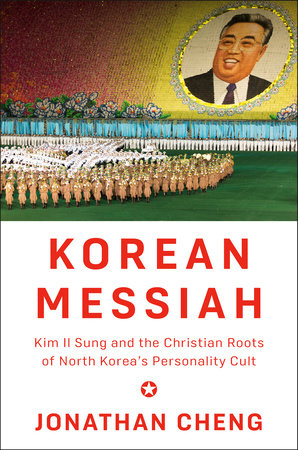
Korean Messiah

Kim Il Sung and the Christian Roots of North Korea's Personality Cult

Author Jonathan Cheng On Tour
Listen to a clip from the audiobook
audio play button
0:00
0:00
A landmark history of North Korea, told through the rise of the Kim dynasty and its surprising ties to American Christianity—a spectacular, penetrating account of the Hermit Kingdom • A Foreign Policy Most Anticipated Book of 2026

“How do personality cults take hold? What happens when leaders mix politics and faith to demand immense sacrifices? Jonathan Cheng’s magnificent tale poses questions about the world far beyond North Korea. This utterly eye-opening history deciphers a defining pattern of global politics in the 21st century.” —Evan Osnos, National Book Award-winning author of Age of Ambition: Chasing Fortune, Truth, and Faith in the New China

For nearly eight decades, North Korea has marched defiantly to its own beat, shaking off its Soviet and Chinese sponsors to emerge as the world’s most enigmatic nation—a nuclear-armed state ruled by a dictatorial dynasty. Underpinning the state is a personality cult more soaked in religiosity than those constructed by Stalin or Mao—one that traces its roots back to the Christian fervor of post–Civil War America.

Jonathan Cheng, the Wall Street Journal’s China bureau chief and former Korea bureau chief, takes us deep inside Pyongyang, a city once so dominated by Christianity that it was known as the “Jerusalem of the East.” Cheng introduces us to Samuel Moffett, a Presbyterian missionary from Madison, Indiana, who would venture into Pyongyang at the end of the nineteenth century and build a remarkable following—one that would include the Kim family that today presides over one of the world’s harshest persecutors of the Christian faith.

At the center of this story is North Korea’s founder, Kim Il Sung, son of two fervent Christians and progenitor of an ideology known as Kimilsungism, an exercise in idolatry that has elevated him, and his successor son and grandson, to Christlike status, from the humble manger where he was born to the subway seat on which the venerated leader once placed his posterior, cordoned off as if it were a religious relic.

Drawing on letters, diaries, and never-before-unearthed archival material that temper and often contradict the glorious historical record promoted by Kim Il Sung’s legions of hagiographers, Korean Messiah tells the true story of a country shrouded in fictions.
1

-

Farewell to Madison

RIVER TOWN

On a Sunday evening three weeks before Christmas in 1889, a young man stood up in front of the congregation at the First Presbyterian Church of Madison, Indiana, to tell his family and friends that he would soon be moving to an unfamiliar kingdom on the other side of the world.

Samuel A. Moffett, twenty-five years old, was a local boy, born and raised in this city of nine thousand on the banks of the Ohio River. Sammie’s father, Samuel S. Moffett, was an elder at First Presbyterian and proprietor of S.S. Moffett & Sons, a fixture on Main Street selling hosiery, gloves, buttons, and other dry goods. The elder Samuel Moffett, with ancestral roots in Scotland, was born and raised in Hagerstown, Maryland, where he was baptized in the local Presbyterian church and “polished the pew with his little breeches.” After being orphaned at age sixteen, Moffett senior headed out west, settling in Madison in 1847 and marrying the daughter of a wealthy saddlemaker.

Madison was a beautiful city, its wide boulevards, grand Italianate façades, and orderly gridlike layout hinting at grand aspirations. Samuel S. Moffett found community at First Presbyterian, where his long white beard and brood of five sons became as much a part of the church as its uncompromising brand of theology. Its pastors preached against the vices of the day—drinking, dancing, card-playing, and going to the horse races—reflecting the strict brand of Presbyterianism that had taken root across the American Midwest in the mid-nineteenth century. Selling textiles and other sundries had made the elder Samuel Moffett wealthy enough to retire early and devote his energies to the church, where he was an elder, deacon, and, for a quarter century, superintendent of the Sunday school. Two of his five boys would later be ordained as pastors, including his fourth son, Sammie, born in 1864 at the height of the Civil War.

“MINISTERIAL GROUP”

Sammie’s early letters hint at a lifelong curiosity about the world, religious faith, and his family roots. Sammie was tall and skinny, with a long face and a sincere disposition. Sermons and Sunday school were a fixture of his upbringing, though he also made time for baseball and was a lifelong devotee of tennis, exchanging forehands with his brothers at the Madison Tennis Club. After high school, Sammie studied chemistry at Hanover College, five miles down the road along the Ohio River. Hanover was a Presbyterian school, founded by staunch abolitionists and home to one of the U.S.’s first college campus Young Men’s Christian Association buildings. It was an idyllic place where the students could live “an enviable life,” in the words of one classmate, marred only by the thought that they would “soon have to leave these scenes of placid enjoyment.”

It was here that Moffett developed a reputation, along with his best friend William M. Baird, as a rather pious straight arrow, engrossing himself in prayer meetings and debating the finer points of biblical authority with his Sunday school teacher at nearby Hanover Presbyterian Church. Moffett’s and Baird’s upright demeanor made them firmly a part of Hanover’s “ministerial group,” though Sammie at least joined the Phi Gamma Delta fraternity, where photos captured the six-foot-one student looking skinny to the point of gaunt and less than convivial. After graduating in 1884 with a bachelor’s degree in chemistry—he was the salutatorian—Sammie stayed on at Hanover for an extra year to earn his master’s degree, which he hoped would open the way to a career as a pharmacist.

Before moving on, though, Sammie Moffett decided that he wanted something completely different: he wanted to become a foreign missionary. Moffett may have been aided in this conviction by his best friend Will Baird, who was named the class’s top orator and who was also making plans to devote his life to missionary work. Baird, too, came from a deeply Presbyterian family, in nearby Charlestown, Indiana, and his older brother taught Christian evidences and other subjects as a professor at Hanover College. Pastors at the Bairds’ childhood church, Charlestown Presbyterian Church, had long instilled in their congregants a belief in the responsibility of spreading Christ’s gospel around the world, and as early as 1873, the church had established a Woman’s Foreign Missionary Society to raise funds for evangelism in Persia, India, Laos, and Japan.

In the fall of 1885, these two earnest Hoosiers, Sam Moffett and Will Baird, shipped off to McCormick Theological Seminary, a training school for pastors on the North Side of Chicago, a city quickly earning renown as a Presbyterian stronghold. The seminary was named for Cyrus H. McCormick, a Virginia native who had become one of Chicago’s first industrial magnates—and, perhaps more importantly, an eager donor to Presbyterian causes, thus ensuring a conservative, missions-focused theology took root as the school grew to become America’s largest Presbyterian seminary.

Moffett and Baird arrived at McCormick at a moment when seminary leaders feared their strict adherence to the Bible was coming under assault as never before. As seminary faculty railed against secularism and other challenges to church teachings, Moffett and Baird attended daily morning prayer meetings and mandatory worship services. The seminarians found inspiration in Rev. Willis G. Craig, a scholar of church history who was so passionate about the newly opened mission field of Korea that he volunteered to give up his professorship and sail to the distant peninsula as a missionary, his eight children in tow, challenging Moffett, Baird, and their classmates to join him.

Perhaps as consequential was a visit to McCormick by Robert P. Wilder and John N. Forman, two recent Princeton University graduates who had developed a burning zeal to see the Christian gospel spread around the world. Standing before Moffett, Baird, and their classmates, Wilder and Forman, each born in India to American missionaries, spoke fervently about the urgency of devoting their lives to missions. By the end of their visit, Moffett, together with Baird and another classmate, Daniel L. Gifford, had signed the pledge that marked them as members of the Student Volunteer Movement for Foreign Missions: “We are willing and desirous, God permitting, to become foreign missionaries.”

The three young men couldn’t have known it at the time, but within four years, they would be living together on the other side of the planet, committing themselves to a cause that would change the fate of an ancient kingdom.

THE PLEDGE

All across America, Canada, Australia, and the United Kingdom, young men and women were signing the same pledge. For young American men like Sam Moffett and Will Baird, the 1870s and 1880s were characterized by a dramatic broadening of horizons. After the carnage of the Civil War and the euphoria of the country’s centennial, a newly confident United States—with its lightbulb, telegraph, and steam engine making it a commercial powerhouse—began asserting itself on the global stage.

Accompanying America’s growing economic and political clout was a new wave of missionary fervor—a spiritual twist on the notion of “manifest destiny,” the American belief in enlightened expansionism—led by Christian leaders like Dwight L. Moody, perhaps the greatest preacher of the nineteenth century. Moody, a rough-hewn farmer’s son whose rousing sermons and stadium-filling crusades would set the blueprint for later evangelists, worked closely with his friend Cyrus McCormick to turn their adopted home of Chicago into a nexus of foreign missionary activity, just as Sam Moffett arrived in town in 1886. That summer, Moody staged a four-week student convention at his hometown in Massachusetts; as the conference reached its emotional climax, one hundred students publicly committed their lives to missionary work.

It was after the excitement of this conference that Wilder and Forman formed the Student Volunteer Movement, barnstorming North America’s colleges and universities and sparking a zeal for foreign missions that spread “like a prairie fire.” Prior to this period, educated Christians rarely became missionaries. But by the end of the nineteenth century, the corps of Christian evangelists was made up almost entirely of college- and seminary-educated Americans like Moffett and Baird, many of them “bright, young, well-scrubbed” Ivy League graduates and all of them “convinced of the superiority of ‘Christian civilization.’ ”

Moffett, Baird, and thousands of others of their generation read The Student Volunteer, Missionary Review of the World, The Gospel in All Lands, and The Word, Work, and World, illustrated periodicals packed with tales of missionary derring-do in remote corners of the world, from the crocodile worshippers of sub-Saharan Africa to the cannibals of Polynesia, that captured the romance of life as an overseas emissary for Christ—“the last of the heroisms,” in the words of one preacher. Members of this “missionary explosion” were intimately familiar with tales of men like William Carey, the impoverished English shoemaker who sailed to India in 1793, inaugurating the age of modern missions, and of David Livingstone, the renowned Scotsman whose disappearance in central Africa in the 1860s made him an icon of swashbuckling Victorian Christianity. Meanwhile, tracts, sold for two cents apiece, pitched the virtues of a missionary life in some of the world’s most remote places: Why You Should Go to Africa; China’s Millions; The Claims of India; The Needs of South America. At home, pastors were urged to preach at least twenty missionary sermons per year—virtually every other Sunday. The cause was taken up by Moody protégés such as John R. Mott and Robert E. Speer, as well as closely aligned institutions including the YMCA, the Salvation Army, and the Student Volunteer Movement, formally established with a slogan breathtaking in its ambition: “The Evangelization of the World in This Generation.”

It had been two millennia since Christ’s last words to His disciples on Earth, known as the Great Commission: “Go ye therefore, and teach all nations, baptizing them in the name of the Father, and of the Son, and of the Holy Ghost.” But the missionaries in the late nineteenth century were fueled by a belief that they were living in the most consequential times of all, that Christ’s promised Second Coming was close at hand, and that spreading the gospel—literally, “good news” in the original Greek—to every last hearer would hasten His return. According to this thinking, the world would end only when every person on the planet had been presented with the gospel and given a chance to accept or reject the faith. Across the English-speaking world, church congregations gathered to pray for God to rescue each of the world’s peoples—“from Greenland’s icy mountains, from India’s coral strand,” as a popular hymn had it.

By the time Samuel Moffett was ordained in 1888, U.S. territorial ambitions had overrun the American continent, and the country soon found itself involved in empire-building in Cuba, Puerto Rico, the Philippines, and a collection of Pacific islands including Hawaii, annexed as U.S. territory in 1898. In 1899, with an eye to the Philippines, the English writer Rudyard Kipling penned a poem whose very title, “The White Man’s Burden,” would—with neither irony nor apology—encapsulate the spirit of the age: the uplifting of the world’s masses with the light of the Christian gospel. In the White House, President William McKinley, torn over the future of the Philippines, knelt in prayer to ask “Almighty God for light and guidance.” When he rose, he concluded that the U.S. had no choice but to take possession of the Spanish-ruled archipelago in order “to educate the Filipinos, and uplift and Christianize them, and by God’s grace do the very best we could by them, as our fellow men for whom Christ died.”

Many missionaries adapted the martial language of conquest to the cause of world evangelization—a crusade that they regarded as an epochal life-and-death battle with eternal souls hanging in the balance. “I look upon the world as a wrecked vessel, its ruin coming nearer and nearer,” Dwight Moody declared. “God has given me a life-boat and said to me, ‘Moody, save all you can.’ ” At one Student Volunteer Movement meeting, some four thousand students listened with bated breath as Robert Speer took out a watch and counted out the number of people in Asia and Africa dying without salvation, each second, each minute.

There was perhaps no greater urgency than in Asia. China, naturally, was the greatest prize of all, with its millions of unreached souls, and by the mid-nineteenth century, Western missionaries had begun, in the words of John Mott, “to lay siege to that great Empire.” But the ultimate goal, Mott emphasized, was to win all of Asia for Christ: “The present urgency and crisis in the Extreme Orient is unmatched by any other crisis and opportunity which has confronted the Christian Church. It involves the destiny of nearly 500 millions of people of Japan, Korea, China, Manchuria. . . . What religion shall dominate these changing people?”

“THE GRAND AND NOBLE WORK”

For Sammie Moffett, a young man from Indiana who yearned to make a mark for his faith, the call of missions was the most noble and important that any human being could heed. From his earliest years, he would flip through the missionary literature that his parents kept at home; at Hanover College and McCormick Seminary, Moffett was deeply stirred by the missionary spirit then sweeping through those schools. In June 1888, after graduating from McCormick, Moffett traveled to his father’s birthplace in Maryland to research his family roots, tailoring his itinerary so he could also catch sermons from American missionaries recently returned from places like Angola and Burma. Moffett so admired missionaries in part because he regarded the Christianizing of England and Scotland—and by extension his own ancestors—as the product of the earliest foreign missionary work. “To the missionary, of all persons, is given the position of greatest privilege,” Moffett later wrote, extolling “the greatness and the honor of his calling.”

On another trip out east, to New York in September 1889, Moffett, then twenty-five years old, met Frank F. Ellinwood, corresponding secretary of the Presbyterian board of foreign missions. For Ellinwood, the choice to send Moffett was an easy one; his main criterion was for men and women whose “great aim is the conversion of men,” and Moffett—earnest and wholly devoted to soul-saving—was precisely that. But while Moffett felt a deep conviction about his calling, he was curiously unconcerned about where he would spend the rest of his life, leaving it to the missions board to decide—perhaps southern China, or somewhere else entirely.
© Gilles Sabrié
JONATHAN CHENG is the China bureau chief for The Wall Street Journal, and was previously the Korea bureau chief, running coverage of the Korean peninsula, including politics and society in both North and South Korea. A native of Toronto, he lives in Beijing. He has traveled to North Korea twice. View titles by Jonathan Cheng
“A brilliant history of North Korea. . . . Highly original, deeply researched and cogently observed. . . . I have been a scholar of Korea for decades, but I learned so much from this book. . . . I haven’t read a better or more rewarding account of how Christianity came to Korea, which occupies about the first 100 pages of the book and manages to be truly informative, wholly serious and sometimes humorous, all at the same time.” —Bruce Cumings, The New York Times Book Review

“Cheng’s book shows rigorous historical use of the Korean sources available for Kim’s early life combined with immense narrative flair. There is plenty more that we need to know today about the Kims’ regime, with its curious mixture of chilling nuclear threat and camp personality cult. But this argument that we should look in part to the missionary ventures of the late 19th century is innovative, plausible and genuinely important for a fuller understanding of a regime that continues to shape the balance of power in Asia in the 21st century.” —Rana Mitter, Financial Times

“North Korea is as much a personality cult as it is a nation, and Jonathan Cheng does a masterful job explaining how the country’s founder, Kim Il Sung, pulled it off. . . . Korean Messiah is equal parts enlightening and disturbing, which translates into journalism at its best.” —Jim Kelly, Air Mail

“This ambitious history, by the Wall Street Journal’s former Korea bureau chief, traces how Kim Il Sung’s cult of personality is indebted to the Presbyterian faith in which he was raised. . . . Cheng traces how, with the help of Kim’s son Jong Il and a distant uncle who was once a pastor, Kim borrowed the tactics of religion to solidify extraordinary psychological control over an entire population.” The New Yorker (“Best Books of 2026 So Far”)

“In keeping with communist principles, North Korea is officially atheist. Nonetheless, in Mr Cheng’s telling, its system owes as much to Jesus, Mary, and Joseph as it does to Marx and Engels. He argues convincingly that Kim Il Sung appropriated the rituals and dogma of religion when forging his political ideology.” The Economist

"Provocative and fascinating, Korean Messiah casts fresh light on North Korea. Jonathan Cheng shows how this country, more hostile to religion than any in the world, was built on a bedrock of Christianity by its founder Kim Il Sung, who discarded the evangelical faith of his family and harnessed its power to create a cult of personality that has endured into the third generation. It's a contrarian approach to North Korea that is nonetheless convincingly argued and meticulously documented." —Barbara Demick, author of Nothing to Envy: Ordinary Lives in North Korea

Korean Messiah is a long-overdue and important addition to our understanding of contemporary North Korea. Cheng expertly fills in another missing piece of the DPRK puzzle.” —Adam Johnson, Pulitzer Prize-winning author of The Orphan Master’s Son

“How do personality cults take hold? What happens when leaders mix politics and faith to demand immense sacrifices? Jonathan Cheng’s magnificent tale poses questions about the world far beyond North Korea. This utterly eye-opening history deciphers a defining pattern of global politics in the 21st century.” —Evan Osnos, New Yorker staff writer, National Book Award-winning author of Age of Ambition: Chasing Fortune, Truth, and Faith in the New China

“More than any book in memory, Korean Messiah provides an answer to the essential riddle that is North Korea, of how a personality cult so powerful it can pass down through generations came to be. Cheng has produced a work as magisterial as it is fascinating, and it should be required reading for all those who hope to understand the modern-day Hermit Kingdom.” —Scott Anderson, author of King of Kings

“Journalists have been telling the same stories about North Korea for decades, but with Korean Messiah, Jonathan Cheng has done something remarkable: Shown us how Kim Il Sung weaponized his Christian upbringing in the ‘Jerusalem of the East’ to gain power and hold onto it despite the odds. This is important reading for understanding how the North Korean regime has managed to persist.” —Anna Fifield, Asia-Pacific editor at The Washington Post and author of The Great Successor: The Divinely Perfect Destiny of Brilliant Comrade Kim Jong Un

“Jonathan Cheng illuminates an important but little understood layer of the mystery of North Korea: how the ruling Kim family drew from Christianity to create one of the most repressive regimes in modern history. This is a fascinating account of the lost community of Presbyterian missionaries from America who transformed Pyongyang into a city known back then as the ‘Jerusalem of the East,’ and their lasting impact on North Korea even as the regime seeks to stamp out Christianity from everyday life today.” —Jean H. Lee, former Pyongyang bureau chief at the Associated Press

"This is an extraordinary book. Jonathan Cheng analyses in minute detail the influence on the young Kim Il Sung of the staunchly Christian family in which he grew up, the profound impact of this upbringing on the way that he and his successors have ruled North Korea since, and the efforts of North Korean propagandists to strip these influences from the official narrative. He carefully dissects the religious roots of many of North Korea's current practices and shows why, having stolen so much from Christianity, the regime is so anxious to prevent the faith itself from reestablishing a presence in North Korea. This is a very valuable contribution to our understanding of this deeply puzzling country." —John Everard, former UK ambassador to North Korea

Korean Messiah is truly a revelation for understanding one of the most opaque, and dangerous, regimes on the planet. Jonathan Cheng’s indefatigable research digs up the Christian roots of the dynasty forged by Kim Il Sung and exposes the curious ways in which a missionary mindset shapes the country under his grandson, Kim Jong Un. Fusing the rigor of a historian with the style of a journalist, Korean Messiah tells the unlikely story of how Christianity accidentally shaped a communist dictatorship.” —John Delury, Asia Society senior fellow, coauthor of Wealth and Power: China’s Long March to the Twenty-first Century

"Jonathan Cheng has stitched together a masterpiece—dazzling in its journalistic storytelling, rich in historical texture, and illuminating in its portrait of the world’s strangest dictatorship. It seems an irony of all ironies that North Korea’s Communist dynasty owes its identity and longevity to Christian proselytizing. But Korean Messiah shows us this is no mere quirk of history—rather, it’s one of the most vivid illustrations of how dogmatic faith and personality cults can consume our politics and capture our societies." —Ishaan Tharoor, World View columnist at the Washington Post

“Cheng’s deep dive is an excellent addition to the literature on North Korea. . . . An indispensable guide to understanding the methods by which the North Korean regime captured at least some of the hearts and minds of the residents of what had once been one of the most rapidly Christianized parts of the world.” —John Feffer, Korean Quarterly

“An extraordinary work of research that weaves together three narratives: the history of Christianity in North Korea; the founding of the Democratic People’s Republic of Korea in 1948; and the enduring influence of Christianity on Kim Il Sung, the regime’s founder, and on the system he ruled for more than four decades.” Foreign Affairs

“An eye-opening view of North Korea’s apocalyptic, messianic, weird—and Christian-based—cult of personality, [with] fascinating insight into the birth of the moral equivalent of a totalitarian theocracy.” Kirkus Reviews (starred review)

“This thorough and fascinating work is essential for anyone interested in the history of North Korea . . . Cheng argues convincingly that, while crafting his cult of personality, Kim [Il-sung] nevertheless drew on the Christian lessons, rituals, and models of devotion that he learned at church from childhood.” Library Journal (starred review)

“[A] stimulating debut history. . . . Cheng paints a colorful and appalling picture of Kim’s cult of personality, but the book is as much about the revolutionary impact of American Protestantism in fostering values of egalitarianism, women’s emancipation, industriousness, and patriotism into traditional Korean society. The result is a fascinating account of the deep intertwining of religion and politics in forms both benign and nefarious.” Publishers Weekly (starred review)

About

A landmark history of North Korea, told through the rise of the Kim dynasty and its surprising ties to American Christianity—a spectacular, penetrating account of the Hermit Kingdom • A Foreign Policy Most Anticipated Book of 2026

“How do personality cults take hold? What happens when leaders mix politics and faith to demand immense sacrifices? Jonathan Cheng’s magnificent tale poses questions about the world far beyond North Korea. This utterly eye-opening history deciphers a defining pattern of global politics in the 21st century.” —Evan Osnos, National Book Award-winning author of Age of Ambition: Chasing Fortune, Truth, and Faith in the New China

For nearly eight decades, North Korea has marched defiantly to its own beat, shaking off its Soviet and Chinese sponsors to emerge as the world’s most enigmatic nation—a nuclear-armed state ruled by a dictatorial dynasty. Underpinning the state is a personality cult more soaked in religiosity than those constructed by Stalin or Mao—one that traces its roots back to the Christian fervor of post–Civil War America.

Jonathan Cheng, the Wall Street Journal’s China bureau chief and former Korea bureau chief, takes us deep inside Pyongyang, a city once so dominated by Christianity that it was known as the “Jerusalem of the East.” Cheng introduces us to Samuel Moffett, a Presbyterian missionary from Madison, Indiana, who would venture into Pyongyang at the end of the nineteenth century and build a remarkable following—one that would include the Kim family that today presides over one of the world’s harshest persecutors of the Christian faith.

At the center of this story is North Korea’s founder, Kim Il Sung, son of two fervent Christians and progenitor of an ideology known as Kimilsungism, an exercise in idolatry that has elevated him, and his successor son and grandson, to Christlike status, from the humble manger where he was born to the subway seat on which the venerated leader once placed his posterior, cordoned off as if it were a religious relic.

Drawing on letters, diaries, and never-before-unearthed archival material that temper and often contradict the glorious historical record promoted by Kim Il Sung’s legions of hagiographers, Korean Messiah tells the true story of a country shrouded in fictions.

Excerpt

1

-

Farewell to Madison

RIVER TOWN

On a Sunday evening three weeks before Christmas in 1889, a young man stood up in front of the congregation at the First Presbyterian Church of Madison, Indiana, to tell his family and friends that he would soon be moving to an unfamiliar kingdom on the other side of the world.

Samuel A. Moffett, twenty-five years old, was a local boy, born and raised in this city of nine thousand on the banks of the Ohio River. Sammie’s father, Samuel S. Moffett, was an elder at First Presbyterian and proprietor of S.S. Moffett & Sons, a fixture on Main Street selling hosiery, gloves, buttons, and other dry goods. The elder Samuel Moffett, with ancestral roots in Scotland, was born and raised in Hagerstown, Maryland, where he was baptized in the local Presbyterian church and “polished the pew with his little breeches.” After being orphaned at age sixteen, Moffett senior headed out west, settling in Madison in 1847 and marrying the daughter of a wealthy saddlemaker.

Madison was a beautiful city, its wide boulevards, grand Italianate façades, and orderly gridlike layout hinting at grand aspirations. Samuel S. Moffett found community at First Presbyterian, where his long white beard and brood of five sons became as much a part of the church as its uncompromising brand of theology. Its pastors preached against the vices of the day—drinking, dancing, card-playing, and going to the horse races—reflecting the strict brand of Presbyterianism that had taken root across the American Midwest in the mid-nineteenth century. Selling textiles and other sundries had made the elder Samuel Moffett wealthy enough to retire early and devote his energies to the church, where he was an elder, deacon, and, for a quarter century, superintendent of the Sunday school. Two of his five boys would later be ordained as pastors, including his fourth son, Sammie, born in 1864 at the height of the Civil War.

“MINISTERIAL GROUP”

Sammie’s early letters hint at a lifelong curiosity about the world, religious faith, and his family roots. Sammie was tall and skinny, with a long face and a sincere disposition. Sermons and Sunday school were a fixture of his upbringing, though he also made time for baseball and was a lifelong devotee of tennis, exchanging forehands with his brothers at the Madison Tennis Club. After high school, Sammie studied chemistry at Hanover College, five miles down the road along the Ohio River. Hanover was a Presbyterian school, founded by staunch abolitionists and home to one of the U.S.’s first college campus Young Men’s Christian Association buildings. It was an idyllic place where the students could live “an enviable life,” in the words of one classmate, marred only by the thought that they would “soon have to leave these scenes of placid enjoyment.”

It was here that Moffett developed a reputation, along with his best friend William M. Baird, as a rather pious straight arrow, engrossing himself in prayer meetings and debating the finer points of biblical authority with his Sunday school teacher at nearby Hanover Presbyterian Church. Moffett’s and Baird’s upright demeanor made them firmly a part of Hanover’s “ministerial group,” though Sammie at least joined the Phi Gamma Delta fraternity, where photos captured the six-foot-one student looking skinny to the point of gaunt and less than convivial. After graduating in 1884 with a bachelor’s degree in chemistry—he was the salutatorian—Sammie stayed on at Hanover for an extra year to earn his master’s degree, which he hoped would open the way to a career as a pharmacist.

Before moving on, though, Sammie Moffett decided that he wanted something completely different: he wanted to become a foreign missionary. Moffett may have been aided in this conviction by his best friend Will Baird, who was named the class’s top orator and who was also making plans to devote his life to missionary work. Baird, too, came from a deeply Presbyterian family, in nearby Charlestown, Indiana, and his older brother taught Christian evidences and other subjects as a professor at Hanover College. Pastors at the Bairds’ childhood church, Charlestown Presbyterian Church, had long instilled in their congregants a belief in the responsibility of spreading Christ’s gospel around the world, and as early as 1873, the church had established a Woman’s Foreign Missionary Society to raise funds for evangelism in Persia, India, Laos, and Japan.

In the fall of 1885, these two earnest Hoosiers, Sam Moffett and Will Baird, shipped off to McCormick Theological Seminary, a training school for pastors on the North Side of Chicago, a city quickly earning renown as a Presbyterian stronghold. The seminary was named for Cyrus H. McCormick, a Virginia native who had become one of Chicago’s first industrial magnates—and, perhaps more importantly, an eager donor to Presbyterian causes, thus ensuring a conservative, missions-focused theology took root as the school grew to become America’s largest Presbyterian seminary.

Moffett and Baird arrived at McCormick at a moment when seminary leaders feared their strict adherence to the Bible was coming under assault as never before. As seminary faculty railed against secularism and other challenges to church teachings, Moffett and Baird attended daily morning prayer meetings and mandatory worship services. The seminarians found inspiration in Rev. Willis G. Craig, a scholar of church history who was so passionate about the newly opened mission field of Korea that he volunteered to give up his professorship and sail to the distant peninsula as a missionary, his eight children in tow, challenging Moffett, Baird, and their classmates to join him.

Perhaps as consequential was a visit to McCormick by Robert P. Wilder and John N. Forman, two recent Princeton University graduates who had developed a burning zeal to see the Christian gospel spread around the world. Standing before Moffett, Baird, and their classmates, Wilder and Forman, each born in India to American missionaries, spoke fervently about the urgency of devoting their lives to missions. By the end of their visit, Moffett, together with Baird and another classmate, Daniel L. Gifford, had signed the pledge that marked them as members of the Student Volunteer Movement for Foreign Missions: “We are willing and desirous, God permitting, to become foreign missionaries.”

The three young men couldn’t have known it at the time, but within four years, they would be living together on the other side of the planet, committing themselves to a cause that would change the fate of an ancient kingdom.

THE PLEDGE

All across America, Canada, Australia, and the United Kingdom, young men and women were signing the same pledge. For young American men like Sam Moffett and Will Baird, the 1870s and 1880s were characterized by a dramatic broadening of horizons. After the carnage of the Civil War and the euphoria of the country’s centennial, a newly confident United States—with its lightbulb, telegraph, and steam engine making it a commercial powerhouse—began asserting itself on the global stage.

Accompanying America’s growing economic and political clout was a new wave of missionary fervor—a spiritual twist on the notion of “manifest destiny,” the American belief in enlightened expansionism—led by Christian leaders like Dwight L. Moody, perhaps the greatest preacher of the nineteenth century. Moody, a rough-hewn farmer’s son whose rousing sermons and stadium-filling crusades would set the blueprint for later evangelists, worked closely with his friend Cyrus McCormick to turn their adopted home of Chicago into a nexus of foreign missionary activity, just as Sam Moffett arrived in town in 1886. That summer, Moody staged a four-week student convention at his hometown in Massachusetts; as the conference reached its emotional climax, one hundred students publicly committed their lives to missionary work.

It was after the excitement of this conference that Wilder and Forman formed the Student Volunteer Movement, barnstorming North America’s colleges and universities and sparking a zeal for foreign missions that spread “like a prairie fire.” Prior to this period, educated Christians rarely became missionaries. But by the end of the nineteenth century, the corps of Christian evangelists was made up almost entirely of college- and seminary-educated Americans like Moffett and Baird, many of them “bright, young, well-scrubbed” Ivy League graduates and all of them “convinced of the superiority of ‘Christian civilization.’ ”

Moffett, Baird, and thousands of others of their generation read The Student Volunteer, Missionary Review of the World, The Gospel in All Lands, and The Word, Work, and World, illustrated periodicals packed with tales of missionary derring-do in remote corners of the world, from the crocodile worshippers of sub-Saharan Africa to the cannibals of Polynesia, that captured the romance of life as an overseas emissary for Christ—“the last of the heroisms,” in the words of one preacher. Members of this “missionary explosion” were intimately familiar with tales of men like William Carey, the impoverished English shoemaker who sailed to India in 1793, inaugurating the age of modern missions, and of David Livingstone, the renowned Scotsman whose disappearance in central Africa in the 1860s made him an icon of swashbuckling Victorian Christianity. Meanwhile, tracts, sold for two cents apiece, pitched the virtues of a missionary life in some of the world’s most remote places: Why You Should Go to Africa; China’s Millions; The Claims of India; The Needs of South America. At home, pastors were urged to preach at least twenty missionary sermons per year—virtually every other Sunday. The cause was taken up by Moody protégés such as John R. Mott and Robert E. Speer, as well as closely aligned institutions including the YMCA, the Salvation Army, and the Student Volunteer Movement, formally established with a slogan breathtaking in its ambition: “The Evangelization of the World in This Generation.”

It had been two millennia since Christ’s last words to His disciples on Earth, known as the Great Commission: “Go ye therefore, and teach all nations, baptizing them in the name of the Father, and of the Son, and of the Holy Ghost.” But the missionaries in the late nineteenth century were fueled by a belief that they were living in the most consequential times of all, that Christ’s promised Second Coming was close at hand, and that spreading the gospel—literally, “good news” in the original Greek—to every last hearer would hasten His return. According to this thinking, the world would end only when every person on the planet had been presented with the gospel and given a chance to accept or reject the faith. Across the English-speaking world, church congregations gathered to pray for God to rescue each of the world’s peoples—“from Greenland’s icy mountains, from India’s coral strand,” as a popular hymn had it.

By the time Samuel Moffett was ordained in 1888, U.S. territorial ambitions had overrun the American continent, and the country soon found itself involved in empire-building in Cuba, Puerto Rico, the Philippines, and a collection of Pacific islands including Hawaii, annexed as U.S. territory in 1898. In 1899, with an eye to the Philippines, the English writer Rudyard Kipling penned a poem whose very title, “The White Man’s Burden,” would—with neither irony nor apology—encapsulate the spirit of the age: the uplifting of the world’s masses with the light of the Christian gospel. In the White House, President William McKinley, torn over the future of the Philippines, knelt in prayer to ask “Almighty God for light and guidance.” When he rose, he concluded that the U.S. had no choice but to take possession of the Spanish-ruled archipelago in order “to educate the Filipinos, and uplift and Christianize them, and by God’s grace do the very best we could by them, as our fellow men for whom Christ died.”

Many missionaries adapted the martial language of conquest to the cause of world evangelization—a crusade that they regarded as an epochal life-and-death battle with eternal souls hanging in the balance. “I look upon the world as a wrecked vessel, its ruin coming nearer and nearer,” Dwight Moody declared. “God has given me a life-boat and said to me, ‘Moody, save all you can.’ ” At one Student Volunteer Movement meeting, some four thousand students listened with bated breath as Robert Speer took out a watch and counted out the number of people in Asia and Africa dying without salvation, each second, each minute.

There was perhaps no greater urgency than in Asia. China, naturally, was the greatest prize of all, with its millions of unreached souls, and by the mid-nineteenth century, Western missionaries had begun, in the words of John Mott, “to lay siege to that great Empire.” But the ultimate goal, Mott emphasized, was to win all of Asia for Christ: “The present urgency and crisis in the Extreme Orient is unmatched by any other crisis and opportunity which has confronted the Christian Church. It involves the destiny of nearly 500 millions of people of Japan, Korea, China, Manchuria. . . . What religion shall dominate these changing people?”

“THE GRAND AND NOBLE WORK”

For Sammie Moffett, a young man from Indiana who yearned to make a mark for his faith, the call of missions was the most noble and important that any human being could heed. From his earliest years, he would flip through the missionary literature that his parents kept at home; at Hanover College and McCormick Seminary, Moffett was deeply stirred by the missionary spirit then sweeping through those schools. In June 1888, after graduating from McCormick, Moffett traveled to his father’s birthplace in Maryland to research his family roots, tailoring his itinerary so he could also catch sermons from American missionaries recently returned from places like Angola and Burma. Moffett so admired missionaries in part because he regarded the Christianizing of England and Scotland—and by extension his own ancestors—as the product of the earliest foreign missionary work. “To the missionary, of all persons, is given the position of greatest privilege,” Moffett later wrote, extolling “the greatness and the honor of his calling.”

On another trip out east, to New York in September 1889, Moffett, then twenty-five years old, met Frank F. Ellinwood, corresponding secretary of the Presbyterian board of foreign missions. For Ellinwood, the choice to send Moffett was an easy one; his main criterion was for men and women whose “great aim is the conversion of men,” and Moffett—earnest and wholly devoted to soul-saving—was precisely that. But while Moffett felt a deep conviction about his calling, he was curiously unconcerned about where he would spend the rest of his life, leaving it to the missions board to decide—perhaps southern China, or somewhere else entirely.

Author

© Gilles Sabrié
JONATHAN CHENG is the China bureau chief for The Wall Street Journal, and was previously the Korea bureau chief, running coverage of the Korean peninsula, including politics and society in both North and South Korea. A native of Toronto, he lives in Beijing. He has traveled to North Korea twice. View titles by Jonathan Cheng

Praise

“A brilliant history of North Korea. . . . Highly original, deeply researched and cogently observed. . . . I have been a scholar of Korea for decades, but I learned so much from this book. . . . I haven’t read a better or more rewarding account of how Christianity came to Korea, which occupies about the first 100 pages of the book and manages to be truly informative, wholly serious and sometimes humorous, all at the same time.” —Bruce Cumings, The New York Times Book Review

“Cheng’s book shows rigorous historical use of the Korean sources available for Kim’s early life combined with immense narrative flair. There is plenty more that we need to know today about the Kims’ regime, with its curious mixture of chilling nuclear threat and camp personality cult. But this argument that we should look in part to the missionary ventures of the late 19th century is innovative, plausible and genuinely important for a fuller understanding of a regime that continues to shape the balance of power in Asia in the 21st century.” —Rana Mitter, Financial Times

“North Korea is as much a personality cult as it is a nation, and Jonathan Cheng does a masterful job explaining how the country’s founder, Kim Il Sung, pulled it off. . . . Korean Messiah is equal parts enlightening and disturbing, which translates into journalism at its best.” —Jim Kelly, Air Mail

“This ambitious history, by the Wall Street Journal’s former Korea bureau chief, traces how Kim Il Sung’s cult of personality is indebted to the Presbyterian faith in which he was raised. . . . Cheng traces how, with the help of Kim’s son Jong Il and a distant uncle who was once a pastor, Kim borrowed the tactics of religion to solidify extraordinary psychological control over an entire population.” The New Yorker (“Best Books of 2026 So Far”)

“In keeping with communist principles, North Korea is officially atheist. Nonetheless, in Mr Cheng’s telling, its system owes as much to Jesus, Mary, and Joseph as it does to Marx and Engels. He argues convincingly that Kim Il Sung appropriated the rituals and dogma of religion when forging his political ideology.” The Economist

"Provocative and fascinating, Korean Messiah casts fresh light on North Korea. Jonathan Cheng shows how this country, more hostile to religion than any in the world, was built on a bedrock of Christianity by its founder Kim Il Sung, who discarded the evangelical faith of his family and harnessed its power to create a cult of personality that has endured into the third generation. It's a contrarian approach to North Korea that is nonetheless convincingly argued and meticulously documented." —Barbara Demick, author of Nothing to Envy: Ordinary Lives in North Korea

Korean Messiah is a long-overdue and important addition to our understanding of contemporary North Korea. Cheng expertly fills in another missing piece of the DPRK puzzle.” —Adam Johnson, Pulitzer Prize-winning author of The Orphan Master’s Son

“How do personality cults take hold? What happens when leaders mix politics and faith to demand immense sacrifices? Jonathan Cheng’s magnificent tale poses questions about the world far beyond North Korea. This utterly eye-opening history deciphers a defining pattern of global politics in the 21st century.” —Evan Osnos, New Yorker staff writer, National Book Award-winning author of Age of Ambition: Chasing Fortune, Truth, and Faith in the New China

“More than any book in memory, Korean Messiah provides an answer to the essential riddle that is North Korea, of how a personality cult so powerful it can pass down through generations came to be. Cheng has produced a work as magisterial as it is fascinating, and it should be required reading for all those who hope to understand the modern-day Hermit Kingdom.” —Scott Anderson, author of King of Kings

“Journalists have been telling the same stories about North Korea for decades, but with Korean Messiah, Jonathan Cheng has done something remarkable: Shown us how Kim Il Sung weaponized his Christian upbringing in the ‘Jerusalem of the East’ to gain power and hold onto it despite the odds. This is important reading for understanding how the North Korean regime has managed to persist.” —Anna Fifield, Asia-Pacific editor at The Washington Post and author of The Great Successor: The Divinely Perfect Destiny of Brilliant Comrade Kim Jong Un

“Jonathan Cheng illuminates an important but little understood layer of the mystery of North Korea: how the ruling Kim family drew from Christianity to create one of the most repressive regimes in modern history. This is a fascinating account of the lost community of Presbyterian missionaries from America who transformed Pyongyang into a city known back then as the ‘Jerusalem of the East,’ and their lasting impact on North Korea even as the regime seeks to stamp out Christianity from everyday life today.” —Jean H. Lee, former Pyongyang bureau chief at the Associated Press

"This is an extraordinary book. Jonathan Cheng analyses in minute detail the influence on the young Kim Il Sung of the staunchly Christian family in which he grew up, the profound impact of this upbringing on the way that he and his successors have ruled North Korea since, and the efforts of North Korean propagandists to strip these influences from the official narrative. He carefully dissects the religious roots of many of North Korea's current practices and shows why, having stolen so much from Christianity, the regime is so anxious to prevent the faith itself from reestablishing a presence in North Korea. This is a very valuable contribution to our understanding of this deeply puzzling country." —John Everard, former UK ambassador to North Korea

Korean Messiah is truly a revelation for understanding one of the most opaque, and dangerous, regimes on the planet. Jonathan Cheng’s indefatigable research digs up the Christian roots of the dynasty forged by Kim Il Sung and exposes the curious ways in which a missionary mindset shapes the country under his grandson, Kim Jong Un. Fusing the rigor of a historian with the style of a journalist, Korean Messiah tells the unlikely story of how Christianity accidentally shaped a communist dictatorship.” —John Delury, Asia Society senior fellow, coauthor of Wealth and Power: China’s Long March to the Twenty-first Century

"Jonathan Cheng has stitched together a masterpiece—dazzling in its journalistic storytelling, rich in historical texture, and illuminating in its portrait of the world’s strangest dictatorship. It seems an irony of all ironies that North Korea’s Communist dynasty owes its identity and longevity to Christian proselytizing. But Korean Messiah shows us this is no mere quirk of history—rather, it’s one of the most vivid illustrations of how dogmatic faith and personality cults can consume our politics and capture our societies." —Ishaan Tharoor, World View columnist at the Washington Post

“Cheng’s deep dive is an excellent addition to the literature on North Korea. . . . An indispensable guide to understanding the methods by which the North Korean regime captured at least some of the hearts and minds of the residents of what had once been one of the most rapidly Christianized parts of the world.” —John Feffer, Korean Quarterly

“An extraordinary work of research that weaves together three narratives: the history of Christianity in North Korea; the founding of the Democratic People’s Republic of Korea in 1948; and the enduring influence of Christianity on Kim Il Sung, the regime’s founder, and on the system he ruled for more than four decades.” Foreign Affairs

“An eye-opening view of North Korea’s apocalyptic, messianic, weird—and Christian-based—cult of personality, [with] fascinating insight into the birth of the moral equivalent of a totalitarian theocracy.” Kirkus Reviews (starred review)

“This thorough and fascinating work is essential for anyone interested in the history of North Korea . . . Cheng argues convincingly that, while crafting his cult of personality, Kim [Il-sung] nevertheless drew on the Christian lessons, rituals, and models of devotion that he learned at church from childhood.” Library Journal (starred review)

“[A] stimulating debut history. . . . Cheng paints a colorful and appalling picture of Kim’s cult of personality, but the book is as much about the revolutionary impact of American Protestantism in fostering values of egalitarianism, women’s emancipation, industriousness, and patriotism into traditional Korean society. The result is a fascinating account of the deep intertwining of religion and politics in forms both benign and nefarious.” Publishers Weekly (starred review)