Books for Jewish American Heritage Month
In celebration of Jewish American Heritage Month in May, we are sharing books by authors who share their individual stories, experiences, and lives. Find our full collection of books here.
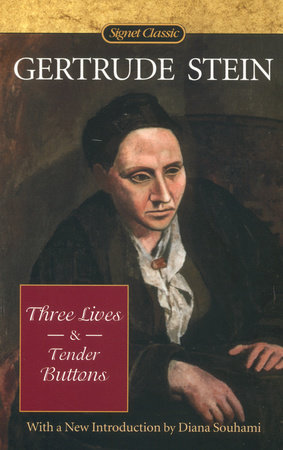
Three short stories comprise Gertrude Stein’s first significant work, each a psychological portrait of a different woman. “The Good Anna” is a kindly but domineering German servant. “The Gentle Lena” apathetically endures her miserable life until she dies in childbirth. “Melanctha” is a young Black woman learning about sexuality and love. Different as they may be, all three women are bound by poverty—and all three face the restrictions of class, race, and sex with resignation.
Tender Buttons
Stein spoke of maintaining a “continuous present,” comprised of “moments of consciousness,” independent of time and memory. Nowhere is this more clear than in her prose poems Tender Buttons. Their repetitive sentences, juxtaposition of sounds, and simple language connote this continuous presence. To live in this state is “to begin again and again,” to “use everything.” Each of the three sections, “Objects,” “Food,” and “Rooms,” employs both this repetition and disjointed words to build images. Prose poetry at its most abstract expression, Tender Buttons “is to writing…what cubism is to art.” (W.G. Rogers)
Three short stories comprise Gertrude Stein’s first significant work, each a psychological portrait of a different woman. “The Good Anna” is a kindly but domineering German servant. “The Gentle Lena” apathetically endures her miserable life until she dies in childbirth. “Melanctha” is a young Black woman learning about sexuality and love. Different as they may be, all three women are bound by poverty—and all three face the restrictions of class, race, and sex with resignation.
Tender Buttons
Stein spoke of maintaining a “continuous present,” comprised of “moments of consciousness,” independent of time and memory. Nowhere is this more clear than in her prose poems Tender Buttons. Their repetitive sentences, juxtaposition of sounds, and simple language connote this continuous presence. To live in this state is “to begin again and again,” to “use everything.” Each of the three sections, “Objects,” “Food,” and “Rooms,” employs both this repetition and disjointed words to build images. Prose poetry at its most abstract expression, Tender Buttons “is to writing…what cubism is to art.” (W.G. Rogers)
In celebration of Jewish American Heritage Month in May, we are sharing books by authors who share their individual stories, experiences, and lives. Find our full collection of books here.
For Mental Health Awareness Month in May, we are sharing books to educate and raise awareness about mental health and the various factors that may affect it, and to provide tools and resources for student wellness. Find our full collection of titles here.
Each May, we honor the stories, histories, and cultures of Asian Americans, Native Hawaiians, and Pacific Islanders. Below is a selection of acclaimed fiction and nonfiction books by AANHPI creators to share with your students this month and throughout the year. Find our full collection of titles for Higher Education here.