Download high-resolution image
Listen to a clip from the audiobook
audio play button
0:00
0:00

Into Thin Air

Listen to a clip from the audiobook
audio play button
0:00
0:00
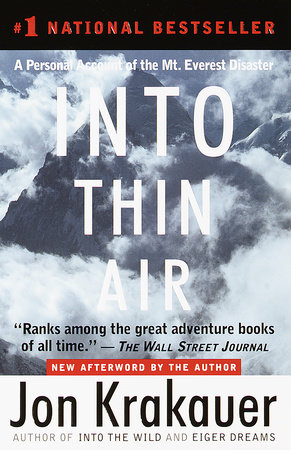
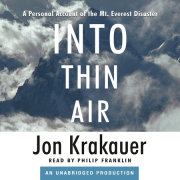
#1 NATIONAL BESTSELLER • The epic account of the storm on the summit of Mt. Everest that claimed five lives and left countless more—including Krakauer's—in guilt-ridden disarray.

“A harrowing tale of the perils of high-altitude climbing, a story of bad luck and worse judgment and of heartbreaking heroism.”—People

A Los Angeles Times Best Nonfiction Book of the Last 30 Years

Reeling from the brain-altering effects of oxygen depletion, Jon Krakauer reached the summit of Mt. Everest in the early afternoon of May 10, 1996. He hadn’t slept in fifty-seven hours. As he turned to begin the perilous descent from 29,032 feet (the cruising altitude of an Airbus jetliner), some twenty other climbers were still pushing doggedly toward the top, unaware that a furious storm would soon engulf them from below. . . .

This is the terrifying story of what happened that calamitous day at the top of the world, during what would be the deadliest season Everest climbers had ever seen. In this harrowing narrative, Krakauer takes the reader along with his ill-fated expedition, step by precarious step, from Kathmandu to the summit where—plagued by a combination of hubris, terrible judgment, and bad luck—they would fall prey to the mountain’s unpredictable violence.

With more than three million copies in print, this extraordinary book is considered a paragon of the narrative nonfiction genre. Brilliantly written and supported by unimpeachable reporting, Into Thin Air will by turns thrill and horrify.
In March 1996, Outside Magazine sent me to Nepal to participate in, and write about, a guided ascent of Mount Everest. I went as one of eight clients on an expedition led by a well-known guide from New Zealand named Rob Hall. On May 10 I arrived on top of the mountain, but the summit came at a terrible cost.

Among my five teammates who reached the top, four, including Hall, perished in a rogue storm that blew in without warning while we were still high on the peak. By the time I'd descended to Base Camp nine climbers from four expeditions were dead, and three more lives would be lost before the month was out.

The expedition left me badly shaken, and the article was difficult to write. Nevertheless, five weeks after I returned from Nepal I delivered a manuscript to Outside, and it was published in the September issue of the magazine. Upon its completion I attempted to put Everest out of my mind and get on with my life, but that turned out to be impossible. Through a fog of messy emotions, I continued trying to make sense of what had happened up there, and I obsessively mulled the circumstances of my companions' deaths.

The Outside piece was as accurate as I could make it under the circumstances, but my deadline had been unforgiving, the sequence of events had been frustratingly complex, and the memories of the survivors had been badly distorted by exhaustion, oxygen depletion, and shock. At one point during my research I asked three other people to recount an incident all four of us had witnessed high on the mountain, and one of us could agree on such crucial facts as the time, what had been said, or even who had been present. Within days after the Outside article went to press, I discovered that a few of the details I'd reported were in error. Most were minor inaccuracies of the sort that inevitably creep into works of deadline journalism, but one of my blunders was in no sense minor, and it had a devastating impact on the friends and family of one of the victims.

Only slightly less disconcerting than the article's factual errors was the material that necessarily had to be omitted for lack of space. Mark Bryant, the editor of Outside, and Larry Burke, the publisher, had given me an extraordinary amount of room to tell the story: they ran the piece at 17,000 words -- four or five times as long as a typical magazine feature. Even so, I felt that it was much too abbreviated to do justice to the tragedy. The Everest climb had rocked my life to its core, and it became desperately important for me to record the events in complete detail, unconstrained by a limited number of column inches. This book is the fruit of that compulsion.

The staggering unreliability of the human mind at high altitude made the research problematic. To avoid relying excessively on my own perceptions, I interviewed most of the protagonists at great length and on multiple occasions. When possible I also corroborated details with radio logs maintained by people at Base Camp, where clear thought wasn't in such short supply. Readers familiar with the Outside article may notice discrepancies between certain details (primarily matters of time) reported in the magazine and those reported in the book; the revisions reflect new information that has come to light since publication of the magazine piece.

Several authors and editors I respect counseled me not to write the book as quickly as I did; they urged me to wait two or three years and put some distance between me and the expedition in order to gain some crucial perspective. Their advice was sound, but in the end I ignored it -- mostly because what happened on the mountain was gnawing my guts out. I thought that writing the book might purge Everest from my life.

It hasn't, of course. Moreover, I agree that readers are often poorly served when an author writes as an act of catharsis, as I have done here. But I hoped something would be gained by spilling my soul in the calamity's immediate aftermath, in the roil and torment of the moment. I wanted my account to have a raw, ruthless sort of honesty that seemed in danger of leaching away with the passage of time and the dissipation of anguish.

Some of the same people who warned me against writing hastily had also cautioned me against going to Everest in the first place. There were many, many fine reasons not to go, but attempting to climb Everest is an intrinsically irrational act -- a triumph of desire over sensibility. Any person who would seriously consider it is almost by definition beyond the sway of reasoned argument.

The plain truth is that I knew better but went to Everest anyway. And in doing so I was a party to the death of good people, which is something that is apt to remain on my conscience for a very long time.
  • WINNER
    New York Public Library Books for the Teen Age
  • WINNER
    YALSA Best Books for Young Adults
  • WINNER | 1998
    Alex Award - YALSA
  • WINNER | 1998
    Margaret A. Edwards Award (Alex Awards)
Jon Krakauer is the author of eight books and has received an Academy Award in Literature from the American Academy of Arts and Letters. According to the award citation, “Krakauer combines the tenacity and courage of the finest tradition of investigative journalism with the stylish subtlety and profound insight of the born writer.”

www.jonkrakauer.com View titles by Jon Krakauer
"Into Thin Air ranks among the great adventure books of all time . . . a book of rare eloquence and power that could remain relevant for centuries."
--Galen Rowell, The Wall Street Journal

About

#1 NATIONAL BESTSELLER • The epic account of the storm on the summit of Mt. Everest that claimed five lives and left countless more—including Krakauer's—in guilt-ridden disarray.

“A harrowing tale of the perils of high-altitude climbing, a story of bad luck and worse judgment and of heartbreaking heroism.”—People

A Los Angeles Times Best Nonfiction Book of the Last 30 Years

Reeling from the brain-altering effects of oxygen depletion, Jon Krakauer reached the summit of Mt. Everest in the early afternoon of May 10, 1996. He hadn’t slept in fifty-seven hours. As he turned to begin the perilous descent from 29,032 feet (the cruising altitude of an Airbus jetliner), some twenty other climbers were still pushing doggedly toward the top, unaware that a furious storm would soon engulf them from below. . . .

This is the terrifying story of what happened that calamitous day at the top of the world, during what would be the deadliest season Everest climbers had ever seen. In this harrowing narrative, Krakauer takes the reader along with his ill-fated expedition, step by precarious step, from Kathmandu to the summit where—plagued by a combination of hubris, terrible judgment, and bad luck—they would fall prey to the mountain’s unpredictable violence.

With more than three million copies in print, this extraordinary book is considered a paragon of the narrative nonfiction genre. Brilliantly written and supported by unimpeachable reporting, Into Thin Air will by turns thrill and horrify.

Excerpt

In March 1996, Outside Magazine sent me to Nepal to participate in, and write about, a guided ascent of Mount Everest. I went as one of eight clients on an expedition led by a well-known guide from New Zealand named Rob Hall. On May 10 I arrived on top of the mountain, but the summit came at a terrible cost.

Among my five teammates who reached the top, four, including Hall, perished in a rogue storm that blew in without warning while we were still high on the peak. By the time I'd descended to Base Camp nine climbers from four expeditions were dead, and three more lives would be lost before the month was out.

The expedition left me badly shaken, and the article was difficult to write. Nevertheless, five weeks after I returned from Nepal I delivered a manuscript to Outside, and it was published in the September issue of the magazine. Upon its completion I attempted to put Everest out of my mind and get on with my life, but that turned out to be impossible. Through a fog of messy emotions, I continued trying to make sense of what had happened up there, and I obsessively mulled the circumstances of my companions' deaths.

The Outside piece was as accurate as I could make it under the circumstances, but my deadline had been unforgiving, the sequence of events had been frustratingly complex, and the memories of the survivors had been badly distorted by exhaustion, oxygen depletion, and shock. At one point during my research I asked three other people to recount an incident all four of us had witnessed high on the mountain, and one of us could agree on such crucial facts as the time, what had been said, or even who had been present. Within days after the Outside article went to press, I discovered that a few of the details I'd reported were in error. Most were minor inaccuracies of the sort that inevitably creep into works of deadline journalism, but one of my blunders was in no sense minor, and it had a devastating impact on the friends and family of one of the victims.

Only slightly less disconcerting than the article's factual errors was the material that necessarily had to be omitted for lack of space. Mark Bryant, the editor of Outside, and Larry Burke, the publisher, had given me an extraordinary amount of room to tell the story: they ran the piece at 17,000 words -- four or five times as long as a typical magazine feature. Even so, I felt that it was much too abbreviated to do justice to the tragedy. The Everest climb had rocked my life to its core, and it became desperately important for me to record the events in complete detail, unconstrained by a limited number of column inches. This book is the fruit of that compulsion.

The staggering unreliability of the human mind at high altitude made the research problematic. To avoid relying excessively on my own perceptions, I interviewed most of the protagonists at great length and on multiple occasions. When possible I also corroborated details with radio logs maintained by people at Base Camp, where clear thought wasn't in such short supply. Readers familiar with the Outside article may notice discrepancies between certain details (primarily matters of time) reported in the magazine and those reported in the book; the revisions reflect new information that has come to light since publication of the magazine piece.

Several authors and editors I respect counseled me not to write the book as quickly as I did; they urged me to wait two or three years and put some distance between me and the expedition in order to gain some crucial perspective. Their advice was sound, but in the end I ignored it -- mostly because what happened on the mountain was gnawing my guts out. I thought that writing the book might purge Everest from my life.

It hasn't, of course. Moreover, I agree that readers are often poorly served when an author writes as an act of catharsis, as I have done here. But I hoped something would be gained by spilling my soul in the calamity's immediate aftermath, in the roil and torment of the moment. I wanted my account to have a raw, ruthless sort of honesty that seemed in danger of leaching away with the passage of time and the dissipation of anguish.

Some of the same people who warned me against writing hastily had also cautioned me against going to Everest in the first place. There were many, many fine reasons not to go, but attempting to climb Everest is an intrinsically irrational act -- a triumph of desire over sensibility. Any person who would seriously consider it is almost by definition beyond the sway of reasoned argument.

The plain truth is that I knew better but went to Everest anyway. And in doing so I was a party to the death of good people, which is something that is apt to remain on my conscience for a very long time.

Awards

  • WINNER
    New York Public Library Books for the Teen Age
  • WINNER
    YALSA Best Books for Young Adults
  • WINNER | 1998
    Alex Award - YALSA
  • WINNER | 1998
    Margaret A. Edwards Award (Alex Awards)

Author

Jon Krakauer is the author of eight books and has received an Academy Award in Literature from the American Academy of Arts and Letters. According to the award citation, “Krakauer combines the tenacity and courage of the finest tradition of investigative journalism with the stylish subtlety and profound insight of the born writer.”

www.jonkrakauer.com View titles by Jon Krakauer

Praise

"Into Thin Air ranks among the great adventure books of all time . . . a book of rare eloquence and power that could remain relevant for centuries."
--Galen Rowell, The Wall Street Journal

Books for Asian American, Native Hawaiian, and Pacific Islander Heritage Month

Each May, we honor the stories, histories, and cultures of Asian Americans, Native Hawaiians, and Pacific Islanders. Below is a selection of acclaimed fiction and nonfiction books by AANHPI creators to share with your students this month and throughout the year. Find our full collection of titles for Higher Education here.

Read more