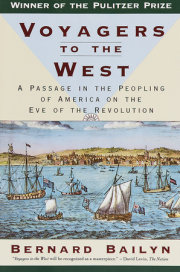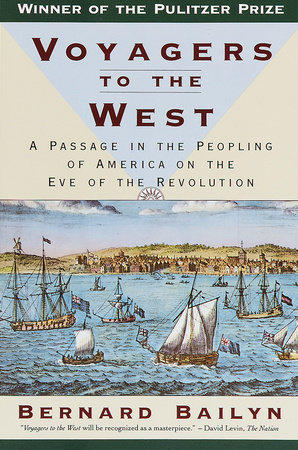

Voyagers to the West

A Passage in the Peopling of America on the Eve of the Revolution (Pulitzer Prize Winner)

Look inside
Paperback
$32.00 US
On sale Apr 12, 1988 | 720 Pages | 9780394757780

See Additional Formats
Winner of the Pulitzer Prize
Winner of the Saloutos Prize of the Immigration History Society


Bailyn's Pulitzer Prize-winning book uses an emigration roster that lists every person officially known to have left Britain for America from December 1773 to March 1776 to reconstruct the lives and motives of those who emigrated to the New World.

"Voyagers to the West is a superb book. . . . It should be equally admired by and equally attractive to the general reader as to the professional historian." —R.C. Simmons, Journal of American Studies
  • WINNER | 1987
    Pulitzer Prize
© Richard Feldman
Bernard Bailyn is Adams University Professor and James Duncan Phillips Professor of Early American History Emeritus at Harvard University. He founded, and for many years directed, the International Seminar on the History of the Atlantic World, which helped to reorient the study of the Atlantic region in the early modern era. His books include The Ideological Origins of the American Revolution, which received the Pulitzer and Bancroft Prizes in 1968; The Ordeal of Thomas Hutchinson, which won the 1975 National Book Award for History; Voyagers to the West, which won the Pulitzer Prize in 1987; Atlantic History: Concept and ContoursThe Barbarous Years: The Peopling of British North America: The Conflict of Civilizations, 1600–1675, and Sometimes an Art: Nine Essays on HistoryView titles by Bernard Bailyn
"These two volumes [The Peopling Of British North America: An Introduction And Voyagers To The West] bring to a triumphant culmination not only a distinguished career but some of the best work of an entire generation of American historians .... He wants to come closer than any predecessor to a comprehensive account of immigration to British North America -- the origins, the motives, the experience -- and these volumes persuade me that he has succeeded....Bailyn has inaugurated one of the most important historical works of the last thirty years."

-- David Levin, The Nation

"A grandly conceived attempt to employ the newest techniques of historical research (notably computerized demographic analysis) to achieve an old purpose: the recovery of a people's mentality from beneath the layers of myth and received opinion that have obscured it....[Votagers To The West] is conceived on an epic scale and executed with heroic determination."

-- Andrew Delbanco, New Republic

"Voyagers To The West is a superb book.... Bailyn joins the imagination and organizing skills of a master scholar to powerful stylistic gifts....It should be equally admired by and equally as attractive to the general reader as to the professional historian."

-- R. C. Simmons, Journal of American Studies

"[Bailyn's] concern -- his passion -- is to make the emigrants and their experiences live once more.... His fusions -- of the general and the particular, of the abstract and the concrete, of thought and feeling -- are the ideal of modern historical writing."

About

Winner of the Pulitzer Prize
Winner of the Saloutos Prize of the Immigration History Society


Bailyn's Pulitzer Prize-winning book uses an emigration roster that lists every person officially known to have left Britain for America from December 1773 to March 1776 to reconstruct the lives and motives of those who emigrated to the New World.

"Voyagers to the West is a superb book. . . . It should be equally admired by and equally attractive to the general reader as to the professional historian." —R.C. Simmons, Journal of American Studies

Awards

  • WINNER | 1987
    Pulitzer Prize

Author

© Richard Feldman
Bernard Bailyn is Adams University Professor and James Duncan Phillips Professor of Early American History Emeritus at Harvard University. He founded, and for many years directed, the International Seminar on the History of the Atlantic World, which helped to reorient the study of the Atlantic region in the early modern era. His books include The Ideological Origins of the American Revolution, which received the Pulitzer and Bancroft Prizes in 1968; The Ordeal of Thomas Hutchinson, which won the 1975 National Book Award for History; Voyagers to the West, which won the Pulitzer Prize in 1987; Atlantic History: Concept and ContoursThe Barbarous Years: The Peopling of British North America: The Conflict of Civilizations, 1600–1675, and Sometimes an Art: Nine Essays on HistoryView titles by Bernard Bailyn

Praise

"These two volumes [The Peopling Of British North America: An Introduction And Voyagers To The West] bring to a triumphant culmination not only a distinguished career but some of the best work of an entire generation of American historians .... He wants to come closer than any predecessor to a comprehensive account of immigration to British North America -- the origins, the motives, the experience -- and these volumes persuade me that he has succeeded....Bailyn has inaugurated one of the most important historical works of the last thirty years."

-- David Levin, The Nation

"A grandly conceived attempt to employ the newest techniques of historical research (notably computerized demographic analysis) to achieve an old purpose: the recovery of a people's mentality from beneath the layers of myth and received opinion that have obscured it....[Votagers To The West] is conceived on an epic scale and executed with heroic determination."

-- Andrew Delbanco, New Republic

"Voyagers To The West is a superb book.... Bailyn joins the imagination and organizing skills of a master scholar to powerful stylistic gifts....It should be equally admired by and equally as attractive to the general reader as to the professional historian."

-- R. C. Simmons, Journal of American Studies

"[Bailyn's] concern -- his passion -- is to make the emigrants and their experiences live once more.... His fusions -- of the general and the particular, of the abstract and the concrete, of thought and feeling -- are the ideal of modern historical writing."