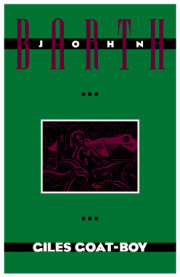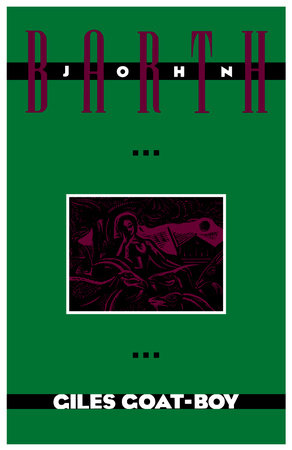

In this outrageously ribald and farcical adventure, hero George Giles sets out to conquer the terrible WESCAC computer system that threatens to destroy his community in this brilliant “fantasy of theology, sociology, and sex.” (Time)
“Funny, bawdy, exciting . . . full of riches. . . . There is greatness in it.” —Saturday Review
John Barth (1930-2024) was an American writer celebrated for his postmodern and metafictional fiction. Barth’s first novel, The Floating Opera, was published in 1956, followed by The End of the Road. Barth achieved critical and commercial success in the 1960s with The Sot-Weed Factor and Giles Goat-Boy. His collection of interconnected stories, Lost in the Funhouse, was a finalist for the National Book Award in 1969. His other works include Chimera, a collection of three novellas that won the National Book Award in 1973; Letters, an epistolary novel; Sabbatical: A Romance; and The Friday Book, a collection of essays.
View titles by John Barth
“Giles Goat-Boy is a bonkers Cold War allegory that draws from the Bible, Oedipus Rex, Don Quixote, and Ulysses, among other works.” —The New York Times
“[Barth’s novels are] distinguished by a wide range of erudition, invention, wit, historical references, whimsy, bawdiness, and a great richness of image and style.” —The Paris Review
“By merrily using fiction to dissect itself, [Barth] was at the vanguard of a movement that defined a postwar American style. . . . Barth’s influence is unmistakable in David Foster Wallace’s work, as it is in that of so many others, including Zadie Smith, Jonathan Lethem, Jennifer Egan, George Saunders and David Mitchell. . . . For all of Barth’s outrageous experiments, he always seemed to find his way back to the basic moral question that every great fiction writer has tried to wrangle: How should one be?” —The New York Times
“[A] playfully erudite author whose darkly comic and complicated novels revolved around the art of literature and launched countless debates over the art of fiction.” —The Guardian
In this outrageously ribald and farcical adventure, hero George Giles sets out to conquer the terrible WESCAC computer system that threatens to destroy his community in this brilliant “fantasy of theology, sociology, and sex.” (Time)
“Funny, bawdy, exciting . . . full of riches. . . . There is greatness in it.” —Saturday Review
Author
John Barth (1930-2024) was an American writer celebrated for his postmodern and metafictional fiction. Barth’s first novel, The Floating Opera, was published in 1956, followed by The End of the Road. Barth achieved critical and commercial success in the 1960s with The Sot-Weed Factor and Giles Goat-Boy. His collection of interconnected stories, Lost in the Funhouse, was a finalist for the National Book Award in 1969. His other works include Chimera, a collection of three novellas that won the National Book Award in 1973; Letters, an epistolary novel; Sabbatical: A Romance; and The Friday Book, a collection of essays.
View titles by John Barth
Praise
“Giles Goat-Boy is a bonkers Cold War allegory that draws from the Bible, Oedipus Rex, Don Quixote, and Ulysses, among other works.” —The New York Times
“[Barth’s novels are] distinguished by a wide range of erudition, invention, wit, historical references, whimsy, bawdiness, and a great richness of image and style.” —The Paris Review
“By merrily using fiction to dissect itself, [Barth] was at the vanguard of a movement that defined a postwar American style. . . . Barth’s influence is unmistakable in David Foster Wallace’s work, as it is in that of so many others, including Zadie Smith, Jonathan Lethem, Jennifer Egan, George Saunders and David Mitchell. . . . For all of Barth’s outrageous experiments, he always seemed to find his way back to the basic moral question that every great fiction writer has tried to wrangle: How should one be?” —The New York Times
“[A] playfully erudite author whose darkly comic and complicated novels revolved around the art of literature and launched countless debates over the art of fiction.” —The Guardian