
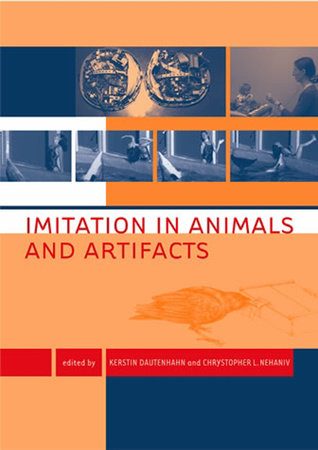





Imitation in Animals and Artifacts

Paperback
$60.00 US
On sale Jun 21, 2002 | 626 Pages | 9780262527750

An interdisciplinary overview of current research on imitation in animals and artifacts.

The effort to explain the imitative abilities of humans and other animals draws on fields as diverse as animal behavior, artificial intelligence, computer science, comparative psychology, neuroscience, primatology, and linguistics. This volume represents a first step toward integrating research from those studying imitation in humans and other animals, and those studying imitation through the construction of computer software and robots.

Imitation is of particular importance in enabling robotic or software agents to share skills without the intervention of a programmer and in the more general context of interaction and collaboration between software agents and humans. Imitation provides a way for the agent—whether biological or artificial—to establish a "social relationship" and learn about the demonstrator's actions, in order to include them in its own behavioral repertoire. Building robots and software agents that can imitate other artificial or human agents in an appropriate way involves complex problems of perception, experience, context, and action, solved in nature in various ways by animals that imitate.

About

An interdisciplinary overview of current research on imitation in animals and artifacts.

The effort to explain the imitative abilities of humans and other animals draws on fields as diverse as animal behavior, artificial intelligence, computer science, comparative psychology, neuroscience, primatology, and linguistics. This volume represents a first step toward integrating research from those studying imitation in humans and other animals, and those studying imitation through the construction of computer software and robots.

Imitation is of particular importance in enabling robotic or software agents to share skills without the intervention of a programmer and in the more general context of interaction and collaboration between software agents and humans. Imitation provides a way for the agent—whether biological or artificial—to establish a "social relationship" and learn about the demonstrator's actions, in order to include them in its own behavioral repertoire. Building robots and software agents that can imitate other artificial or human agents in an appropriate way involves complex problems of perception, experience, context, and action, solved in nature in various ways by animals that imitate.

Books for Women’s History Month

In honor of Women’s History Month in March, we are sharing books by women who have shaped history and have fought for their communities. Our list includes books about women who fought for racial justice, abortion rights, equality in the workplace, and ranges in topics from women in politics and prominent women in history to

Read more