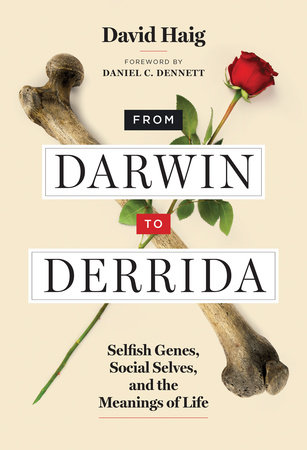
From Darwin to Derrida

Selfish Genes, Social Selves, and the Meanings of Life

Author David Haig
Foreword by Daniel C. Dennett
Ebook
On sale Mar 31, 2020 | 512 Pages | 9780262358033

See Additional Formats
How the meaningless process of natural selection produces purposeful beings who find meaning in the world . . . 

“A challenging though rewarding exploration of the meaning and purpose of life” that blends evolutionary biology and philosophy (Kirkus Reviews).

Evolutionary biologist David Haig explains how a physical world of matter in motion gave rise to a living world of purpose and meaning. Natural selection, a process without purpose, gives rise to purposeful beings who find meaning in the world. The key to this, Haig proposes, is the origin of mutable “texts”—genes—that preserve a record of what has worked in the world. These texts become the specifications for the intricate mechanisms of living beings.

Haig draws on a wide range of sources—from Laurence Sterne and Immanuel Kant’s to Jacques Derrida and the latest findings on gene transmission, duplication, and expression—to make his argument. Genes and their effects are like eggs and chickens. Eggs exist for the sake of becoming chickens and chickens for the sake of laying eggs. A gene’s effects have a causal role in determining which genes are copied—and a gene persists if its lineage has been consistently associated with survival and reproduction. Organisms can be understood as interpreters that link information from the environment to meaningful action in the environment.

Meaning, Haig argues, is the output of a process of interpretation; there is a continuum from the very simplest forms of interpretation, instantiated in single RNA molecules near the origins of life, to the most sophisticated. Life is interpretation—the use of information in choice.
Foreword by Daniel C. Dennett xi
Prologue: From the Beginning Was the Word xxi
1 Barren Virgins 1
2 Social Genes 17
3 The "Gene" Meme 53
4 Differences That Make a Difference 73
5 Limber Robots and Lumbering Genes 101
6 Intrapersonal Conflict 125
7 Scratching Your Own Back 143
8 Reflexions on Self 165
9 How Come? What For? Why? 183
10 Sameness and Difference 203
11 Fighting the Good Cause 233
Interlude 271
12 Making Sense 281
X Vive la differance 317
13 On the Origin of Meaning 321
14 On the Past and Future of Freedom 347
15 Darwinian Hermeneutics 359
Cadenza 379
Appendix (a Vestigial Organ): Words about Words 381
Acknowledgments 393
References 395
Sources 435
Index 437

David A. Haig is George Putnam Professor of Organismic and Evolutionary Biology at Harvard University.

Daniel C. Dennett is University Professor Codirector of the Center for Cognitive Studies at Tufts University. He is the author of Brainchildren: Essays on Designing Minds; Sweet Dreams: Philosophical Obstacles to a Science of Consciousness; Elbow Room: The Varieties of Free Will Worth Wanting; Sweet Dreams: Philosophical Obstacles to a Science of Consciousness (all published by the MIT Press), From Bacteria to Bach and Back: The Evolution of Mind, and other books.
A challenging though rewarding exploration of the meaning and purpose of life.—Kirkus Reviews

About

How the meaningless process of natural selection produces purposeful beings who find meaning in the world . . . 

“A challenging though rewarding exploration of the meaning and purpose of life” that blends evolutionary biology and philosophy (Kirkus Reviews).

Evolutionary biologist David Haig explains how a physical world of matter in motion gave rise to a living world of purpose and meaning. Natural selection, a process without purpose, gives rise to purposeful beings who find meaning in the world. The key to this, Haig proposes, is the origin of mutable “texts”—genes—that preserve a record of what has worked in the world. These texts become the specifications for the intricate mechanisms of living beings.

Haig draws on a wide range of sources—from Laurence Sterne and Immanuel Kant’s to Jacques Derrida and the latest findings on gene transmission, duplication, and expression—to make his argument. Genes and their effects are like eggs and chickens. Eggs exist for the sake of becoming chickens and chickens for the sake of laying eggs. A gene’s effects have a causal role in determining which genes are copied—and a gene persists if its lineage has been consistently associated with survival and reproduction. Organisms can be understood as interpreters that link information from the environment to meaningful action in the environment.

Meaning, Haig argues, is the output of a process of interpretation; there is a continuum from the very simplest forms of interpretation, instantiated in single RNA molecules near the origins of life, to the most sophisticated. Life is interpretation—the use of information in choice.

Table of Contents

Foreword by Daniel C. Dennett xi
Prologue: From the Beginning Was the Word xxi
1 Barren Virgins 1
2 Social Genes 17
3 The "Gene" Meme 53
4 Differences That Make a Difference 73
5 Limber Robots and Lumbering Genes 101
6 Intrapersonal Conflict 125
7 Scratching Your Own Back 143
8 Reflexions on Self 165
9 How Come? What For? Why? 183
10 Sameness and Difference 203
11 Fighting the Good Cause 233
Interlude 271
12 Making Sense 281
X Vive la differance 317
13 On the Origin of Meaning 321
14 On the Past and Future of Freedom 347
15 Darwinian Hermeneutics 359
Cadenza 379
Appendix (a Vestigial Organ): Words about Words 381
Acknowledgments 393
References 395
Sources 435
Index 437

Author

David A. Haig is George Putnam Professor of Organismic and Evolutionary Biology at Harvard University.

Daniel C. Dennett is University Professor Codirector of the Center for Cognitive Studies at Tufts University. He is the author of Brainchildren: Essays on Designing Minds; Sweet Dreams: Philosophical Obstacles to a Science of Consciousness; Elbow Room: The Varieties of Free Will Worth Wanting; Sweet Dreams: Philosophical Obstacles to a Science of Consciousness (all published by the MIT Press), From Bacteria to Bach and Back: The Evolution of Mind, and other books.

Praise

A challenging though rewarding exploration of the meaning and purpose of life.—Kirkus Reviews

Books for Women’s History Month

In honor of Women’s History Month in March, we are sharing books by women who have shaped history and have fought for their communities. Our list includes books about women who fought for racial justice, abortion rights, equality in the workplace, and ranges in topics from women in politics and prominent women in history to

Read more