
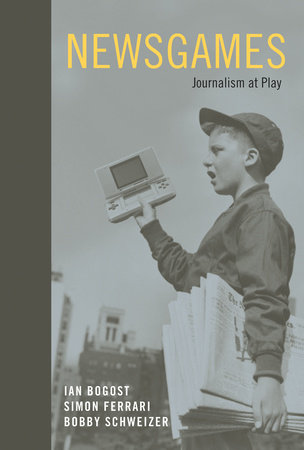

Newsgames

Journalism at Play

Ebook
On sale Sep 21, 2012 | 248 Pages | 9780262289085

How videogames offer a new way to do journalism.

Journalism has embraced digital media in its struggle to survive. But most online journalism just translates existing practices to the Web: stories are written and edited as they are for print; video and audio features are produced as they would be for television and radio. The authors of Newsgames propose a new way of doing good journalism: videogames.

Videogames are native to computers rather than a digitized form of prior media. Games simulate how things work by constructing interactive models; journalism as game involves more than just revisiting old forms of news production. Wired magazine's game Cutthroat Capitalism, for example, explains the economics of Somali piracy by putting the player in command of a pirate ship, offering choices for hostage negotiation strategies.

Videogames do not offer a panacea for the ills of contemporary news organizations. But if the industry embraces them as a viable method of doing journalism—not just an occasional treat for online readers—newsgames can make a valuable contribution.

Ian Bogost is Ivan Allen College Distinguished Chair in Media Studies and Professor of Interactive Computing at the Georgia Institute of Technology, a Founding Partner at Persuasive Games LLC, and the coauthor of Newsgames: Journalism at Play (MIT Press, 2010).

Simon Ferrari is a doctoral student in digital media at the Georgia Institute of Technology.

Bobby Schweizer is a doctoral student in digital media at the Georgia Institute of Technology.
Newsgames pushes the profession to think differently about how current events can be turned into systems of scenarios and variables, instead of mere stories.—Alyssa Abkowitz, Columbia Journalism Review

In their well-researched and intriguing new book Newsgames: Journalism at Play, Ian Bogost, Simon Ferrari and Bobby Schweizer examine the practice of fusing gaming with journalism. It's not a new idea. From before personal computers, with games like 'Diplomacy' and 'Risk' to early computer games, such as 'Balance of Power' and 'Hidden Agenda,' front-page reality and game-room fantasy have meshed well. Newsgames suggests this link should get stronger by purposefully employing gaming to convey news of the day. And it sets down a challenge, not to gamers, but to journalists.

—Forbes.com Technology, "Techno-tainers" blog—

About

How videogames offer a new way to do journalism.

Journalism has embraced digital media in its struggle to survive. But most online journalism just translates existing practices to the Web: stories are written and edited as they are for print; video and audio features are produced as they would be for television and radio. The authors of Newsgames propose a new way of doing good journalism: videogames.

Videogames are native to computers rather than a digitized form of prior media. Games simulate how things work by constructing interactive models; journalism as game involves more than just revisiting old forms of news production. Wired magazine's game Cutthroat Capitalism, for example, explains the economics of Somali piracy by putting the player in command of a pirate ship, offering choices for hostage negotiation strategies.

Videogames do not offer a panacea for the ills of contemporary news organizations. But if the industry embraces them as a viable method of doing journalism—not just an occasional treat for online readers—newsgames can make a valuable contribution.

Author

Ian Bogost is Ivan Allen College Distinguished Chair in Media Studies and Professor of Interactive Computing at the Georgia Institute of Technology, a Founding Partner at Persuasive Games LLC, and the coauthor of Newsgames: Journalism at Play (MIT Press, 2010).

Simon Ferrari is a doctoral student in digital media at the Georgia Institute of Technology.

Bobby Schweizer is a doctoral student in digital media at the Georgia Institute of Technology.

Praise

Newsgames pushes the profession to think differently about how current events can be turned into systems of scenarios and variables, instead of mere stories.—Alyssa Abkowitz, Columbia Journalism Review

In their well-researched and intriguing new book Newsgames: Journalism at Play, Ian Bogost, Simon Ferrari and Bobby Schweizer examine the practice of fusing gaming with journalism. It's not a new idea. From before personal computers, with games like 'Diplomacy' and 'Risk' to early computer games, such as 'Balance of Power' and 'Hidden Agenda,' front-page reality and game-room fantasy have meshed well. Newsgames suggests this link should get stronger by purposefully employing gaming to convey news of the day. And it sets down a challenge, not to gamers, but to journalists.

—Forbes.com Technology, "Techno-tainers" blog—

Books for Women’s History Month

In honor of Women’s History Month in March, we are sharing books by women who have shaped history and have fought for their communities. Our list includes books about women who fought for racial justice, abortion rights, equality in the workplace, and ranges in topics from women in politics and prominent women in history to

Read more