Books for Arab American Heritage Month
In honor of Arab American Heritage Month in April, we are sharing books by Arab and Arab American authors that share their culture, history, and personal lives.
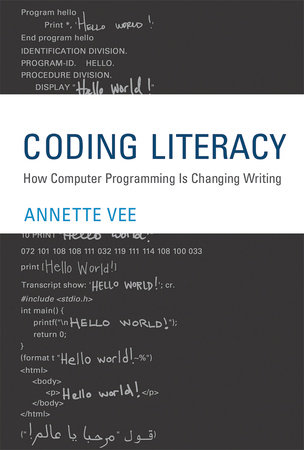
The message from educators, the tech community, and even politicians is clear: everyone should learn to code. To emphasize the universality and importance of computer programming, promoters of coding for everyone often invoke the concept of “literacy,” drawing parallels between reading and writing code and reading and writing text. In this book, Annette Vee examines the coding-as-literacy analogy and argues that it can be an apt rhetorical frame. The theoretical tools of literacy help us understand programming beyond a technical level, and in its historical, social, and conceptual contexts. Viewing programming from the perspective of literacy and literacy from the perspective of programming, she argues, shifts our understandings of both. Computer programming becomes part of an array of communication skills important in everyday life, and literacy, augmented by programming, becomes more capacious.
Vee examines the ways that programming is linked with literacy in coding literacy campaigns, considering the ideologies that accompany this coupling, and she looks at how both writing and programming encode and distribute information. She explores historical parallels between writing and programming, using the evolution of mass textual literacy to shed light on the trajectory of code from military and government infrastructure to large-scale businesses to personal use. Writing and coding were institutionalized, domesticated, and then established as a basis for literacy. Just as societies demonstrated a “literate mentality” regardless of the literate status of individuals, Vee argues, a “computational mentality” is now emerging even though coding is still a specialized skill.

The message from educators, the tech community, and even politicians is clear: everyone should learn to code. To emphasize the universality and importance of computer programming, promoters of coding for everyone often invoke the concept of “literacy,” drawing parallels between reading and writing code and reading and writing text. In this book, Annette Vee examines the coding-as-literacy analogy and argues that it can be an apt rhetorical frame. The theoretical tools of literacy help us understand programming beyond a technical level, and in its historical, social, and conceptual contexts. Viewing programming from the perspective of literacy and literacy from the perspective of programming, she argues, shifts our understandings of both. Computer programming becomes part of an array of communication skills important in everyday life, and literacy, augmented by programming, becomes more capacious.
Vee examines the ways that programming is linked with literacy in coding literacy campaigns, considering the ideologies that accompany this coupling, and she looks at how both writing and programming encode and distribute information. She explores historical parallels between writing and programming, using the evolution of mass textual literacy to shed light on the trajectory of code from military and government infrastructure to large-scale businesses to personal use. Writing and coding were institutionalized, domesticated, and then established as a basis for literacy. Just as societies demonstrated a “literate mentality” regardless of the literate status of individuals, Vee argues, a “computational mentality” is now emerging even though coding is still a specialized skill.
In honor of Arab American Heritage Month in April, we are sharing books by Arab and Arab American authors that share their culture, history, and personal lives.
For National Poetry Month in April, we are sharing poetry collections and books about poetry by authors who have their own stories to tell. These poets delve into history, reimagine the present, examine poetry itself—from traditional poems many know and love to poems and voices that are new and original.